
How to Use a Two Person Kayak: A Practical Paddling Guide for 2026
Learn how to use a two person kayak basics with practical coordination tips, proper cockpit seating, and gear advice for October 2026.
 By Brooke Hess
Updated October 4, 2026
By Brooke Hess
Updated October 4, 2026

Launching a tandem paddlecraft with a partner presents an exciting mix of double the paddling power and double the coordination demands. Learning how to use a two person kayak requires understanding crew roles, synchronized cadence, and proper weight distribution to prevent clashing paddle blades or unexpected instability. Tandem hulls are wider and offer generous primary stability, yet coordinating strokes between the bow and stern paddlers remains essential for straight-line tracking. Before even setting the craft into the water, securing reliable kayak roof rack systems ensures that heavy two-person boats arrive at the launch ramp without damaging vehicle crossbars.
The relationship between crew weight and boat trim dictates whether a tandem craft glides efficiently or wallows sluggishly in the chop. Whether you pilot an open sit-on-top hull like the Perception Kayaks Rambler Sit On Top or an enclosed cockpit model, following fundamental tandem kayaking techniques keeps your outing smooth and enjoyable. Paying attention to US Coast Guard safety requirements, maintaining safe payload margins, and establishing clear on-water communication will build confidence across every stroke. With the right foundation, sharing a boat creates an efficient, cooperative adventure rather than an exhausting tug-of-war.
| Award | Product | WSG Score About WSG ScoreThe WSG Score is our own rating from 0 to 10, based on performance, design and build, ease of use, and value. It reflects independent research and is never influenced by manufacturers, retailers, or affiliate commissions. Learn more › | |
|---|---|---|---|
| Best Overall |
BKC Brooklyn 13.0 Pro Tandem Fishing Kayak
|
8.8/10 | Buy |
| Best Budget |
 Bestway Hydro-Force Rapid X3 3-Person Kayak
|
8.6/10 | Buy |
| Best Value |
 Perception Rambler 13'6" Tandem Sit-On-Top
|
8.6/10 | Buy |
| Best Premium |
 Old Town Twin Heron 14-Foot Kayak
|
8.6/10 | Buy |
 BKC Brooklyn 13.0 Pro Tandem Fishing Kayak
|
8.6/10 | Buy | |
 Keystone Peak 2-Person Inflatable Kayak
|
8.4/10 | Buy | |
 BKC Brooklyn 12.5 Tandem Fishing Kayak
|
8.4/10 | Buy | |
 Sevylor 1-Person Inflatable Lake Kayak
|
8.3/10 | Buy | |
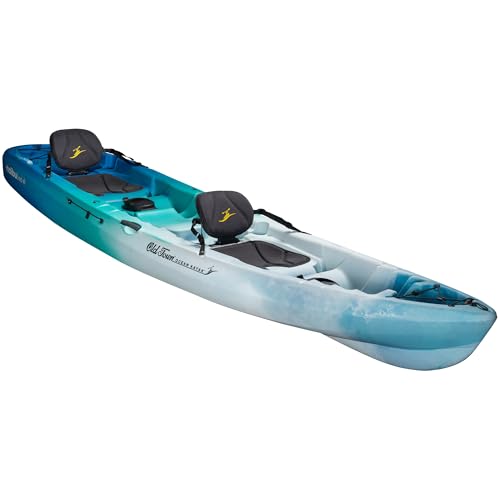 Old Town Ocean Kayak Malibu Two XL Sit-on-Top
|
8.3/10 | Buy | |
 Old Town Ocean Kayak Malibu Two 12-Foot Sit-on-Top
|
8.1/10 | Buy |
BKC Brooklyn 13.0 Pro Tandem Fishing Kayak
The BKC Brooklyn 13.0 Pro is an expansive sit-on-top kayak offering an impressive 800-pound capacity, adjustable aluminum frame seats, and a versatile layout that converts smoothly from tandem to center solo paddling. It delivers strong primary stability and dedicated fishing outfitting, making it a reliable option for angling pairs, small families, or gear-heavy solo paddlers on calm lakes and slow rivers.
Pros
- Generous 800-pound capacity easily supports two adults and a child or substantial camping and angling payloads
- Flexible seat configuration allows one seat to mount in the center position for balanced solo outings
- Height-adjustable aluminum frame seats deliver superior upright comfort compared to basic foam backrests
- Comes pre-rigged with accessory mounting rails, flush rod holders, and dual dry storage compartments
- Flat-bottomed 34-inch hull provides reassuring initial flatwater balance for casting and landing fish
Cons
- Unladen bare-boat weight of 85 pounds makes solo roof-rack car-topping demanding without a load-assist system
- Wide flat-bottom profile prioritizes initial stability over fast displacement cruising speed and long-distance glide
- Stock package does not explicitly include paddles, requiring separate purchase of adequately sized tandem paddles
Bestway Hydro-Force Rapid X3 3-Person Kayak
Built for group outings, this 12-foot inflatable kayak accommodates up to three adults with a supportive 551-pound capacity. Its puncture-resistant Inflata-Shield construction and dual removable fins deliver reliable tracking and stability on calm waters.
Pros
- High 551-pound load capacity accommodates three paddlers
- Durable Inflata-Shield material resists tears and punctures
- Two swappable fins improve directional control
- Includes hand pump, carrying bag, and repair patch
Cons
- Supplies only two paddles for a three-person boat
- Relatively heavy to carry alone at over 41 pounds
Perception Rambler 13'6" Tandem Sit-On-Top
The Perception Rambler 13'6" is a versatile tandem sit-on-top kayak featuring a stable 34-inch beam, removable padded backrests, and a 550-pound maximum capacity. It is an ideal, user-friendly choice for pairs, families paddling with a child or pet, and casual weekend flatwater explorers.
Pros
- Generous 550 lb maximum capacity comfortably supports two adults plus a child or canine companion
- Broad 34-inch beam delivers reassuring flatwater balance suitable for beginners and casual recreational use
- Molded-in center jump seat adds family versatility without requiring complicated deck hardware adjustments
- Padded seats and backrests are fully removable for easy vehicle transport and winter storage
Cons
- At 78 pounds unladen, solo roof-rack loading and long portages are difficult without a second person or kayak cart
- Open deck layout lacks sealed dry hatch compartments, requiring dry bags to protect moisture-sensitive gear
- Paddles, scupper plugs, and personal flotation devices are not included and must be sourced separately
Old Town Twin Heron 14-Foot Kayak
Designed for day outings and casual angling, the Old Town Twin Heron features an adjustable Comfort Flex seat paired with supportive foot braces and padded thigh rests. A stern Quick Seal hatch and molded cockpit tray keep essential gear and drinks organized and within reach.
Pros
- Comfort Flex seat with supportive thigh padding
- Adjustable foot braces for customized leg room
- Dedicated stern Quick Seal dry hatch
- Molded cockpit tray with cup holder and paddle rest
- Protective skid plate safeguards the hull bottom
Cons
- At 60 pounds, solo loading can be cumbersome
- Long 14-foot hull demands substantial vehicle and storage space
BKC Brooklyn 13.0 Pro Tandem Fishing Kayak
The BKC Brooklyn 13.0 Pro is a 153-inch tandem-to-solo convertible sit-on-top fishing kayak featuring an 800 lb manufacturer-rated weight capacity and a flat-bottomed hull for reassuring flatwater stability. With height-adjustable aluminum frame seats and integrated accessory rails, it is an adaptable watercraft for tandem angling partners, families with a child, or solo paddlers hauling heavy cargo.
Pros
- High 800 lb manufacturer-rated weight capacity accommodates multiple passengers and bulky fishing gear
- Versatile seating design converts easily between tandem, three-person family, and balanced solo paddling positions
- Two-inch height-adjustable aluminum frame seats offer superior ergonomic support compared to basic molded floor seats
- Pre-installed fishing features including accessory tracks, flush rod holders, tackle trays, and dual dry hatches
- Broad flat-bottom profile provides excellent primary stability for confident boarding and casting on flatwater
Cons
- Bare hull weight of approximately 90 pounds makes solo roof-rack car-topping physically demanding without a load-assist system
- Flat-bottom hull architecture trades off tracking efficiency and speed in choppy open water or stiff headwinds
- Substantial 153-inch overall length requires significant garage or rack storage space
Keystone Peak 2-Person Inflatable Kayak
Designed for recreational outings on calm waters, this tandem inflatable kayak features a removable sun canopy and seating for two adults plus a pet. Reinforced PVC construction and an included high-output pump deliver a practical, all-in-one setup for casual paddling.
Pros
- Removable canopy shields paddlers from direct sun
- Reinforced PVC resists punctures in calm waters
- Complete kit includes pump, paddles, and bags
- Adjustable seats configure for two adults and a pet
Cons
- Not designed for rough rapids or open ocean swells
- 440-pound capacity restricts heavier cargo loads
BKC Brooklyn 12.5 Tandem Fishing Kayak
Built for pairs or small families seeking versatile angling, this 12.5 foot sit on top kayak provides a 600 pound capacity alongside six integrated rod holders. Its rotomolded hull delivers steady balance for standing casts while supporting an optional trolling motor mount.
Pros
- High 600-pound load capacity accommodates two adults and gear
- Six versatile rod holders support multiple fishing lines
- Includes two padded seats and two paddles right away
- Integrated mounting area allows adding a trolling motor
- Durable rotomolded hull resists impacts and sun damage
Cons
- At 68 pounds, it is heavy for solo transport
- Trolling motor is not included with the package
Sevylor 1-Person Inflatable Lake Kayak
This lightweight 8-foot-7-inch solo inflatable kayak features a durable 21-gauge PVC hull, a puncture-resistant tarpaulin bottom, and an innovative backpack carry system that doubles as the seat. Weighing just over 20 pounds, it is an accessible, trunk-friendly choice for casual lake paddlers and apartment dwellers.
Pros
- Remarkably lightweight 20.28-pound hull makes solo transport and trunk storage effortless
- Backpack carrying harness transforms into the padded seat and supportive backrest
- Reinforced tarpaulin bottom adds substantial abrasion protection against gravel launches and lakebed debris
- Multiple safety air chambers provide peace of mind during flatwater recreation
Cons
- Paddle and inflation pump are not specified as included and must be sourced separately
- Lightweight inflatable profile is susceptible to wind drift and weathercocking in open-water chop
- Low-pressure PVC construction does not match the tracking efficiency or glide of rigid hard-shell kayaks
Old Town Ocean Kayak Malibu Two XL Sit-on-Top
The Old Town Ocean Kayak Malibu Two XL is a versatile 13-foot sit-on-top kayak designed for tandem outings or solo paddling from a center position. With a broad 34-inch beam and a 90-pound rigid hull, it delivers outstanding primary stability for families and flatwater explorers.
Pros
- Broad 34-inch beam provides excellent primary stability that inspires confidence for beginners and families
- Overlapping footwells accommodate tandem pairs as well as solo paddlers utilizing the center seating position
- Generous open tankwells at the bow and stern offer ample room for gear secured by flexible bungee rigging
- Improved scupper drainage system helps keep standing water off the cockpit deck during casual outings
Cons
- Substantial 90-pound unladen hull weight makes solo rooftop loading challenging without a cart or load-assist system
- Paddles and padded Comfort Plus seats are not included with the bare hull and must be purchased separately
- Open sit-on-top deck exposes occupants to natural paddle drip and wave splash in windy conditions
Old Town Ocean Kayak Malibu Two 12-Foot Sit-on-Top
The Old Town Ocean Kayak Malibu Two is a stable 12-foot sit-on-top tandem kayak featuring a 36-inch beam, a 453-pound capacity, and versatile center solo seating. Its stackable design, splash-resistant QuickStash hatch, and 78-pound hull weight make it a dependable recreational watercraft for pairs and solo paddlers on calm lakes and sheltered waterways.
Pros
- Convertible seating layout transitions seamlessly between two-person tandem cruising and centered solo paddling
- Broad 36-inch beam creates excellent initial flatwater balance for beginners, families, and casual weekend recreation
- Bow and stern bungee tankwells combined with a QuickStash hatch provide flexible on-deck cargo staging options
- Integrated YakLock security bar offers a dedicated, sturdy anchor point for cable locks during transit or outdoor storage
Cons
- Bare hull weight of 78 pounds makes solo lifting onto vehicle rooftop J-cradles physically challenging for a single person
- Paddles are not included in the standard package and must be purchased separately prior to your first launch
- Wider recreational hull profile focuses on primary balance rather than high straight-line tracking speed or long-distance glide efficiency
Complete Practical Guide on How to Use a Two Person Kayak
Sharing a tandem kayak allows two paddlers to pool their physical power, maintain conversation, and explore coastal flats or freshwater lakes together. Successfully operating a double kayak requires understanding the specific mechanics of dual paddling, hull trim, and coordinated boat control. Unlike solo paddlecraft where a single boater manages both propulsion and heading simultaneously, a tandem boat divides these duties between two distinct stations. Once you master the fundamental teamwork and seating dynamics, tandem paddling becomes a smooth and predictable experience.
Understanding Tandem Crew Roles: Bow vs Stern Paddler Responsibilities
Clear division of responsibilities prevents confusion and ensures steady forward progress across open water. The paddler sitting in the front bow seat serves as the motor and tempo-setter for the entire craft. Because the bow paddler cannot see what is happening behind them, their job is to maintain a steady, uniform forward stroke cadence. Placing the lighter boater in the bow usually benefits the vessel by preventing the nose from plowing into incoming waves.
The paddler in the rear stern seat acts as the captain, primary rudder, and course navigator. From the stern position, this paddler can clearly observe the front paddler’s stroke rhythm and match blade entries on every stroke cycle. The stern paddler must apply corrective sweep strokes, ruddering draws, or back-strokes to keep the craft tracking straight toward the intended target. Consistent verbal communication between both stations ensures smooth transitions when changing heading or stopping suddenly.
Synchronizing Paddle Cadence to Prevent Clashing Blades
Blades clashing together is the most common frustration experienced by tandem paddlers of all skill levels. When both boaters enter the water at random intervals, paddle shafts frequently collide and disrupt the balance of the craft. To eliminate this problem, both paddlers must synchronize their strokes so that their blades hit the water in perfect unison. If the bow paddler takes a stroke on the port side, the stern paddler must mirror that exact stroke on the port side.
Maintaining synchronized strokes requires the stern paddler to actively adjust their cadence to match the bow paddler’s natural rhythm. If the stern boater possesses greater physical strength, they should apply more power per stroke rather than increasing their stroke speed. When entering tight river bends or avoiding obstacles, the stern paddler can take wider sweep strokes while the bow paddler continues steady forward strokes. Taking a deliberate pause when rhythm is broken allows the crew to reset their timing without bumping paddle blades.
Cockpit Configurations: Sit-on-Top Drainage vs Enclosed Sit-Inside Tracking
Choosing between open-deck and enclosed hulls fundamentally changes how a tandem boat handles moisture and cockpit comfort. Sit-on-top models like the Perception Kayaks Rambler Sit On Top and the Old Town Ocean Kayak Malibu Two Sit-on-Top Kayak feature self-bailing scupper holes that allow water to drain automatically. These open platforms simplify re-entry from the water, making them popular for recreational lake days, warm-weather paddling, and family outings. The Old Town Ocean Kayak Malibu Two XL Sit-on-Top adds enhanced scupper placement to keep the cockpit floor dry even when carrying heavy gear loads.
In contrast, sit-inside designs such as the Old Town Twin Heron Sit-Inside Kayak, Horizon lower the paddlers’ center of gravity deep into the hull. This lower seating position enhances secondary stability and offers protection against chilly crosswinds and splashing waves. Sit-inside models feature specialized foot-brace tracks and thigh padding that promote efficient lower-body engagement during long touring sessions. However, enclosed cockpits require a manual bilge pump or sponge to evacuate water if the boat takes on waves without spray skirts.
Proper Weight Distribution and Hull Trim Calculations
Achieving proper longitudinal trim is critical for keeping a two-person kayak balanced, responsive, and easy to steer. In almost all paddling situations, the heavier paddler should occupy the rear stern seat while the lighter paddler takes the front bow seat. When the heavier person sits in the front, the bow dives deep into the water, causing severe bow-steering where the boat yaws unpredictably with every puff of wind. A properly trimmed hull keeps the bow slightly elevated, allowing the keel to slice cleanly through flatwater and chop.
Never exceed the craft’s usable operating weight capacity when calculating the combined weight of paddlers, coolers, and fishing gear. Prudent boaters adhere to the 70 to 75 percent rule, reserving roughly a quarter of the manufacturer’s gross capacity as a buoyancy buffer. For example, the BKC Brooklyn 13.0 Pro Tandem Fishing Kayak lists an 800-pound maximum capacity, easily accommodating two adults, tackle, and heavy gear while preserving abundant freeboard. Conversely, boats with tighter limits, such as the 453-pound capacity on the 12-foot Malibu Two, require careful gear budgeting to avoid sitting too low in the water.
Launching and Boarding Techniques from Shorelines and Docks
Launching a two-person craft requires coordinated footwork to prevent accidental capsizing before your journey even begins. When launching from a shallow sandy beach, walk the tandem kayak out until the hull floats freely in ankle-deep water. The bow paddler should board first by straddling the cockpit, lowering their center of gravity smoothly into the seat, and extending their legs. Once the front boater is seated, the stern paddler pushes the boat completely clear of the shoreline and steps aboard the rear deck.
Dock launches require a parallel boarding technique that keeps the boat secure against the dock edge throughout the process. The stern paddler stabilizes the kayak against the dock by holding the cockpit coaming or grab handles while the bow paddler steps in. The boarding paddler should keep their body weight low and centered along the boat’s centerline rather than leaning toward the dock. After the bow paddler settles into their seat with paddle resting across the gunwales, the stern boater steps into the rear cockpit and pushes away into open water.
Turning, Stopping, and Maneuvering a Tandem Craft
Maneuvering a 12- to 14-foot tandem boat demands coordinated blade strokes rather than individual effort. To execute a broad, sweeping turn toward the port side, the stern paddler applies a wide forward sweep on the starboard side while the bow paddler continues normal strokes. For rapid pivot turns in tight channels, both paddlers execute opposing strokes simultaneously. The bow paddler takes a wide forward sweep on one side while the stern paddler executes an aggressive reverse sweep on the opposite side, spinning the hull on its axis.
Stopping a moving tandem kayak quickly requires simultaneous reverse strokes from both crew members. Both boaters must bury their paddle blades deeply into the water and push forward in short, firm braking strokes. The stern paddler can also employ low-brace ruddering to maintain directional control while the craft slows down. Practicing emergency stopping procedures on calm flatwater ensures that both paddlers react instinctively when approaching low-hanging branches or unexpected water hazards.
Paddle Sizing and Ergonomics for Wide Tandem Beams
Using an undersized paddle on a wide two-person kayak leads to rapid shoulder fatigue and frequent knuckle scrapes against the gunwales. Tandem hulls are wider than typical solo kayaks, frequently measuring between 34 and 39 inches in beam width. A standard 220-centimeter paddle is often too short for these wide platforms, forcing boaters to lean awkwardly over the edge on every stroke. Selecting a paddle between 230 and 250 centimeters allows the blades to enter the water cleanly without requiring excessive torso leaning.
Ergonomic seating outfitting plays a vital role in preventing lower back strain during long paddling sessions. Elevated aluminum frame seats, such as those found on the BKC Brooklyn 13.0 Pro Tandem Fishing Kayak, provide breathable lumbar support and keep paddlers dry above pooled cockpit water. Models equipped with adjustable foot-brace systems, such as the Support Track foot bracing on the Twin Heron, allow each boater to customize leg extension for optimal posture. Proper foot contact gives you mechanical leverage to transfer rotational torso power through the paddle blades.
Inflatable Tandem Setup and Drop-Stitch Hull Considerations
Modern inflatable paddlecraft offer practical transport advantages for paddlers who lack rooftop crossbars or dedicated garage storage. Products like the Bestway Hydro-Force 12’6″ x 39″ Rapid X3 utilize heavy-duty Inflata-Shield fabric to resist accidental punctures and maintain structural integrity. Paddlers interested in portable vessels can explore heavy-duty inflatable kayak designs to understand how multi-chamber construction provides redundant buoyancy on open waterways. The Inflatable Kayak for 2 People with Detachable canopy offers an integrated sunshade, making it appealing for sunny lake outings.
Achieving proper chamber pressure is essential when inflating a tandem boat to prevent hull sagging under crew weight. A sagging center floor creates massive hydrodynamic drag, causing sluggish paddling and severe tracking drift. Always inflate chambers in the sequence specified by the manufacturer, using the included pressure gauge to verify recommended operating levels. Attaching the removable tracking fins or skegs before launching ensures that lightweight inflatable hulls hold a true heading instead of blowing sideways in gusty breezes.
Safety Protocols, USCG Regulations, and Deep-Water Re-Entry
Federal navigation regulations under US Coast Guard Title 33 CFR Part 175 require each paddler to carry an approved wearable personal flotation device aboard the vessel. High-back Type III paddling vests feature thin foam behind the shoulder blades, allowing full clearance above kayak backrests. Federal rules also mandate carrying an efficient sound-producing device, such as a pea-less whistle attached to your life vest, to signal other boaters in low visibility. When paddling in cold lakes or coastal waters, wearing a proper wetsuit for kayaking helps prevent the sudden physiological onset of cold-water shock.
Executing a deep-water re-entry in a tandem craft requires strict team coordination to prevent the boat from rolling over repeatedly. Both swimmers should position themselves on opposite sides of the overturned hull, working together to flip the kayak upright. Once the boat is upright, the rear paddler can assist by holding down the opposite gunwale while the forward paddler executes a belly-scramble onto the center cockpit deck. After the first paddler slides their legs into the cockpit and establishes balance, they stabilize the boat while the second boater scrambles aboard.
Solo Conversion and Center-Seat Weight Balance
Many modern two-person kayaks offer modular seating configurations that allow a single paddler to operate the boat efficiently. The BKC Brooklyn 12.5 Tandem Fishing Kayak and the Malibu Two XL include center-molded seat positions or adjustable frame brackets for solo journeys. Attempting to paddle a tandem kayak solo from the rear seat causes the bow to point up into the air, creating severe weathercocking in crosswinds. Relocating a single seat to the center of the vessel centers your mass over the widest point of the hull for balanced tracking.
When converting a tandem kayak for solo use, adjusting cargo placement helps maintain optimal waterline trim. Placing a dry bag, cooler, or water container in the forward tankwell counters any slight rear weight bias. A centered seating position also brings accessory rails, tackle trays, and rod holders within comfortable reach without requiring you to lunge forward. This multi-paddler flexibility ensures that your kayak remains functional whether paddling with a partner, taking children out on the lake, or fishing solo.
Transport, Car-Topping, and Hull Oil-Canning Prevention
Transporting a tandem kayak demands proper lifting techniques because rigid polyethylene two-person hulls frequently weigh between 65 and 85 pounds. Always use two people to lift the craft, gripping molded bow and stern handles rather than grabbing fragile seat frames or rigging straps. Secure the kayak onto roof crossbars or J-cradles using heavy-duty, non-stretch cam straps rather than mechanical ratchet straps. Ratchet straps generate excessive mechanical advantage that can crush plastic gunwales and cause permanent structural indentations.
Long-term garage storage requires careful hull support to prevent plastic oil-canning, which refers to permanent bottom deformation caused by concentrated weight points. Store your tandem kayak on its side, suspended in wide webbing straps, or resting upside down on its sturdy gunwales. Never store a rotomolded plastic boat sitting directly on narrow crossbars or hard concrete floors under summer heat. Keeping the hull properly supported preserves the original hull lines, ensuring clean tracking and smooth glide across the water for years to come.
Mastering tandem kayaking transforms an ordinary water outing into a fun, highly collaborative paddling partnership. By designating clear crew roles, locking into a synchronized stroke cadence, and respecting safe payload margins, you can pilot a two-person craft with complete confidence. Always verify local waterway regulations, equip every passenger with a fitted USCG-approved life jacket, and perform pre-launch trim checks before pushing off into the water. With deliberate practice and clear on-water communication, tandem paddling offers one of the most rewarding ways to share time on the water.
About the author
Brooke Hess is an accomplished whitewater kayaker and outdoor writer with years of experience paddling rivers around the world. He has competed internationally in freestyle kayaking and extreme races and has represented the United States in competitive kayaking. His deep understanding of river conditions and paddling performance gives her valuable insight into technical kayaking gear.