
How to Transport Kayak and Paddleboard: Practical Guide for 2026
Learn how to transport kayak and paddleboard safely using roof racks, dollies, and carry straps with our practical guide updated for October 2026.
 By Edward Ting
Updated October 5, 2026
By Edward Ting
Updated October 5, 2026

Moving a rigid sit-on-top hull or wide stand-up paddleboard from your garage to the water presents an unexpected physical challenge. Loading multi-craft combinations onto a vehicle requires balanced weight distribution, correct crossbar spacing, and dependable non-stretch cam straps to protect against wind shear at highway speeds. Figuring out how to transport kayak and paddleboard safely means matching your vehicle roof profile to the hull geometry of each craft while preventing composite dents and polyethylene oil-canning. Investing in reliable tie-down points and heavy-duty kayak rack setups ensures both vessels remain firmly anchored throughout highway transit.
Once you arrive at the boat ramp or shoreline access point, the physical transport process shifts from car-topping to ground logistics. Dragging a rotomolded hull across coarse gravel or dragging a paddleboard over sharp rocks quickly abrades the bottom surface and damages delicate tracking fins. Using dedicated portage carts, shoulder slings, and secure paddle keepers allows solo paddlers to manage heavy gear across uneven terrain with minimal physical strain. Mastering these practical techniques keeps your watercraft pristine, your shoulders relaxed, and your setup fully compliant with outdoor safety expectations.
| Award | Product | WSG Score About WSG ScoreThe WSG Score is our own rating from 0 to 10, based on performance, design and build, ease of use, and value. It reflects independent research and is never influenced by manufacturers, retailers, or affiliate commissions. Learn more › | |
|---|---|---|---|
| Best Overall |
GanFindX Heavy-Duty Stainless Steel Kayak Cart
|
8.9/10 | Buy |
| Best Value |
 FitiRoker 8-Inch 300 lb Kayak Cart
|
8.6/10 | Buy |
| Best Premium |
 Bonnlo Universal Kayak Cart with Airless Tires
|
8.4/10 | Buy |
| Best Budget |
 KOETSU Adjustable SUP Carry Strap
|
8.3/10 | Buy |
 Tactical Single Element 74-Inch Kayak Sling
|
8.3/10 | Buy | |
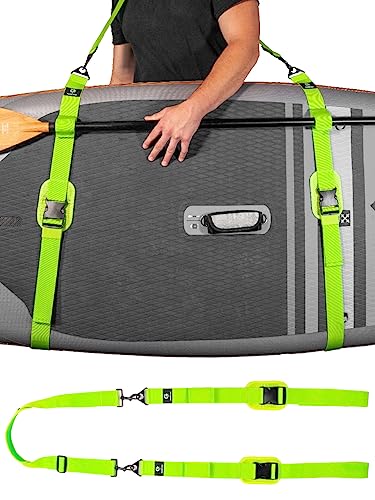 Gradient Fitness Paddle Board Carrying Strap
|
8.3/10 | Buy | |
 Bonnlo Universal Kayak Dolly Cart
|
8.3/10 | Buy | |
 KASHUNUO Kayak Paddle Clips (6-Pack)
|
7.8/10 | Buy | |
 VEVOR 300 lb Foldable Kayak Cart
|
7.8/10 | Buy | |
 VEVOR Kayak and Paddle Board Cart
|
7.8/10 | Buy |
GanFindX Heavy-Duty Stainless Steel Kayak Cart
The GanFindX Kayak Cart is a heavy-duty stainless steel scupper trolley built to transport sit-on-top kayaks up to 240 pounds without cumbersome tie-down straps. Its 0.8-inch rubber-sleeved posts and puncture-proof 8-inch foam wheels make it a practical portage tool for solo paddlers hauling gear across gravel, grass, and boat ramps.
Pros
- Strap-free scupper insertion enables fast, single-person loading without wrestling loose cam straps
- Stainless steel frame construction delivers a generous 240-pound maximum weight capacity
- Solid 8-inch foam wheels are completely puncture-proof and maintenance-free on rough ground
- Protective rubber sleeves prevent bare metal hardware from rubbing against plastic scupper holes
Cons
- Strictly limited to sit-on-top kayaks with vertical scupper holes wider than 0.8 inches
- Cannot be used with sit-inside recreational kayaks, inflatables, or folding watercraft lacking scupper drains
- Narrow 8-inch foam wheels require extra pulling effort through deep, loose beach sand compared to balloon tires
FitiRoker 8-Inch 300 lb Kayak Cart
Built with a powder-coated aluminum frame, this FitiRoker dolly safely hauls up to 300 pounds of watercraft from car to shoreline. Its flat-free wheels and adjustable support bars make it a dependable hauler for solo paddlers managing recreational or fishing kayaks.
Pros
- High 300-pound capacity handles heavy fishing and tandem setups
- Corrosion-resistant aluminum frame holds up in coastal environments
- Puncture-proof airless tires eliminate flat tires completely
- Adjustable cradle fits hull widths up to 14 inches
- Thick rubber padding prevents scratches and hull damage
Cons
- 8-inch wheels are smaller than dedicated balloon sand tires
- Maximum frame width is limited to 14 inches
Bonnlo Universal Kayak Cart with Airless Tires
Built with puncture-proof 10-inch tires and tool-free breakdown, this Bonnlo carrier simplifies hauling watercraft over sand and loose gravel. Its 150-pound capacity and included tie-down straps make it well-suited for solo paddlers moving kayaks, canoes, or paddleboards.
Pros
- Flat-free tires eliminate puncture and inflation concerns
- Tool-free disassembly makes vehicle storage effortless
- Compatible with a wide variety of small watercraft
- Includes two dedicated 7.75-foot ratchet tie-down straps
Cons
- 150-pound capacity excludes heavier tandem or gear-laden boats
- Steel frame adds more carrying weight than aluminum alternatives
KOETSU Adjustable SUP Carry Strap
Transporting bulky water gear becomes significantly more manageable with this padded strap system, which accommodates boards up to 47 inches wide. An integrated Velcro paddle holder keeps your hands free on the trek from your vehicle to the shoreline.
Pros
- Padded design cushions the shoulder effectively
- Dedicated Velcro holder secures your paddle
- Swivel clips prevent annoying strap tangles
- Wide adjustability fits various board widths
Cons
- Length capacity limited to boards around 79 inches
- Requires manual buckle adjustments between different boards
Tactical Single Element 74-Inch Kayak Sling
Built with 1.5-inch webbing and dual end hooks, this adjustable sling suspends watercraft up to 74 inches in circumference from garage walls or ceilings. Dedicated hook-and-loop straps keep paddles secured alongside your gear, offering an efficient storage setup for multi-craft owners.
Pros
- Extra-wide webbing prevents surface damage to hulls
- Integrated straps keep paddles securely in place
- Bottom hooks allow multi-craft vertical storage
- Accommodates up to 74-inch circumference equipment
- Compatible with both wall and ceiling hoist hooks
Cons
- Restricted to watercraft under 74 inches in circumference
- Requires existing wall or ceiling hooks for installation
Gradient Fitness Paddle Board Carrying Strap
Gradient Fitness designed this lightweight harness system to streamline hauling bulky stand up paddleboards and kayaks down to the water. Featuring an ergonomic shoulder sling and an integrated paddle holder, it provides a stable, hands free transport solution for outdoor paddlers.
Pros
- Lightweight design weighing just 0.75 pounds
- Integrated holder secures paddle alongside the board
- Fast lock carabiners streamline attachment and removal
- Reinforced polypropylene straps and sturdy POM buckles
- Adjustable shoulder strap extends up to 41.7 inches
Cons
- Tie down straps max out at 36 inches
- Four step setup required before each transport
Bonnlo Universal Kayak Dolly Cart
The Bonnlo Universal Kayak Carrier is a lightweight, 5-pound folding transport dolly built with sturdy aluminum tubing, airless 10-inch solid PU tires, and a 200-pound payload limit. It is an ideal portage solution for solo paddlers, kayak anglers, and canoeists wanting to haul heavy watercraft from vehicle to water without flat tires or back strain.
Pros
- Airless 10-inch solid PU tires eliminate the risk of punctures, air leaks, or valve failures at the boat ramp.
- Spring-loaded double kickstand keeps the dolly elevated and stable for easy one-person kayak positioning.
- Lightweight 5-pound anodized aluminum frame folds down quickly for storage inside kayak hatches or car trunks.
- Generous 200-pound load capacity comfortably handles heavy rotomolded hulls and rigged angling watercraft.
- Comes complete with two ratchet tie-down straps and thick protective foam padding on the frame arms.
Cons
- Narrow 3-inch solid tires roll smoothly on hardpack and grass but can sink into deep, powdery beach sand.
- Ratchet straps generate high clamping force that requires careful tensioning to prevent denting lighter thermoformed hulls.
- Wide multi-chine or tunnel-hull kayaks may require precise placement across the padded bunks to prevent side shifting.
KASHUNUO Kayak Paddle Clips (6-Pack)
Designed for kayak anglers and paddle boarders, this six-pack provides tool-free gear security using aluminum carabiners and adjustable nylon wraps. The straps fit shafts up to 6 cm, making them a practical way to lash paddles, fishing rods, or cooler ties to onboard D-rings.
Pros
- Tool-free carabiner design requires no drilling
- Adjustable straps fit shafts up to 6 cm
- Corrosion-resistant build resists saltwater and UV wear
- Versatile six-pack secures paddles, rods, and coolers
Cons
- Requires existing D-rings or deck rigging points
- Not compatible with gear shafts exceeding 6 cm
VEVOR 300 lb Foldable Kayak Cart
Built with a durable composite frame supporting up to 300 pounds, this cart rolls smoothly across sand and gravel on maintenance-free solid rubber tires. Adjustable brackets allow it to adapt to diverse hull shapes, making it a dependable transport solution for paddlers.
Pros
- Maintenance-free solid rubber tires never go flat
- Strong 300-pound load capacity supports heavy craft
- Adjustable brackets fit flat, curved, and V-shaped hulls
- Folds down compactly for transport and storage
Cons
- Solid tires provide less cushioning than air-filled wheels
- Composite frame instead of an all-metal build
- Includes only one ratchet strap for boat security
VEVOR Kayak and Paddle Board Cart
The VEVOR Foldable Dolly provides an effortless way to transport heavy paddle boards, kayaks, and canoes from vehicle to water without back strain. Featuring a 250-pound load capacity, 10-inch solid flat-free tires, and a padded aluminum frame, it is a practical choice for solo paddlers managing long trail launches.
Pros
- Solid 10-inch puncture-proof tires require no air pressure maintenance and will never go flat on rough trails
- Robust 250 lb rated aluminum frame easily supports heavy fishing SUPs, rigged kayaks, and loaded touring gear
- Included 12-foot non-slip tie-down strap and thick foam padding protect hulls from gouges and shifting
- Single kickstand foot stabilizes the dolly for straightforward, one-person gear loading
- Toolless lynch pins allow quick wheel removal and compact folding for car trunk storage
Cons
- Solid rubber tires may dig into loose, deep sugar sand compared to specialized wide balloon beach tires
- Requires careful strap placement and balancing to prevent wider paddle boards from shifting on steep inclines
- Kickstand must be flipped up completely before pulling to avoid catching on high trail obstacles
Essential Methods for Transporting Kayaks and Paddleboards Together
Transporting a kayak and a stand-up paddleboard on the same journey requires deliberate planning, balanced weight distribution, and the right carrying hardware. Because these two paddlecraft feature drastically different hull profiles and structural tolerances, using a single loading technique rarely works for both. Understanding vehicle roof load ratings, strap dynamics, and shoreline portage options allows you to move both vessels efficiently without risking hull damage or highway safety hazards.
Evaluating Vehicle Roof Capacities and Crossbar Widths
Before lifting any equipment onto your vehicle roof, verify the dynamic weight rating of your crossbars and roof rails. Factory-installed crossbars frequently max out between 100 and 150 pounds of dynamic load, which refers to the maximum weight permitted while driving at highway speeds. A standard rotomolded sit-on-top fishing kayak often weighs between 60 and 85 pounds, while a rigid epoxy stand-up paddleboard typically weighs between 25 and 35 pounds. Adding heavy racks, mounting saddles, and wet paddling gear can push your total rooftop load dangerously close to vehicle limits.
Crossbar width also dictates how easily you can place both vessels side by side. Standard compact crossbars measuring 48 to 50 inches wide rarely leave enough horizontal space to lay a 32-inch kayak flat next to a 32-inch paddleboard. Upgrading to 58-inch, 60-inch, or wider aero crossbars creates the lateral real estate needed to support dual carriers. Always confirm that your crossbars do not extend past the outer edge of your vehicle side mirrors, preserving safe driving clearance and passenger safety.
Dual-Craft Roof Rack Configurations: J-Cradles and Stackers
Positioning both craft onto a standard vehicle roof requires orienting at least one vessel on its edge. Carrying a kayak inside an angled J-cradle tilts the hull to approximately 45 degrees, drastically cutting down on horizontal bar space. This tilted position leaves ample flat space on the remaining crossbar surface for a paddleboard or a set of flat foam pads. Kayak hulls handle side loading exceptionally well because rotomolded plastic exhibits high rigidity along the gunwales and chines.
Vertical post stackers offer an alternative solution when you need to pack multiple narrow watercraft onto a single vehicle. With a central vertical post attached to each crossbar, you can lash the kayak on one side of the upright post and position the paddleboard vertically or angled on the opposing side. If you carry a rigid paddleboard on its edge, wrap dense foam padding around the contact points to safeguard delicate fiberglass rails. Never clamp bare metal uprights directly against composite gelcoats or lightweight epoxy laminates.
Proper Tie-Down Mechanics: Cam Straps Versus Ratchet Straps
Mechanical ratchet straps represent one of the most common causes of permanent watercraft damage during transport. Ratchets generate immense mechanical leverage, making it deceptively easy to crush hollow polyethylene kayak hulls or fracture rigid paddleboard cores. Overtightening a ratchet strap under direct summer sunlight can create permanent depressions, known as oil-canning, along the bottom of your kayak. Solid polyester cam straps rely solely on hand strength, providing plenty of holding power without deforming fragile hull materials.
Thread your cam buckle straps underneath the crossbar on the inside of the mounting foot before looping over the watercraft. Running the strap under the crossbar creates a mechanical block that keeps the boat from shifting laterally in sharp turns. Loop the webbing completely over the hull or paddleboard deck, pass it under the crossbar on the opposite side, and feed it through the spring-loaded cam buckle. Tuck any excess strap tail inside the vehicle door jam or knot it securely around the crossbar to eliminate loud highway flapping.
Bow and stern safety tie-downs provide essential protection against wind uplift and sudden stops. Running non-stretch lines from the kayak bow handle to your front vehicle recovery point prevents the boat from peeling backward at highway speeds. For the paddleboard, tie-down options depend on deck hardware, but a front line looped around an integrated leash plug or D-ring adds valuable insurance. Inspect every tie-down strap within the first twenty miles of travel to confirm that wind vibrations have not loosened the cam buckles.
Managing Inflatable Craft and Deflated Transport Options
Deflating inflatable paddleboards and kayaks simplifies dual-craft logistics by shifting cargo from the roof into your trunk or back seat. High-pressure drop-stitch construction allows modern boards and boats to pack into compact carry bags without sacrificing on-water rigidity. Choosing rugged inflatable kayaks paired with inflatable paddleboards eliminates aerodynamic roof drag, improves vehicle fuel economy, and removes car-topping lift height entirely. This transport method suits apartment dwellers and drivers with compact hatchbacks or sedans.
If you transport an inflatable paddleboard inflated on your vehicle roof, adjust internal chamber pressure before hitting the road. Direct sunlight and hot asphalt radiate extreme thermal energy, which causes air trapped inside PVC drop-stitch bladders to expand rapidly. A board inflated to 15 PSI on a cool morning can easily spike past safe working limits after an hour of highway driving in midday sun. Bleed two to three PSI from the internal chamber before securing the board to your roof rack, and reinflate to operational pressure at the water’s edge.
Shoreline Portage: Selecting the Right Cart and Dolly System
Carrying a kayak and a paddleboard from a distant parking lot to the shoreline by hand quickly leads to physical exhaustion. Dedicated cart dollies take the full brunt of hull weight, turning an awkward two-person struggle into a relaxed solo stroll. Different craft designs require specific cart geometry to prevent slippage and hull stress over uneven ground. Understanding the differences between plug-in scupper dollies and universal cradles ensures smooth portage across gravel, grass, and shoreline access trails.
Plug-in scupper carts, such as the GanFindX model with vertical upright posts, slide directly through the drainage scuppers of sit-on-top kayaks. This plug-in layout eliminates the need for tie-down straps and provides rapid loading from vehicle to shoreline. Upright posts require scupper holes larger than 0.8 inches, and you must verify inner diameter clearances before rolling across uneven ground. Scupper carts work exclusively with drain-equipped sit-on-top hulls, meaning they cannot support flat-bottom paddleboards or sit-inside models.
Universal folding cradles, including models from Bonnlo, FitiRoker, and VEVOR, utilize horizontal padded support bars and heavy-duty tie-down straps. These cradle carts support sit-on-top kayaks, traditional canoes, and wide stand-up paddleboards with equal capability. Models with adjustable frame widths from 3.6 inches up to 16 inches accommodate deep V-hulls, pontoon fishing kayaks, and wide float mats. Large solid rubber and airless PU tires eliminate puncture risks when rolling across sharp rocks, oyster shells, and broken shoreline branches.
Ergonomic Shoulder Slings and Hands-Free Portage Straps
Shoulder carry straps offer an ultra-lightweight portage solution when wheel carts are impractical over deep mud, loose sand dunes, or steep riverbanks. Padded strap systems, like those from KOETSU and Gradient Fitness, wrap wide webbing around both ends of your paddleboard or kayak hull. The padded shoulder section distributes the deadweight across your shoulder and upper back muscles rather than concentrating strain in your fingers and forearms. This hands-free carrying position allows you to maintain balance on slick rocks or carry additional dry bags with your free hand.
Adjust the perimeter loop straps so the craft balances horizontally at your hip without dragging its tail along the ground. Built-in hook-and-loop paddle loops on the carry sling let your paddle act as an integrated carrying strut or stabilizer. When transporting a paddleboard alongside a kayak, one paddler can pull the wheeled cart while the other easily carries the lighter SUP on a padded shoulder sling. Once you reach the launch, these compact straps unclip quickly and stow inside dry bags or under bungee deck rigging.
Securing Paddles and Small Accessories During Transit
Loose paddles, tracking fins, and safety accessories create significant flight hazards if left unsecured inside open truck beds or rooftop wells. High-end carbon-fiber SUP paddles and two-piece kayak paddles suffer chipped blades and cracked shafts when tossed loosely beside heavy rotomolded hulls. Dedicated deck clips, such as KASHUNUO paddle keeper straps with carabiners, lock paddle shafts firmly against hull D-rings and deck bungees. These micro-adjustable nylon straps grip shafts from 1.5 cm to 6 cm in diameter, holding paddles secure during bumpy transport.
Removable center fins on stand-up paddleboards demand careful handling before loading boards onto vehicle crossbars. Leaving a 9-inch touring or surf fin attached while strapping a board flat against roof crossbars can bend the fin box or crack surrounding epoxy glass under strap tension. Slide quick-release fins out of their US-box or click-fin housings and store them inside vehicle consoles along with fin screws and leashes. Stashing hardware inside labeled mesh bags prevents lost parts and ensures rapid rigging once you arrive at the water.
Safety Precautions, Waterway Regulations, and Weather Readiness
Safe transport extends beyond highway logistics to ensuring all required safety gear arrives at the launch site intact and ready for deployment. The United States Coast Guard treats both kayaks and stand-up paddleboards operating outside surf and swim zones as recreational vessels under federal jurisdiction. Federal regulations under Title 33 CFR Part 175 require each paddler to carry a properly fitted, USCG-approved Type III or Type V wearable personal flotation device. State and federal conservation officers also mandate an efficient sound-producing device, such as a pea-less whistle attached to your life jacket zipper.
Preparing for varying water temperatures and unpredictable weather is essential whenever you hit the water. Cold-water immersion presents immediate physical dangers through involuntary gasp reflexes and rapid muscle incapacitation. Equipping yourself with reliable wetsuits for kayaking and cold-water paddleboarding provides vital thermal insulation during unexpected capsizes. Always verify that your drain plugs are screwed tight, hatch covers are sealed against water ingress, and your safe operating payload remains comfortably within seventy percent of maximum capacity.
Post-Trip Hull Maintenance and Off-Season Storage Methods
Transporting watercraft back home after an outing requires immediate attention to cleaning and proper storage orientation. Road grime, exhaust particles, and dried saltwater quickly degrade plastic polymers, corrode aluminum cart frames, and wear out strap cam springs. Rinse both vessels, your cart wheels, and tie-down hardware thoroughly with fresh water before stowing them away. Applying a UV-protectant spray to polyethylene kayak hulls and PVC paddleboards shields structural materials from solar embrittlement and discoloration.
Storing kayaks and rigid paddleboards flat on garage concrete floors invites moisture entrapment and bottom-hull oil-canning. Utilizing adjustable wall-hanging strap systems, like the Tactical Single Element hoist sling, suspends heavy hulls and SUPs safely against wall studs or garage ceilings. These wide nylon webbing cradles distribute hull weight across 74 inches of contact area, eliminating focal pressure points that distort hull geometry over winter. Hanging paddles on integrated hook-and-loop straps keeps your entire gear inventory organized, elevated, and ready for your next adventure.
Practical Verification Protocol Before Driving Away
Before putting your vehicle into drive, complete a physical perimeter check of every attachment point on your transport setup. Grab the bow and stern of both the kayak and the paddleboard and shake the entire assembly firmly from side to side. The watercraft should move in unison with the vehicle suspension rather than wiggling independently inside its saddles or cradles. If the hull shifts even half an inch, release the cam buckles, reseat the craft on its padding, and re-tension the straps securely.
Plan a brief roadside stop after driving the first ten to fifteen miles on highway surfaces. Road vibration, crosswinds, and moisture loss on wet webbing frequently cause strap tension to slacken during initial miles. Re-check the cam buckle grip, verify that safety strap tails remain securely knotted, and confirm that front bow lines have not developed slack against your vehicle bumper. Adopting this disciplined transport and portage routine ensures your kayak and paddleboard arrive safely at every destination season after season.
About the author
Reuben Parsons is an experienced water-sports writer and gear reviewer specializing in surfing and stand-up paddleboarding. With a background in marine biology and more than a decade of outdoor writing, He has tested hundreds of products and spent thousands of hours evaluating outdoor gear. He approach combines technical research with genuine experience on the water.