
How to Move a Kayak on a Car: Practical Vehicle Transport Guide for 2026
Learn how to move a kayak on a car safely in October 2026 with reliable roof-loading steps, secure tie-downs, and hull transport advice.
 By Marius Fox
Updated October 5, 2026
By Marius Fox
Updated October 5, 2026

Transporting a recreational or fishing kayak from the driveway to the water often presents a major physical challenge for paddlers. Heavy rotomolded polyethylene hulls frequently weigh between 60 and 85 pounds, making solo overhead lifting awkward while risking scratches to vehicle paint or denting roof sheet metal. Figuring out how to move a kayak on a car requires understanding safe vehicle load limits, dependable roof mounting hardware, and proper securing methods that protect your boat. Investing in dedicated heavy-duty kayak roof racks creates a solid foundation on factory crossbars, preventing dangerous shifts during highway travel. Taking the time to master basic loading techniques transforms an intimidating chore into a fast, manageable launch routine.
Paddler safety also depends on selecting the right loading accessories and tie-down hardware to prevent structural hull damage. Overtightening rigid cargo straps can permanently crush plastic hulls or create unsightly oil-canning indentations, while loose straps risk watercraft slippage at highway speeds. Using specialized gear such as rolling suction load assists, folding J-style cradles, and puncture-proof dolly carts helps you maneuver heavy boats without back strain. A dependable vehicle transit routine ensures that you arrive at the boat ramp with your craft fully intact, ready to paddle, and secured according to basic road safety standards.
| Award | Product | WSG Score About WSG ScoreThe WSG Score is our own rating from 0 to 10, based on performance, design and build, ease of use, and value. It reflects independent research and is never influenced by manufacturers, retailers, or affiliate commissions. Learn more › | |
|---|---|---|---|
| Best Overall |
AA-Racks Folding J-Bar Kayak Roof Rack 2-Pair
|
8.9/10 | Buy |
| Best Premium |
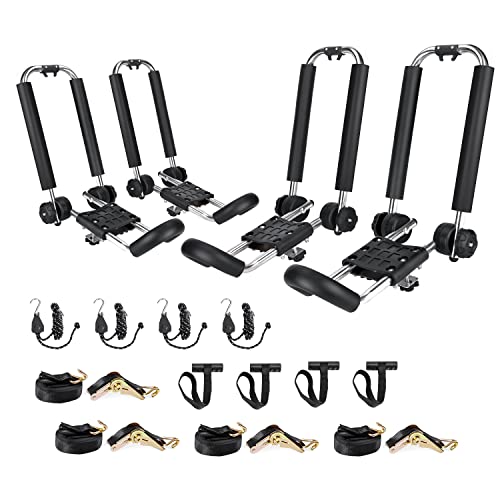 AA-Racks 2-Kayak Folding Roof Rack
|
8.8/10 | Buy |
| Best Budget |
 Bonnlo Foldable Kayak Cart Dolly with 10-Inch
|
8.3/10 | Buy |
 HUIMENG Kayak Roller Load Assist
|
7.8/10 | Buy |
AA-Racks Folding J-Bar Kayak Roof Rack 2-Pair
This dual-pair folding J-bar rooftop rack provides a reliable way to carry up to two kayaks or canoes without sacrificing parking garage clearance. With dense protective foam, real rubber base pads, and four 16-foot ratchet straps, it offers solid transport utility for solo boaters and paddling duos.
Pros
- Foldable design lays flat when not in use to clear low garages and drive-thrus without unbolting
- Two full pairs included in one package, allowing direct transport for two separate kayaks
- Dense foam sleeves and non-slip rubber bases safeguard plastic and composite hulls from hard contact
- Comes with four 16-foot heavy-duty ratchet straps reviewed to 2,200 pounds for secure transport
Cons
- Vehicle roof rack crossbars are not included and must be sourced separately before installation
- Ratchet straps require careful tensioning to avoid overtightening and deforming hollow rotomolded plastic hulls
- Mounting hardware may require periodic retightening checks following highway travel on bumpy backroads
AA-Racks 2-Kayak Folding Roof Rack
The AA-Racks Folding J-Bar Roof Rack carries up to two kayaks with a 150-pound total capacity, featuring fold-down stainless steel frames and protective foam padding. It provides an efficient car-topping solution for paddlers and families who need reliable vehicle transport without sacrificing parking garage clearance.
Pros
- Fold-down design eliminates the hassle of removing racks when entering low-clearance garages
- Transports two full-sized watercraft simultaneously to maximize vehicle roof space
- Durable corrosion-resistant steel build with anti-slip rubber cushioning to protect boat hulls
- Complete rigging bundle with 16-foot ratchet straps and bow and stern tie-downs included
Cons
- 150-pound total load limit requires caution when transporting two heavy rotomolded fishing kayaks
- Ratchet-style tie-downs can risk denting plastic hulls if overtightened compared to traditional cam straps
- Total rack hardware weight of 20 pounds adds meaningful static load to vehicle crossbars
Bonnlo Foldable Kayak Cart Dolly with 10-Inch
The Bonnlo Foldable Kayak Cart provides a reliable 200-pound transport solution featuring 10-inch puncture-proof solid tires and a lightweight aluminum frame. It is ideal for solo paddlers and anglers needing to haul kayaks, canoes, or paddleboards from the vehicle to the water without tire-pressure hassles.
Pros
- Airless 10-inch solid PU tires never go flat or require air pumps at the boat ramp
- Sturdy 200-pound load limit easily supports rigged fishing kayaks, canoes, and paddleboards
- Spring-loaded 12-inch kickstand keeps the dolly propped up for steady solo loading
- Folds down compactly with detachable wheels for convenient storage inside a hatch or on deck
- Thick foam padding prevents aluminum tubing from gouging or scratching composite and plastic hulls
Cons
- Included strap is suited for craft under 31.5 inches wide, requiring a longer strap for extra-wide fishing kayaks
- Narrower 3-inch solid tires can dig into deep, loose beach sand more than specialized balloon wheels
- Requires careful placement under the kayak center of gravity to avoid frame slippage on steep launch ramps
HUIMENG Kayak Roller Load Assist
The HUIMENG Kayak Roller is a heavy-duty aluminum roof load assist designed to help solo paddlers roll kayaks and canoes onto vehicle crossbars or roof pads. Rated for up to 220 pounds, its side-stop rollers and protective EVA foam make car-topping heavy watercraft manageable without scratching vehicle paint.
Pros
- Substantial 220-pound maximum load rating accommodates heavy fishing kayaks and canoes
- Side-stop roller configuration effectively prevents lateral hull drift during solo loading
- High-density EVA foam cushions contact points against vehicle paint and rear glass
- Sub-4-pound aluminum build is lightweight and stows easily inside a vehicle cargo hatch
Cons
- Requires careful height alignment so the roller does not sit higher than vehicle crossbars
- Installation requires clean vehicle contact surfaces and proper strap tensioning to prevent shifting
- Rear window curvature and spoiler profiles on some vehicles may require trial-and-error placement
Complete Step-by-Step Guide to Moving a Kayak on a Car
Moving a kayak on a passenger vehicle requires a clear understanding of balance, weight distribution, and secure mechanical attachment. Whether you drive a compact sedan with a bare roof or an SUV equipped with factory crossbars, following a disciplined loading and tie-down procedure eliminates highway hazards and physical strain. Mastering these practical techniques ensures your watercraft stays undamaged and your vehicle remains safe from road vibrations and wind shear.
Evaluating Vehicle Roof Capacities and Crossbar Systems
Every vehicle roof features a manufacturer dynamic weight rating that dictates how much cargo it can support while in motion. Dynamic ratings represent the maximum safe mass during highway maneuvers, sudden braking, and sharp turns, which is typically much lower than a vehicle static weight limit. Most passenger sedans and compact crossovers offer dynamic roof capacities between 110 and 165 pounds. Checking your vehicle owner manual prevents roof rail deformation, structural pillar buckling, or sunroof shattering under heavy composite or rotomolded plastic hulls.
Crossbar spread also plays a major role in highway stability. Crossbar spread refers to the distance between your front and rear crossbars, ideally measuring at least 24 to 36 inches apart for a standard 10 to 14-foot kayak. Narrow crossbar spreads concentrate upward aerodynamic lift on a small section of the hull, creating severe boat teetering at highway speeds. If your vehicle features fixed mounting points with a narrow spread, using front and rear tie-down lines becomes even more essential to counteract levered wind shear.
Factory installed crossbars frequently feature curved aerodynamic profiles designed to reduce wind noise rather than carry heavy sporting cargo. While sleek, these factory bars may flex under heavy recreational or tandem kayaks that weigh 75 pounds or more. Aftermarket steel or heavy-duty aluminum crossbars provide rigid flat surfaces and higher weight ratings, ensuring that attachment hardware remains securely clamped without slipping along the bar during transit.
Choosing the Right Transport Carrier: J-Cradles vs Saddles vs Bare Roof Pads
J-style cradle racks remain one of the most popular transport solutions for multi-boat paddlers. Units like the folding steel carriers from AA-Racks hold kayaks on their sides at roughly a 45-degree angle, which frees up valuable crossbar space on your roof. This angled orientation allows you to mount a second kayak, a cargo box, or a bicycle carrier on the opposite side of your vehicle crossbars. Folding models also offer the practical benefit of collapsing flat when unloaded, allowing your vehicle to clear low parking garage entrances without removing the entire rack assembly.
Saddle carriers support kayaks hull-down or deck-down, cradling the bottom profile with wide rubberized pads that distribute downward weight evenly across the crossbars. This horizontal layout creates a lower aerodynamic profile, reducing highway drag and minimizing crosswind push against tall vehicle side panels. However, carrying kayaks flat requires substantial crossbar width, which usually limits transport to a single wide fishing kayak on standard passenger cars.
Paddlers without factory roof rails or crossbars often rely on temporary foam block kits or padded roof straps. These systems rest directly on the vehicle bare metal roof, with straps running through the interior door frames to cinch down the craft. While functional for short trips at secondary road speeds, bare roof setups lack lateral rigidity and can compress vehicle sheet metal if over-tightened. Foam blocks also tend to vibrate and degrade over time, making them a temporary solution rather than a permanent transit strategy.
Solo Loading Mechanics: Using Load Assist Rollers and Pivot Techniques
Lifting a 60 to 80-pound rotomolded polyethylene kayak onto a tall vehicle roof poses a significant challenge for solo paddlers. Attempting a direct deadlift from ground to roof rack frequently leads to lower back strains, dropped boats, or scratched vehicle paint. Using a dedicated rolling load assist, such as the HUIMENG Kayak Roller, dramatically simplifies this task by dividing the boat weight in half during the lift. These roller systems attach securely to your rear windshield or tailgate using heavy-duty suction mounts or strap brackets, creating a smooth pivot point.
The solo loading sequence begins by placing the bow of your kayak on the ground behind your vehicle, resting on a protective mat or grass. Lift the stern of the kayak first and set it onto the rear roller assist, keeping the bow anchored on the ground so you only support roughly half the boat total weight. Once the stern rests firmly against the roller, walk back to the bow, lift it off the ground, and push the entire hull forward in one fluid motion. The roller guides the boat effortlessly upward and forward onto your roof crossbars or J-cradles without contacting your vehicle paint.
Side-loading pivot techniques provide a reliable alternative if you lack a rear roller assist. In this approach, you place a thick towel or rubber bath mat across the rear corner of your vehicle roof or rear quarter panel. Lift the bow onto the padded crossbar corner first, then move to the stern to lift and slide the boat into its final centered position. This end-over-end pivoting method keeps the center of gravity low and eliminates the need to press the entire watercraft overhead in a single vulnerable motion.
Two-Person Lifting Protocols to Protect Vehicle Panels and Lower Backs
Moving a kayak with a partner is significantly safer and faster when both individuals communicate clearly before initiating the lift. Tandem lifting prevents sudden slips and ensures the watercraft clears vehicle side mirrors, antennas, and painted door pillars. Before lifting, both paddlers should stand on opposite ends of the hull, grasping molded side handles or dedicated bow and stern toggles. Agreeing on a simple countdown ensures both ends rise simultaneously, preventing one person from absorbing unbalanced weight.
Proper ergonomic mechanics are vital when lifting heavy plastic hulls from ground level to shoulder height. Both paddlers must bend at the knees, maintain a straight spine, and keep the kayak hull close to their torsos rather than reaching outward with extended arms. Lifting with your legs protects lumbar discs from acute strain and provides stable balance on uneven gravel launch parking lots. Once the boat reaches chest height, both lifters press the boat upward in tandem directly over the vehicle crossbars.
Lowering the kayak onto the carrier requires controlled, gentle placement rather than dropping the hull onto the crossbars. Dropping heavy plastic or fiberglass boats can crack gel coats, dent vehicle roof metal, or shear mounting brackets. Once the hull rests in the saddles or J-cradles, check that the boat sits centered along the vehicle midline to equalize weight distribution across both front and rear axles.
Securing the Hull: Cam Straps vs Ratchet Straps and Hull Oil-Canning Risks
Selecting the correct tie-down straps is essential for protecting your kayak from permanent structural damage during transport. Experienced paddlers overwhelmingly recommend heavy-duty cam buckle straps made from non-stretch polyester webbing. Cam straps rely on spring-loaded metal teeth that grip the webbing when pulled hand-tight, allowing you to secure the hull firmly without applying excessive mechanical leverage. Rubber bumper covers around the metal cam buckles prevent gouging your car paint and scratching the kayak gel coat.
Heavy-duty mechanical ratchet straps, although rated for immense cargo loads, present severe risks when used on hollow plastic kayaks. A ratchet mechanism easily generates hundreds of pounds of crushing force with minimal hand effort. Overtightening ratchet straps across rotomolded polyethylene deforms the plastic hull, creating permanent indentations known as oil-canning. An oil-canned hull severely degrades on-water performance by increasing hydrodynamic drag, causing sluggish tracking, and compromising primary stability.
When threading your cam straps, always route the webbing underneath the crossbar inside the mounting bracket towers, pass it over the kayak hull, loop it under the opposite side of the crossbar, and bring it back over the top to the cam buckle. Cinching the strap hand-tight against the rubber padding of your carrier provides ample tension. Always tie off loose webbing tails with half-hitch knots behind the buckle to prevent accidental slippage and stop annoying strap buzzing at highway speeds.
Rigging Bow and Stern Safety Tie-Down Lines to Structural Anchor Points
Relying exclusively on belly straps across your vehicle crossbars is a dangerous mistake for highway travel. Aerodynamic lift and sudden crosswinds create massive upward and lateral forces on the kayak bow, especially when driving at speeds above 55 miles per hour. Installing dedicated bow and stern safety tie-down lines secures the front and back of the watercraft directly to your vehicle chassis. These auxiliary lines act as fail-safe backups that prevent the kayak from launching off your car if a crossbar bracket fails under aerodynamic stress.
Locating solid structural attachment points on modern passenger cars requires careful inspection. Never hook tie-down lines to flimsy plastic bumper covers, plastic grilles, or thin decorative trim, as highway air resistance will rip these parts directly off your vehicle. Instead, connect your lines to factory steel recovery tow loops beneath the front and rear bumpers. If your car lacks exposed steel tow points, install inexpensive under-hood tie-down loops that bolt directly to structural fender bolts inside the engine compartment and hatch frame.
Bow and stern lines should be snugged firmly to remove slack without bowing the front or rear stems of your kayak downward. Applying excessive downward tension on the bow bends the boat backbone, leading to rocker distortion and hull warping in hot summer weather. Using braided polypropylene or polyester rope paired with compact ratchet pulleys or non-slip trucker hitches allows precise tension control while maintaining balanced hull geometry.
Ground Transit from Parking Lot to Shoreline Using Foldable Hull Dollies
Getting your kayak off the car roof is only half the battle; transporting it across sandy beaches or rough launch trails requires dedicated wheeled gear. Heavy rotomolded fishing kayaks loaded with tackle, crates, and battery boxes are nearly impossible to drag solo across soft sand. A foldable kayak dolly, such as the aluminum cart from Bonnlo, features large 10-inch solid puncture-proof polyurethane tires that roll effortlessly over loose gravel, mud, and turf without going flat.
Mounting your kayak onto a transport dolly works best when positioning the cart slightly behind the center of gravity. Placing the cart under the midship balance point allows the cart wheels to bear roughly 80 percent of the total watercraft weight, leaving only light downward pressure on the bow handle. Use the integrated tie-down straps to firmly cinch the cart frame against the hull bottom, ensuring the foam bumpers cradle the hull chines to prevent slippage on steep launch ramps.
Collapsible aluminum dolly frames provide the added benefit of compact on-water storage. After wheeling your boat to the water edge, release the quick-detach wheel pins, fold the frame flat, and stow the cart inside your kayak rear tankwell or front hatch. Having your transport cart onboard allows you to exit at a different downstream takeout point without being tethered to your initial vehicle parking location.
Highway Driving Safety Checks, Crosswind Management, and Transit Verification
Safe highway driving with a kayak on your roof begins with a comprehensive pre-departure inspection routine. Grab the bow of the kayak and give it a firm push and pull in all directions before pulling out of your driveway. If the kayak wiggles independently of the vehicle, your straps or crossbar clamps are too loose; the entire car should rock slightly on its suspension when you shake a properly secured boat. Recheck strap tension after driving the first five to ten miles, as webbing often stretches slightly under initial road vibrations.
Aerodynamic dynamics change dramatically when carrying a 12 to 14-foot watercraft on your roof. Passing large commercial semi-trucks, driving across exposed bridges, and encountering strong lateral gusts can push your vehicle off course if you do not anticipate wind shear. Reducing your highway speed by 5 to 10 miles per hour substantially decreases aerodynamic lift and stress on your roof rack brackets. Maintaining extra following distance gives you ample room to brake smoothly without placing extreme forward momentum on your tie-down system.
Paddlers venturing into cold shoulder-season conditions should also pack appropriate personal gear inside the car rather than leaving it exposed on the roof. Equipping yourself with dependable protective wetsuits for kayaking ensures thermal safety once you arrive at cold-water launch sites, keeping you warm even during challenging wet launches. Keep all sensitive electronics, dry bags, and life jackets stored safely in the vehicle trunk or cabin to protect them from road grime and highway rain.
Compact Transport Alternatives: When Inflatables Outperform Hard-Shell Car-Topping
While hard-shell rotomolded and thermoformed kayaks offer excellent on-water performance, car-topping logistics can prove overwhelming for apartment dwellers or owners of small subcompact cars. Hoisting heavy boats onto high SUV roofs requires physical strength, vehicle roof racks, and ample storage space at home. Paddlers seeking to bypass car-top lifting entirely often explore heavy-duty inflatable kayaks that fold directly into a duffel bag and fit inside a standard trunk.
Modern high-pressure drop-stitch inflatable kayaks provide surprising hull stiffness and tracking performance that rivals traditional recreational hard shells. These portable boats inflate in minutes at the launch site using high-pressure pumps, eliminating the need for roof racks, crossbar hardware, and highway tie-down anxiety. Choosing an inflatable craft also protects vehicle fuel economy, as bare vehicle roofs create far less highway drag than carrying bulky hard-shell watercraft overhead.
Deciding between roof-top hard-shell transport and trunk-stowed portable designs ultimately depends on your physical capabilities, storage space, and paddling frequency. If you prefer instant launch readiness and custom rod rigging, mastering car-topping hardware and safe lifting mechanics provides unmatched convenience. By pairing reliable roof racks, load-assist rollers, and quality cam straps, any paddler can transport their kayak securely and enjoy peace of mind on the open road.
About the author
Marius Fox brings extensive hands-on experience from both above and below the water. A PADI Master Scuba Diver Trainer and AIDA freediver, she has worked as a scuba instructor, managed diving operations, participated in shark research, and contributed to marine conservation projects. His expertise provides a practical perspective on diving, snorkeling, water safety, and adventure gear.