
Stinger Xp Kayak for Sale of 2026 Stability Picks
Searching for stinger xp kayak for sale in November 2026? Compare stable hulls, pedal systems, and payload limits to pick the right boat for your next water trip.
 By Brooke Hess
Updated October 28, 2026

Fighting a sluggish, unstable boat across open water turns an exciting morning into an exhausting chore. Poor hull tracking and flimsy backrests quickly sap your energy on calm lakes or tidal bays. If you are searching for a reliable stinger xp kayak for sale, reviewing hull designs, pedal systems, and total weight capacity helps you select a vessel that stays upright and tracks straight without demanding brutal physical effort. Evaluating rotomolded polyethylene options like the BKC Brooklyn lineup ensures you get durable construction that handles shallow sandbars and rocky launches without denting your investment.
Balancing cockpit space, dry storage, and transport weight makes a massive difference before you ever hit the boat ramp. Models engineered with hands-free flipper or propeller propulsion let you focus entirely on casting lines or taking in the scenery instead of constantly correcting your course with a paddle. If you prefer shared outings, exploring how to paddle a tandem kayak solo gives you the flexibility to handle two-person adventures or solo fishing excursions with one capable craft. Looking closely at factory specifications and real paddler feedback ensures your next watercraft matches your personal stability and cargo expectations.
| Award | Product | WSG Score About WSG ScoreThe WSG Score is our own rating from 0 to 10, based on performance, design and build, ease of use, and value. It reflects independent research and is never influenced by manufacturers, retailers, or affiliate commissions. Learn more › | |
|---|---|---|---|
| Best Overall |
BKC Brooklyn 12.0 Pedal Fishing Kayak
|
8.9/10 | Buy |
| Best Premium |
 BKC Brooklyn 13.0 Pro Tandem Fishing Kayak |
8.8/10 | Buy |
| Best Value |
 BKC Brooklyn 13.0 Pro Tandem Fishing Kayak |
8.6/10 | Buy |
| Best Budget |
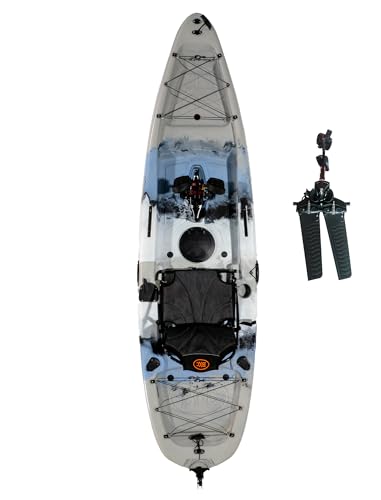 BKC Brooklyn 10.0 Pedal Fishing Kayak |
8.0/10 | Buy |
BKC Brooklyn 12.0 Pedal Fishing Kayak
The BKC Brooklyn 12.0 is a 12-foot sit-on-top fishing kayak featuring a hands-free propeller pedal drive, responsive hand-controlled rudder, and a 33.5-inch wide UV-protected HDPE hull. Weighing 75 pounds and equipped with an ergonomic aluminum frame seat, it is well suited for lake and coastal bay anglers seeking hands-free trolling and reliable primary stability.
Pros
- Hands-free propeller pedal drive facilitates effortless trolling and position-holding while casting
- Wide 33.5-inch beam and 12-foot waterline provide strong primary stability on lakes, slow rivers, and sheltered bays
- Ergonomic aluminum frame seat keeps paddlers elevated off the deck with breathable lumbar support
- Hand-operated rudder system delivers smooth steering response without requiring foot-peg adjustments
- Comprehensive storage layout includes dual dry bag-equipped hatches, rear bungee well, and scupper plugs
Cons
- Listed 75-pound bare hull weight can make solo rooftop car-topping demanding without a load-assist rack or cart
- Fixed propeller pedal mechanism requires manual lifting or removal when navigating shallow water or thick vegetation
- Propeller system does not feature an instant-kick-up obstacle avoidance mechanism found on premium fin drives
BKC Brooklyn 13.0 Pro Tandem Fishing Kayak
The BKC Brooklyn 13.0 Pro is an expansive sit-on-top kayak offering an impressive 800-pound capacity, adjustable aluminum frame seats, and a versatile layout that converts smoothly from tandem to center solo paddling. It delivers strong primary stability and dedicated fishing outfitting, making it a reliable option for angling pairs, small families, or gear-heavy solo paddlers on calm lakes and slow rivers.
Pros
- Generous 800-pound capacity easily supports two adults and a child or substantial camping and angling payloads
- Flexible seat configuration allows one seat to mount in the center position for balanced solo outings
- Height-adjustable aluminum frame seats deliver superior upright comfort compared to basic foam backrests
- Comes pre-rigged with accessory mounting rails, flush rod holders, and dual dry storage compartments
- Flat-bottomed 34-inch hull provides reassuring initial flatwater balance for casting and landing fish
Cons
- Unladen bare-boat weight of 85 pounds makes solo roof-rack car-topping demanding without a load-assist system
- Wide flat-bottom profile prioritizes initial stability over fast displacement cruising speed and long-distance glide
- Stock package does not explicitly include paddles, requiring separate purchase of adequately sized tandem paddles
BKC Brooklyn 13.0 Pro Tandem Fishing Kayak
The BKC Brooklyn 13.0 Pro is a 153-inch tandem-to-solo convertible sit-on-top fishing kayak featuring an 800 lb manufacturer-rated weight capacity and a flat-bottomed hull for reassuring flatwater stability. With height-adjustable aluminum frame seats and integrated accessory rails, it is an adaptable watercraft for tandem angling partners, families with a child, or solo paddlers hauling heavy cargo.
Pros
- High 800 lb manufacturer-rated weight capacity accommodates multiple passengers and bulky fishing gear
- Versatile seating design converts easily between tandem, three-person family, and balanced solo paddling positions
- Two-inch height-adjustable aluminum frame seats offer superior ergonomic support compared to basic molded floor seats
- Pre-installed fishing features including accessory tracks, flush rod holders, tackle trays, and dual dry hatches
- Broad flat-bottom profile provides excellent primary stability for confident boarding and casting on flatwater
Cons
- Bare hull weight of approximately 90 pounds makes solo roof-rack car-topping physically demanding without a load-assist system
- Flat-bottom hull architecture trades off tracking efficiency and speed in choppy open water or stiff headwinds
- Substantial 153-inch overall length requires significant garage or rack storage space
BKC Brooklyn 10.0 Pedal Fishing Kayak
The BKC Brooklyn 10.0 is a 10-foot sit-on-top fishing kayak featuring a hands-free flipper pedal drive, hand-operated rudder, and a stable 33.25-inch beam. With a 350-pound maximum weight capacity and built-in rod holders, it offers a maneuverable platform for calm lakes, slow rivers, and inshore waters.
Pros
- Smooth flipper pedal drive frees hands for casting, trolling, and handling tackle
- Wide 33.25-inch beam offers reassuring flatwater balance and easy boarding for recreational anglers
- Elevated aluminum-frame seat provides better lumbar support and a drier ride than flat molded foam seats
- Pre-rigged with essential fishing features including rod holders, accessory tracks, and a stern rudder
Cons
- Listing features contain conflicting notes on whether a paddle is included or must be purchased separately
- At 75 pounds total rigged weight (58 pounds bare hull), solo car-topping onto tall vehicle roofs may require a load-assist bar or cart
- Short 10-foot waterline is engineered for agility in tight spaces rather than high-speed open-water tracking
Frequently Asked Questions
What is the main advantage of a pedal-drive kayak over a traditional paddle model?
Hands-free propulsion is the biggest benefit of a pedal-drive system. It lets you maintain steady boat position against wind or current while keeping your hands free for fishing rods or camera gear. Propeller and flipper mechanisms also recruit your larger leg muscle groups, reducing shoulder and upper back fatigue during long crossings.
How do you calculate safe usable weight capacity for a fishing kayak?
Follow the seventy percent rule to determine safe usable capacity on the water. If a boat lists an 800-pound maximum rating, keep the combined weight of paddlers, tackle crates, coolers, and safety gear under 560 pounds. Exceeding this boundary pushes scupper holes below the waterline, degrading secondary stability and making the hull sluggish.
Can a tandem fishing kayak be comfortably paddled by one person?
Yes, tandem hulls featuring repositionable seats allow balanced solo paddling. Certain models allow one aluminum frame seat to shift to the center position to balance out trim. This centered setup prevents bow rise and maintains straight-line tracking when enjoying trips like kayaking in Wisconsin without a partner.
What is the difference between primary and secondary stability on sit-on-top hulls?
Primary stability measures how steady a kayak feels when sitting flat on calm water, while secondary stability measures resistance to capsizing when tipped on edge. Wide, flat-bottom hulls deliver excellent initial steadiness for standing and casting. Rounded or pontoon-style hulls provide dependable secondary stability when waves and boat wakes roll past.
How should you transport a heavy rotomolded kayak without a factory roof rack?
Dense foam block kits or temporary roof pads work well on bare vehicle roofs. Pass heavy-duty cam buckle straps through open car doors, and always attach bow and stern tie-downs to structural vehicle tow points. Adding a portable wheeled cart also protects the hull when moving heavy gear from parking areas to launches during Hocking Hills kayaking trips.
Why are scupper holes and plugs essential on sit-on-top kayaks?
Scupper holes provide continuous deck drainage so splashing waves do not pool inside the cockpit. Inserting rubber scupper plugs keeps your seat dry in flat, calm conditions or chilly weather. Pulling the plugs open allows any accumulated water from chop or boat wash to exit naturally through the bottom.
About the author
Brooke Hess is an accomplished whitewater kayaker and outdoor writer with years of experience paddling rivers around the world. He has competed internationally in freestyle kayaking and extreme races and has represented the United States in competitive kayaking. His deep understanding of river conditions and paddling performance gives her valuable insight into technical kayaking gear.