
How to Transport a Kayak on a Truck: A Practical Guide for 2026
Master how to transport a kayak on a truck safely with our expert guide to bed loading, tie-downs, and rack setups for October 2026.
 By Brooke Hess
Updated October 5, 2026
By Brooke Hess
Updated October 5, 2026

Pickup trucks offer one of the most versatile platforms for hauling paddlecraft, yet improper loading angles and overhang violations can easily damage a composite or plastic hull. Understanding how to transport a kayak on a truck begins with evaluating your truck bed length against the overall waterline length of your boat. Polyethylene hulls remain vulnerable to heat-induced warping when concentrated pressure points rest across a sharp tailgate edge during warm weather. Equipping your vehicle with suitable support accessories and durable heavy-duty kayak racks preserves the structural rocker profile of your craft while keeping your load stable on the highway.
Transporting a boat safely requires balancing bed security, strap friction, and regional road regulations regarding rear cargo extension. Many paddlers mistakenly depend on overtightened straps or allow hulls to slide freely across slick spray-in bed liners during transit. Selecting the right combination of weather-resistant cam straps, bed extenders, and dense protective padding prevents dangerous road incidents and hull distortion. Aligning your truck configuration with the specific dimensions of your watercraft ensures safe travel to remote launch sites without costly structural damage.
| Award | Product | WSG Score About WSG ScoreThe WSG Score is our own rating from 0 to 10, based on performance, design and build, ease of use, and value. It reflects independent research and is never influenced by manufacturers, retailers, or affiliate commissions. Learn more › | |
|---|---|---|---|
| Best Overall |
GigaCraft 32-Inch Kayak Cart Dolly with 10-Inch
|
8.4/10 | Buy |
| Best Budget |
 Newcod Adjustable Scupper Kayak Cart
|
8.3/10 | Buy |
 GanFindX 16-Inch Kayak Cart (350 lbs)
|
8.1/10 | Buy | |
| Best Premium |
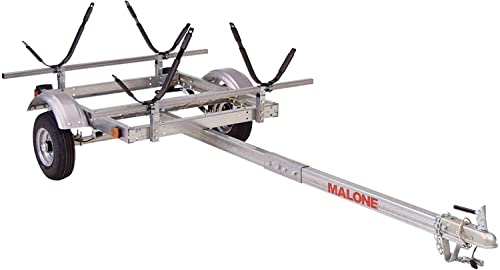 Malone EcoLight 2-Kayak Trailer with J-Racks
|
8.1/10 | Buy |
GigaCraft 32-Inch Kayak Cart Dolly with 10-Inch
The GigaCraft Kayak Cart Dolly is a track-mounted transport system featuring a 32-inch crossbar and 10-inch flat-free TPE wheels rated up to 150 pounds. It provides solo kayak anglers with stable ramp portage and convenient on-water stowing without slipping straps.
Pros
- Direct track attachment prevents the carrier from slipping out from under the hull like traditional friction-strap dollies
- Puncture-resistant 10-inch TPE wheels roll reliably across asphalt, boat ramps, and compacted soil without tire pressure maintenance
- Stowable design keeps the wheels out of the water line while paddling without consuming precious rear tankwell crate storage
- Stainless steel and aluminum components provide dependable corrosion resistance for brackish and marine launches
Cons
- 150-pound maximum weight threshold may not accommodate extra-heavy motorized tournament rigs loaded with large batteries
- 32-inch crossbar requires compatible gear track spacing on your kayak hull for proper mounting alignment
- Adds 16 pounds of transport rigging that stays with the watercraft unless completely disassembled prior to launch
Newcod Adjustable Scupper Kayak Cart
Built for sit-on-top watercraft, this lightweight aluminum dolly slots directly into scupper holes to keep hulls stable during transit. Its puncture-proof 10-inch wheels and variable width make it a practical carrier across gravel, pavement, and packed turf.
Pros
- Puncture-proof solid wheels never need air inflation
- Adjustable width fits scupper spacing up to 23.4 inches
- Lightweight 7-pound aluminum frame resists corrosion
- Protective foam padding prevents scupper hole scuffing
- 220-pound load rating handles heavy gear loads
Cons
- Requires kayaks to have scupper holes of at least 1-inch
- Incompatible with sit-inside kayaks and solid-bottom hulls
- Solid wheels roll poorly over loose, deep beach sand
GanFindX 16-Inch Kayak Cart (350 lbs)
Built with a reinforced steel frame and oversized 16-inch wheels, this folding dolly hauls watercraft up to 350 pounds across soft sand and rough terrain. An integrated kickstand and adjustable width make solo loading straightforward at any launch point.
Pros
- Robust 350-pound load rating
- Large 16-inch wheels handle rough terrain smoothly
- Adjustable frame adapts to diverse hull contours
- Pre-assembled design is ready to use immediately
- Integrated kickstand allows hassle-free solo loading
Cons
- Steel frame is heavier than aluminum alternatives
- Oversized 16-inch wheels require more storage space
Malone EcoLight 2-Kayak Trailer with J-Racks
The Malone EcoLight 2-Kayak Trailer delivers a road-ready transport solution designed to haul two kayaks up to 14 feet with a 400-pound maximum load capacity. Built with pre-galvanized marine-grade steel, submersible LED lighting, and included J-style carriers, it is ideal for paddlers looking to avoid vehicle roof loading.
Pros
- Submersible pontoon wheels and sealed marine bearings allow confident backing directly down boat ramps
- Low loading height eliminates the heavy physical strain of lifting kayaks onto tall vehicle roof racks
- Sturdy 11-gauge pre-galvanized steel frame provides solid resistance against road grime and moisture
- Package comes complete with two sets of J-rack carriers, hardware, and pre-wired submersible LED lights
Cons
- Requires three to four hours of mechanical assembly and standard tools prior to first-time road use
- Maximum watercraft length rating is limited to 14 feet, excluding longer ocean touring and expedition kayaks
- Galvanized industrial finish offers a purely utilitarian aesthetic compared to painted trailer frames
Complete Truck Bed and Rack Kayak Transportation Guide
Transporting a kayak using a pickup truck is generally faster than car-topping onto a tall sport utility vehicle. The lower bed height reduces physical lifting strain and simplifies solo loading at the boat ramp or trailhead. However, the physical dynamics of hauling an extended watercraft require strict attention to weight distribution, tie-down angles, and road vibration. A boat that shifts in transit can distract the driver, damage the truck tailgate, or scratch exterior vehicle paint.
Evaluating Truck Bed Length and Kayak Overhang Dynamics
Truck bed dimensions dictate the safest method for carrying your watercraft without risking structural damage. Modern pickup trucks feature bed lengths ranging from compact five-foot configurations to spacious eight-foot work platforms. A short bed leaves a ten-foot to fourteen-foot kayak extending significantly beyond the rear bumper. Keeping at least two-thirds of the total kayak length fully supported inside the truck bed maintains a safe center of gravity.
When more than one-third of the hull extends past the tailgate, road bumps exert upward leverage on the bow. This teeter-totter motion places excessive stress on the forward tie-down anchor points and the boat keel. Bouncing over uneven road joints can permanently bend a plastic hull resting against the tailgate corner. Choosing between a dropped tailgate, a hitch receiver extender, or an elevated ladder rack depends directly on this dimensional balance.
Vehicle aerodynamics also shift depending on how the hull is positioned in the bed. A kayak resting flat inside an open bed creates minimal wind resistance compared to a roof-mounted setup. When the bow points upward against the closed tailgate, the hull acts like a sail and catches oncoming highway airflow. Positioning the boat flat along the bed floor keeps wind resistance low and maintains overall fuel economy.
Direct Bed Hauling with the Tailgate Down
Hauling a kayak directly in the bed with the tailgate lowered is the simplest method for short trips. Lowering the tailgate adds eighteen to twenty-four inches of continuous flat support for the hull. This configuration works exceptionally well for recreational boats up to ten or eleven feet in length. Paddlers transporting single sit-in kayaks should face the cockpit down or secure a fitted cockpit cover to prevent highway crosswinds from creating an aerodynamic parachute inside the open cockpit rim.
Bare truck bed steel and coarse composite spray liners can act like sandpaper on gelcoat and thermoformed plastic. Placing an outdoor carpet runner, rubber utility mat, or closed-cell foam pad across the truck bed protects the hull finish. The padding increases surface friction, preventing the kayak from sliding sideways during quick steering maneuvers. Wrapping the tailgate edge in a thick closed-cell foam block or dedicated tailgate pad prevents deep pressure grooves along the boat bottom.
Securing the craft inside an open bed requires routing straps through the forward and rearward factory cargo tie-down rings. Thread a non-stretch cam strap across the widest beam of the hull and pull it snug against the bed floor. A second strap should loop through a structural scupper hole or carry handle to prevent rearward sliding under heavy acceleration. Never trust unsecured elastic bungee cords to hold a watercraft against highway wind forces.
Using Hitch-Mounted Bed Extenders for Long Hulls
Paddlers transporting touring craft or long angling vessels require structural support beyond the dropped tailgate. Hitch-mounted bed extenders slide directly into a standard two-inch receiver hitch to provide an additional crossbar. This crossbar can extend cargo support between three and five feet behind the truck bumper. By supporting the stern further back, the extender eliminates dangerous cantilever leverage on the boat hull.
Proper vertical alignment is essential when setting up a hitch extender for horizontal bed hauling. The support crossbar must sit on the exact same horizontal plane as the lowered tailgate. If the extender crossbar sits too high, the boat rests exclusively on two narrow contact points, leaving the center unsupported. If the bar is adjusted too low, the boat bows downward, causing stress cracking around scupper tubes and molded seat wells.
Road vibrations can cause standard hitch pins to rattle and rock inside the receiver tube during long drives. Installing an anti-rattle hitch clamp stabilizes the extender and eliminates noisy metal clatter on the highway. Run your cam straps from the integrated loop anchors on the extender wings directly across the kayak stern deck. This keeps the rear of the craft anchored down against wind buffeting and road bounce.
Overhead Truck Bed Racks and Crossbar Systems
Overhead truck racks preserve the full volume of your truck bed for camping coolers, tackle boxes, and dry bags. These structural steel or aluminum frames mount to the truck bed stake pockets or utility track channels. Overhead racks position the kayak above the vehicle cab, keeping long hulls completely contained within the truck footprint. This method is preferred when towing a camping trailer or navigating tight parking areas near launch ramps.
Lifting a heavy rotomolded hull up to shoulder height or above an elevated cab rack requires careful physical technique. Solo paddlers can lift the bow onto the rear crossbar first while resting the stern on a protective ground pad. Once the bow is supported, lifting the stern and sliding the hull forward minimizes personal lower-back strain. Padded load-assist bars that extend outward from the crossbar provide an interim resting step during the loading process.
Mounting options on elevated racks include padded saddle cradles, foam gunwale blocks, and vertical J-style carriers. Padded saddles contour to the hull shape and distribute downward strap pressure across a broad surface area. J-cradles carry boats on their sides, allowing you to transport multiple kayaks side by side on a single rack system. Whatever cradle design you choose, ensure the crossbar spread spans at least one-third of the total kayak length to eliminate hull wobble.
Cam Straps Versus Ratchet Straps: Preventing Polyethylene Hull Deformation
Choosing the correct tie-down strap design is critical when securing thermoformed ABS, fiberglass, or rotomolded polyethylene boats. Ratchet straps use mechanical ratcheting gears that multiply hand leverage significantly. A user can easily apply several hundred pounds of downward tension without realizing the force being exerted. This concentrated mechanical torque can crush internal foam bulkheads, crack gelcoat, and permanently distort plastic gunwales.
Heavy-duty cam buckle straps are the preferred tie-down standard across the entire paddle-sports industry. Cam buckles rely strictly on direct hand-pull tension, preventing accidental overtightening of the boat hull. The spring-loaded cam teeth grip wide polyester webbing securely without slipping under dynamic highway braking. Quality cam straps feature rubber protective housings around the zinc buckle to prevent scratching vehicle sheet metal and boat finishes.
Webbing flutter at highway speeds creates an irritating buzzing noise and can slowly scuff the clear coat on your vehicle. This vibration occurs when high-velocity air rushes over completely flat, straight strap sections. Putting a single half-twist in the webbing run disrupts laminar airflow and prevents harmonic strap flutter. Tuck away all excess strap tails by knotting them beneath the cam buckle to prevent them from whipping against the truck body.
Overhang Regulations, Red Safety Flags, and Legal Highway Compliance
Transporting cargo extending past the rear bumper is regulated by state vehicle codes and federal transportation statutes. Most jurisdictions require a visible safety warning flag on any load extending more than four feet beyond the vehicle bed. Some local statutes enforce strict overhang limits starting at three feet from the rear bumper. Failing to mark protruding cargo can result in traffic citations and creates a serious collision hazard for following motorists.
Safety warning flags should measure at least twelve inches square and feature bright red or high-visibility fluorescent orange coloring. Secure the warning flag to the stern carry handle, rudder assembly, or trailing toggle with a durable carabiner or safety knot. Ensure the flag hangs freely in clean air so it remains visible to drivers behind your truck. A flag that wraps around the bumper or tucks under the hull fails to provide adequate visual warning.
Driving during twilight hours or at night introduces additional legal requirements for extended cargo. Many state transit guidelines mandate a red warning light visible from at least five hundred feet when transporting cargo with substantial rear overhang after dark. Inexpensive battery-powered red LED clip lights can be fastened directly to the kayak stern handle alongside your flag. Taking this extra precaution ensures following drivers judge braking distances accurately in low-light driving conditions.
Staging and Launching: Integrating Kayak Carts and Utility Trailers
Once you arrive at the water, unloading the watercraft from the truck bed is only the first part of your logistical journey. Unloading heavy boats becomes challenging when parking areas are separated from the shoreline by long gravel paths, sand dunes, or boat ramps. This is especially true for wide, stable motorized pedal-drive fishing kayaks that easily exceed one hundred pounds when fully outfitted with battery boxes and drive units.
Deploying an all-terrain cart directly beneath the tailgate simplifies the transition from truck bed to launch area. Carts with large wheels, such as the GanFindX Kayak Cart with 16-inch wheels rated for up to 350 pounds, roll smoothly over loose sand, mud, and uneven ramps. Paddlers using sit-on-top hulls can utilize upright scupper posts like the Newcod sit-on-top cart with solid wheels to lock the dolly firmly into drain channels. Staging the cart behind the lowered tailgate allows you to slide the boat down directly onto the cart frame without lifting the entire hull weight.
Some angling configurations incorporate integrated wheel hardware directly into accessory rails. The GigaCraft Kayak Cart Trailer Package features a thirty-two-inch crossing bar that mounts directly onto hull gear tracks. This design provides carry-on landing wheels that allow smooth land transport and stow securely out of the way once the boat is floating. Eliminating the need to detach and carry a loose cart frame saves valuable deck space during fishing excursions.
When bed space is occupied by a slide-in camper, tools, or fifth-wheel hardware, towing a lightweight trailer is an outstanding alternative. A dedicated platform like the Malone MPG586XJ EcoLight 2 Kayak Trailer supports two fourteen-foot kayaks with a four-hundred-pound capacity. Its pre-galvanized marine-grade steel frame and submersible pontoon wheels allow paddlers to back boats directly into the water like a powerboat. This method eliminates truck lifting entirely and keeps the pickup bed open for secure gear storage.
Preventing Hull Oil-Canning and Heat Distortion During Transit
Rotomolded high-density polyethylene is the most common material used in modern recreational and fishing kayaks. Polyethylene possesses natural elasticity that allows it to bounce back from river rock impacts and shoreline scrapes. However, this thermoplastic material softens when exposed to direct summer sunlight, highway asphalt heat, and vehicle exhaust fumes. When a softened plastic hull rests over a narrow tailgate ridge under strap tension, the bottom can develop permanent indentations known as oil-canning.
Oil-canning deforms the hydrodynamic keel line of your kayak, causing sluggish paddling performance and persistent tracking pull in open water. Distributing the boat weight across broad, flat surfaces rather than narrow contact points prevents this structural distortion. Utilizing wide foam cradles or positioning the kayak along its reinforced side gunwales distributes transport stress evenly. If your truck bed has a drop-in ribbed plastic liner, avoid strapping a warm boat tightly against the high ridges.
If minor oil-canning does occur during transport, the deformation is often reversible using ambient solar heat. Place the boat on a flat grassy surface in direct sunlight with the dented section facing upward. The natural thermal memory of rotomolded polyethylene encourages the hull to return to its original molded shape as the plastic warms. Avoid applying concentrated open flames or high-temperature heat guns, which can melt the polymer matrix and destroy hull integrity.
Final Pre-Trip Rigging and Highway Safety Verification
Executing a physical shake test before pulling out of your driveway prevents catastrophic load shifts on the road. Grasp the kayak firmly by the stern handle or gunwale and shake the entire assembly vigorously. The kayak and the pickup truck should move together as a single unified structure. If the boat slides, shifts, or pivots independently inside the bed, unfasten your straps and reset your tie-down angles immediately.
Road vibrations, sudden braking, and airflow can cause tie-down straps to settle and lose initial tension within the first few miles. Pull over safely after driving five to ten miles to inspect your tie-downs, bed extender pins, and safety flag attachment. Verify that the cam buckles remain locked and that the hull has not migrated toward the tailgate edge. Making this brief inspection part of your routine travel protocol guarantees a safe arrival at the water.
Hauling your kayak on a pickup truck provides quick, low-strain access to countless paddling destinations when executed with care. Matching your bed length to your boat dimensions, utilizing non-stretch cam straps, and adhering to legal overhang guidelines protects your equipment and other drivers. With your boat securely rigged and properly supported, you can focus on enjoying smooth glide, stable fishing, and memorable adventures across your favorite waterways.
About the author
Brooke Hess is an accomplished whitewater kayaker and outdoor writer with years of experience paddling rivers around the world. He has competed internationally in freestyle kayaking and extreme races and has represented the United States in competitive kayaking. His deep understanding of river conditions and paddling performance gives her valuable insight into technical kayaking gear.