
How to Make a Kayak Storage Rack: Practical Guide for 2026
Learn how to make a kayak storage rack to protect your hull from deformation and save garage floor space in October 2026.
 By Brooke Hess
Updated October 4, 2026
By Brooke Hess
Updated October 4, 2026

Storing a paddlecraft properly between trips is just as critical as maintaining gear on the water. Leaving a rotomolded polyethylene hull flat on a cold concrete slab or leaning precariously against a garage wall invites permanent hull warping, known across the paddling community as oil-canning. Learning how to make a kayak storage rack allows paddlers to protect their boat investment, optimize vertical floor space, and keep hulls supported along structural bulkheads. Pairing custom wooden builds with commercial hardware or dedicated heavy-duty kayak storage racks ensures that heavy fishing rigs and recreational boats stay elevated and secure throughout the off-season.
A well-planned storage setup must account for bare hull weight, total beam width, and proper arm placement to distribute weight evenly. Many kayak owners transition between building free-standing timber frames, installing heavy-duty wall cradles, and suspending boats overhead with ceiling hoists to accommodate tight garage layouts. Understanding how beam geometry and structural load points interact prevents uneven pressure that compromises hull stiffness and on-water tracking performance. Implementing proper wall mounting or ceiling suspension also keeps delicate deck rigging, high-back framed seats, and rudder assemblies safe from accidental ground impacts.
| Award | Product | WSG Score About WSG ScoreThe WSG Score is our own rating from 0 to 10, based on performance, design and build, ease of use, and value. It reflects independent research and is never influenced by manufacturers, retailers, or affiliate commissions. Learn more › | |
|---|---|---|---|
| Best Overall |
WALMANN Wall Mount Kayak Hooks (4-Pack)
|
8.9/10 | Buy |
| Best Premium |
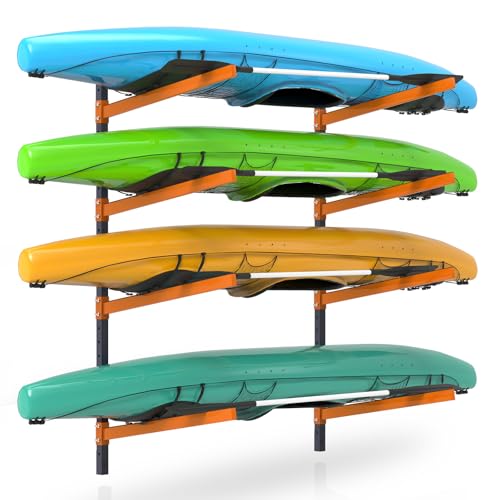 UOKRR 4-Tier Wall Mount Kayak Storage Rack
|
8.9/10 | Buy |
 GoSports 2-Kayak Ceiling Mount Rack
|
8.6/10 | Buy | |
| Best Value |
 RAD Sportz Kayak Hoist 2-Pack Garage Ceiling
|
8.1/10 | Buy |
| Best Budget |
 RAD Sportz Surfboard & Kayak Wall Mount Rack
|
8.0/10 | Buy |
WALMANN Wall Mount Kayak Hooks (4-Pack)
This four-piece steel hook set frees up garage floor space by securing up to two lightweight kayaks or boards against the wall. Equipped with protective padding and mounting hardware, it offers a practical storage solution for recreational gear weighing under 50 pounds.
Pros
- Protective padding prevents scratches on equipment
- Solid powder-coated steel construction
- Versatile design accommodates kayaks, boards, and ladders
- Includes hardware for wood stud and masonry mounting
Cons
- 50-pound weight capacity limits heavier kayaks
- Included wall anchors only work in brick or concrete
UOKRR 4-Tier Wall Mount Kayak Storage Rack
The UOKRR 4-Tier Wall Mount Kayak Storage Rack is an industrial steel organizer engineered to hold up to four watercraft with a robust 150-pound rating per level. Featuring weatherproof felt-padded arms and adjustable vertical spacing, it is an ideal storage upgrade for multi-boat paddlers looking to protect their hulls in a garage, shed, or dock.
Pros
- Sturdy 150-pound per level capacity reliably supports heavy rotomolded fishing kayaks and tandem hulls
- Weatherproof felt-covered arms prevent surface gouges and reduce contact friction on watercraft finishes
- Multiple rail adjustment points allow custom spacing to fit varying hull depths and gear cowlings
- Powder-coated steel build makes it versatile for indoor garage organization or outdoor dockside mounting
Cons
- Requires a 12mm drill bit for wall installation that is not included in the package
- Requires secure anchoring directly into wall studs or solid masonry to support multi-boat load weight safely
- Lifting heavier 70-to-80-pound fishing kayaks onto the top tier can be challenging for solo paddlers
GoSports 2-Kayak Ceiling Mount Rack
Designed to reclaim garage floor space, this dual-sided overhead hanger suspends up to two watercraft with a combined 200-pound weight capacity. Its rotatable brackets and adjustable drop clearance offer adaptable mounting across varied ceiling joist configurations.
Pros
- Substantial 200-pound total weight capacity
- Rotating brackets fit perpendicular or parallel joists
- Adjustable drop clearance accommodates thicker watercraft
- Protective foam sleeves shield gear surfaces
- Heavy-duty steel build minimizes arm deflection
Cons
- Requires lifting heavy kayaks overhead for loading
- Vertical clearance is capped at 19.5 inches
- Wide 30-inch arms may not suit narrower gear
RAD Sportz Kayak Hoist 2-Pack Garage Ceiling
The RAD Sportz Kayak Hoist 2-Pack provides a reliable garage ceiling storage system with a 125-pound capacity per lift, designed to get kayaks, canoes, and ladders safely off the floor. Featuring an automatic locking rope brake, wide nylon straps, and rubber-coated hooks, it is an ideal storage upgrade for solo paddlers and multi-boat households.
Pros
- Convenient two-pack setup provides ceiling storage for two personal watercraft at an accessible price point
- Self-locking rope brake mechanism stops slippage instantly, making solo loading and unloading manageable
- Protective nylon straps distribute hull weight broadly to reduce the risk of bottom oil-canning during hot summer storage
- Rubber-coated attachment hooks prevent cosmetic scratching on composite, thermoformed, or polyethylene hulls
- Flexible ceiling bracket mounting works with both parallel and perpendicular joist layouts up to 12-foot heights
Cons
- Requires careful measurement and secure anchoring into structural ceiling joists with basic workshop tools
- The 125-pound maximum rating will not support oversized, fully rigged pedal fishing kayaks or heavy motorized rigs
- Ceiling joist spacing in some garages may require mounting a secondary wooden backing board for proper strap alignment
RAD Sportz Surfboard & Kayak Wall Mount Rack
The RAD Sportz wall mount rack features heavy-duty powder-coated steel J-hooks with protective foam padding to keep surfboards, paddleboards, and kayaks safely off the ground. With a 100-pound load capacity per pair, it offers a practical, space-saving storage solution for surfers looking to prevent floor dings and garage clutter.
Pros
- Durable powder-coated steel frame delivers a solid 100-pound weight capacity per pair
- Protective foam padding cushions surfboard rails against direct contact and scratches
- Elevates boards off damp concrete floors to save vital garage space and prevent dings
- Includes mounting hardware and an instruction manual for simple stud installation
Cons
- Must be anchored directly into solid wall studs to safely support heavier watercraft
- Single pair stores only one large board or kayak at a time
- Supplied hardware may need upgrading for specialized masonry or metal stud walls
Planning and Constructing an Effective Kayak Storage System
Building a durable kayak storage system requires balancing hull protection with efficient space management. When learning how to make a kayak storage rack, the primary goal is supporting watercraft along their strongest structural points while keeping floor space clear. Whether constructing a custom wooden frame or installing heavy-duty steel brackets, proper alignment ensures the boat retains its factory shape. Assessing your garage layout and boat dimensions early prevents costly structural damage to both your gear and your walls.
Understanding Hull Mechanics and Weight Distribution to Prevent Oil-Canning
Polyethylene plastics behave like a slow-moving solid that yields under sustained heat and pressure over time. Resting a rotomolded hull on narrow, unpadded contact points causes the plastic to sag into permanent indentations. This deformation, known as oil-canning, ruins hydrodynamic efficiency and causes sluggish tracking on open water. Distributing boat weight across wide, padded supports prevents localized stress concentrations that lead to bottom warping.
Kayak hulls display their greatest structural rigidity along curved gunwales and near internal bulkheads. Placing support arms roughly one-third of the boat length inward from the bow and stern matches these natural load-bearing zones. Storing boats on their sides or on edge against padded uprights often preserves bottom contours better than resting them flat. Solid planning during rack construction ensures your boat maintains its factory rocker profile season after season.
Selecting the Right Storage Architecture for Your Space
Paddlers generally choose between wall-mounted racks, freestanding storage towers, and overhead ceiling systems. Freestanding wooden racks work well in spacious garages or covered sheds where wall space is obstructed by shelving. These units hold multiple boats on staggered tiers without requiring anchors into structural wall studs. But freestanding racks occupy a permanent floor footprint, which can challenge owners of compact single-car garages.
Wall-mounted brackets lift watercraft completely off the floor while maintaining easy loading access. Commercial wall hooks like the WALMANN Lightweight Kayak Storage Rack or steel J-hooks from RAD Sportz attach directly to framing studs to support hulls horizontally. If you own multiple crafts, vertical track systems like the UOKRR 4 Kayak Storage Rack provide adjustable arm spacing for varied hull depths. Wall mounts also allow you to park vehicles underneath the lowest hull when ceiling height allows.
Ceiling suspension systems utilize vertical space that otherwise sits vacant above garage doors or parked vehicles. Overhead frames like the GoSports Kayak Rack for Garage Ceiling Mount hold boats close to ceiling joists with rigid steel arms. Pulley hoists like the RAD Sportz Kayak Hoist 2-Pack Quality Garage allow a single paddler to raise heavy watercraft using mechanical advantage and automatic locking brakes. Overhead storage works best for long-term holding where daily access is not an immediate priority.
Sourcing Materials and Hardware for a Custom DIY Wooden Rack
Standard two-by-four dimensional lumber forms the backbone of most homemade kayak storage towers. Selecting straight, kiln-dried pine or fir prevents warping and joint loosening as ambient garage humidity fluctuates. For outdoor or open-shed installations, pressure-treated lumber offers essential resistance against rot, fungal decay, and boring insects. Pairing quality lumber with three-inch exterior-grade wood screws provides the shear strength required to support heavy watercraft.
Connecting joints securely requires galvanized steel gussets or half-inch exterior plywood corner braces. Butt joints secured only by end-grain screws will loosen under the rotational torque applied by cantilevered rack arms. Using heavy-duty carriage bolts at major pivot points ensures the frame bears cumulative boat weight without sagging. Rust-resistant hardware also prevents structural failures caused by dripping lake water after paddling trips.
Protective cushioning completes the contact surfaces where lumber meets the plastic or composite hull. Closed-cell polyethylene foam, dense pipe insulation, or marine carpeting wrapped tightly around support arms cushions the boat against friction scratches. Avoid open-cell sponge rubber because it absorbs moisture, holds grit against the hull, and breaks down quickly under friction. Securing foam padding with heavy-duty zip ties or industrial staples creates a clean, durable resting surface.
Step-by-Step Framing and Assembly for a Freestanding Storage Tower
Begin construction by building a wide rectangular base to establish a low center of gravity. A base measuring four feet wide by four to five feet long provides adequate resistance against tipping when fully loaded. Assemble the perimeter frame using two-by-four lumber on edge, securing the corners with structural wood screws and interior corner blocks. Adding cross-members across the base prevents racking when shifting boats during loading.
Erect two vertical upright posts centered on the side rails of the base frame. Secure each vertical post with diagonal two-by-four knee braces extending from the base rails at a forty-five-degree angle. These angled braces eliminate lateral sway, which is the most common structural failure point in tall freestanding towers. Verify that both upright posts remain plumb using a carpenter level before tightening the fasteners.
Attach cantilevered horizontal support arms to the vertical uprights at heights matching your kayak collection. Space the tiers at least twenty-four inches apart to allow sufficient clearance for tall seat frames, gear tracks, and rod holders. Angle the support arms slightly upward, roughly five to ten degrees above horizontal, so boats slide naturally toward the central post. Fasten each arm using through-bolts backed with wide fender washers to distribute clamping forces evenly.
Complete the frame by adding horizontal top stretchers between the two vertical posts to tie the assembly together. Sand down rough edges and sharp lumber corners to prevent accidental gouging during rushed post-paddle unloading. Wrap each cantilever arm with closed-cell padding, ensuring the material extends past the outer tips. Test the structural integrity of the completed frame with moderate hand pressure before loading your actual watercraft.
Wall-Mounted Racks and Stud-Anchoring Techniques
Mounting rack arms directly to garage walls requires positive engagement with internal structural framing studs. Drywall anchors or hollow-wall toggle bolts must never be used alone to support a watercraft, as static loads will tear out the wallboard. Use a reliable electronic stud finder to locate the center of each wooden or metal wall stud. Standard residential studs sit on sixteen-inch or twenty-four-inch centers, allowing spacing that matches your boat length.
For optimal load distribution, install a horizontal two-by-six backing board across three or four wall studs using heavy lag screws. This wooden ledger board provides a solid anchoring substrate and eliminates the restriction of mounting hardware strictly to fixed stud locations. Commercial systems like the Kayak Storage Rack – Kayak Wall Mount Hangers can then be bolted directly into the ledger board. Pre-drilling pilot holes prevents splitting structural studs while driving lag bolts firmly into the framing.
Position the wall brackets high enough to keep floor areas clear for lawn equipment or vehicle parking. When storing longer single sit-in kayaks, space the wall cradles roughly five to seven feet apart to prevent excessive overhang. Ensure both brackets sit level with each other using a long spirit level or laser line. Tilting the boat slightly so the cockpit faces outward prevents dust accumulation and allows internal moisture to evaporate naturally.
Overhead Ceiling Suspension and Pulley Lift Configurations
Ceiling-mounted storage takes advantage of overhead clearance but demands strict attention to structural joist alignment. Ceiling joists generally support drywall and ceiling loads, so mounting heavy gear requires distributing weight across multiple framing members. Fasten a two-by-four or two-by-six mounting plate across the ceiling framing perpendicular to the joist direction. This distributes downward pull across several rafters and provides secure attachment points for ceiling brackets or pulley hooks.
Rigid ceiling hangers like the GoSports ceiling rack provide stable, fixed-elevation overhead storage for two kayaks up to two hundred pounds. These units feature telescoping arms that adjust from twelve and a half inches up to nineteen and a half inches of ceiling clearance. Rotating mounting plates allow joist alignment regardless of framing orientation in the ceiling. Foam-coated arms protect upper hulls, while pin-locking pins maintain chosen drop heights without slippage.
Pulley hoists provide an effortless lifting alternative for solo paddlers who cannot lift heavy plastic boats above shoulder level. Systems like the RAD Sportz hoist utilize durable rope, coated hooks, and an integrated rope brake to lock lines automatically during lifting. Fasten the rope cleats securely to a nearby wall stud to tie off excess rope after hoisting the craft to ceiling height. Always double-check strap security around the hull perimeter before stepping under a suspended kayak.
Padding, Strap Placement, and Hull Contact Points
Proper padding prevents pressure indentations and preserves exterior hull finishes during months of static storage. Bare wood or painted steel creates high-friction spots that can scuff thermoformed ABS sheets or rub decals off composite hulls. High-density EVA foam or marine carpet wrapped around rack arms distributes the contact footprint over several square inches. Secure the protective padding with weather-resistant zip ties or stainless steel staples that will not rust in damp garage air.
Strap placement along the hull requires careful balance between stability and material tension. Webbing straps used on wall mounts or ceiling hoists should cradle the boat without applying crushing force to the plastic deck. Never use ratcheting cargo straps to crank a kayak down tightly onto a storage rack, as excessive mechanical force easily collapses internal bulkheads and deforms cockpit coamings. Wide two-inch polyester cam buckle straps provide secure holding without generating destructive clamping forces.
Avoid supporting watercraft by inserting rigid hooks or dowels directly into the scupper holes of sit-on-top hulls. Scupper tubes feature thin plastic walls designed solely for gravity water drainage, not for supporting the static weight of the boat. Concentrated stress on scupper seams frequently causes hairline cracks that lead to internal hull flooding on the water. Always support boats from the exterior hull contours using wide arms, padded cradles, or flexible belly slings.
Storage Strategies for Heavy Fishing Rigs and Specialized Craft
Modern angling paddlecraft frequently weigh between seventy and over one hundred pounds once fully outfitted with rails, rod holders, and seating frames. Fully rigged pedal kayaks with trolling motors represent substantial static loads that challenge lightweight storage racks. Before hoisting or racking a motorized fishing craft, remove detachable gear such as deep-cycle lithium batteries, fish finders, and motor brackets. Stripping the boat down to its bare hull weight reduces structural stress on wall studs, ceiling joists, and rack arms.
Wide fishing platforms with catamaran or pontoon hulls require wider support arm spacing than narrow touring kayaks. Narrow arms concentrate boat weight directly onto the thin central deck trough instead of the rigid outer sponsons. Adjusting rack arm spread to support the dual pontoons keeps the hull stable and prevents bottom sag. If using multi-tier wall racks like the UOKRR system, place the heaviest fishing boat on the lowest tier to lower the center of gravity.
Pedal drive units and integrated rudders require special storage attention to prevent mechanical damage. Always remove drive units, rudder blades, and steering cables before racking the craft on wall arms or ceiling cradles. Storing delicate pedal drives on nearby garage shelving prevents bent prop shafts, damaged oscillating fins, and tangled deployment cords. Keeping drive components clean, lubricated, and stored in a dry space extends the service life of steering components.
Off-Season Protection, Climate Control, and Pre-Season Verification
Garage and shed environments experience severe temperature fluctuations between hot summer afternoons and freezing winter nights. Direct sunlight streaming through garage windows can heat localized hull sections past the softening point of polyethylene, leading to severe sagging under strap tension. Cover racked boats with breathable canvas dust sheets or UV-resistant tarps, keeping covers loose to promote air circulation. Good ventilation prevents condensation buildup inside the cockpit that encourages mold, mildew, and corrosion on metal hardware.
Winter storage demands extra caution against plastic embrittlement caused by freezing temperatures. Polyethylene becomes significantly more brittle in sub-freezing weather, making hulls vulnerable to cracking if struck by heavy garage tools or dropped during handling. Avoid stacking heavy ladders, camping gear, or storage bins on top of stored kayaks during winter months. Keeping hulls unencumbered preserves deck contours and prevents seam separation around hatches and bulkheads.
Conduct a comprehensive safety inspection of your storage system and watercraft before launching each spring. Inspect all wooden joints, lag bolts, and ceiling pulley ropes for signs of loosening, wood rot, or mechanical fraying. Examine the kayak hull carefully for any subtle signs of bottom deformation, cracking near scupper seams, or hatch gasket deterioration. Addressing minor rack adjustments or hull issues during storage ensures your gear remains seaworthy, reliable, and ready for calm waters.
Investing time into learning how to make a kayak storage rack protects your watercraft investment and keeps gear ready for spontaneous paddling trips. A sturdy system built to match your boat weight and garage layout eliminates clutter while preserving the structural integrity of your hull. Whether you select a custom wooden frame, wall-mounted steel hooks, or an overhead pulley lift, proper weight distribution ensures countless seasons of dependable performance on the water.
About the author
Brooke Hess is an accomplished whitewater kayaker and outdoor writer with years of experience paddling rivers around the world. He has competed internationally in freestyle kayaking and extreme races and has represented the United States in competitive kayaking. His deep understanding of river conditions and paddling performance gives her valuable insight into technical kayaking gear.