
How to Attach a Kayak to Roof Bars: Practical Guide for 2026
Learn how to attach a kayak to roof bars safely with proper strap routing, J-cradle positioning, and bow tie-downs updated for October 2026.
 By Brooke Hess
Updated October 5, 2026
By Brooke Hess
Updated October 5, 2026

Hoisting a watercraft onto a vehicle roof can feel intimidating, especially when you face highway crosswinds or long trips to the boat ramp. Learning how to attach a kayak to roof bars properly prevents costly hull slippage, protects your vehicle sheet metal from gouges, and eliminates wind lift during highway transit. Whether you use factory crossbars or specialized heavy-duty kayak roof racks, the anchoring mechanics require steady contact points and dependable strap tension. A sloppy car-topping setup creates dangerous aerodynamic drag and risks permanent hull distortion if pressure points pinch the plastic improperly.
Reliable transport begins with inspecting your crossbar spread, fitting quality padding, and securing the boat with non-stretch marine tie-downs. Many paddlers mistakenly rely on hardware-store ratchets that crush hollow rotomolded polyethylene shells, leading to severe bottom oil-canning and compromised tracking. Understanding the exact routing through J-cradles, saddle mounts, and vehicle recovery hooks guarantees peace of mind from your driveway to the shoreline. Taking several minutes to double-check each anchor connection ensures that both your boat and vehicle arrive ready for a smooth day of paddling.
| Award | Product | WSG Score About WSG ScoreThe WSG Score is our own rating from 0 to 10, based on performance, design and build, ease of use, and value. It reflects independent research and is never influenced by manufacturers, retailers, or affiliate commissions. Learn more › | |
|---|---|---|---|
| Best Overall |
Forluck J-Bar Kayak Roof Carrier (2 Pairs)
|
8.9/10 | Buy |
| Best Premium |
 FORWODE 2-Pair Folding J-Bar Kayak Rack
|
8.4/10 | Buy |
| Best Budget |
 Forluck J-Bar Kayak Roof Rack (150 lbs)
|
8.3/10 | Buy |
 PIRIPARA J-Bar Kayak Roof Rack 2-Pair Set
|
8.1/10 | Buy | |
 YUANSHI 2-Pair J-Bar Kayak Roof Rack
|
8.1/10 | Buy | |
| Best Value |
 GZDEMYYXGS Folding Kayak Roof Rack J-Bar
|
8.1/10 | Buy |
 Mrhardware Heavy-Duty J-Bar Kayak Roof Rack
|
8.0/10 | Buy | |
 Leader Accessories Folding Kayak J-Bar Rack
|
8.0/10 | Buy |
Forluck J-Bar Kayak Roof Carrier (2 Pairs)
Built for transporting up to two kayaks, this alloy steel J-bar carrier mounts to standard crossbars with a 150-pound capacity per pair. Protective EVA foam and rubber bases safeguard boat hulls, while quick-release nuts allow tool-free installation.
Pros
- High 150-pound load capacity per pair
- Tool-free installation requires no extra equipment
- EVA padding protects watercraft from scratches
- Powder-coated steel resists rust and weather
Cons
- Compatible only with square and oval crossbars
- Conflicting listing details regarding included bar quantity
FORWODE 2-Pair Folding J-Bar Kayak Rack
Built with heavy carbon steel tubing, this dual J-bar carrier transports two watercraft while folding flat when not in use. It comes fully equipped with tie-down straps, protective foam padding, and dedicated paddle mounts for paddlers needing extra roof storage.
Pros
- Carbon steel frame supports up to 160 pounds
- Folds flat to clear low overhead spaces
- Comprehensive strap kit included for secure mounting
- Integrated paddle holders save cargo space inside vehicle
- Thick foam padding protects watercraft hulls from scratches
Cons
- Relatively heavy assembly at over 28 pounds
- Total 160-pound limit may exclude heavier tandem kayaks
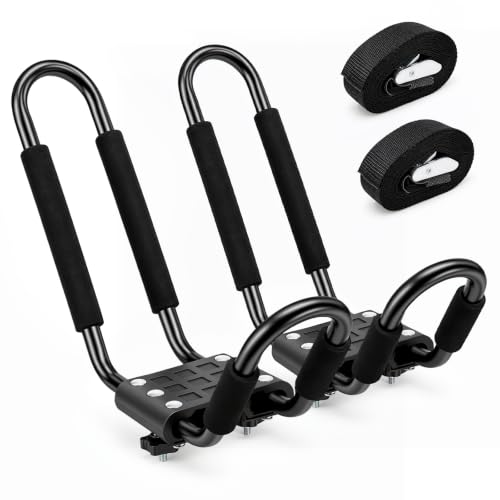
Forluck J-Bar Kayak Roof Rack (150 lbs)
Built from powder-coated alloy steel, this J-bar carrier securely transports a single kayak up to 150 pounds across square or oval crossbars. Quick-release hardware and protective EVA foam padding make it a practical, tool-free solution for solo paddlers.
Pros
- Sturdy 150-pound capacity supports heavier watercraft
- Tool-free setup with quick-release mounting nuts
- Protective EVA padding prevents scratches and dents
- Corrosion-resistant powder-coated steel tubing
- Wide-mouth opening simplifies loading and unloading
Cons
- Fixed frame does not fold flat when unloaded
- Single-pair setup carries only one kayak
- Not compatible with round roof crossbars
PIRIPARA J-Bar Kayak Roof Rack 2-Pair Set
The PIRIPARA J-Bar Kayak Roof Rack set provides two pairs of alloy steel carriers designed to haul two kayaks with a combined capacity of up to 150 pounds. It offers a practical vehicle transport solution for paddlers looking to maximize rooftop space on square, oval, or flat crossbars.
Pros
- Transports two full-sized kayaks with four total J-bar uprights included in a single package
- Wide-mouth cradle opening makes side-loading kayaks onto high vehicle roofs significantly easier
- Adjustable padding helps safeguard plastic, composite, and thermoformed hulls from frame abrasion
- Versatile bracket design mounts securely onto flat, square, and oval crossbar shapes
- Includes four 8-foot tie-down straps and mounting bolts for immediate out-of-the-box installation
Cons
- Mounting brackets are strictly incompatible with round crossbar systems
- Total 150-pound limit requires careful weight budgeting if hauling two heavy rotomolded fishing kayaks
- Included 8-foot tie-down straps may prove short for extra-wide beam hulls or tall SUVs, and bow/stern safety lines are not included
YUANSHI 2-Pair J-Bar Kayak Roof Rack
Constructed from alloy steel with a 150-pound capacity, this four-piece carrier set transports two kayaks simultaneously using padded wide-mouth cradles. It secures to most flat, oval, and square crossbars for reliable recreational gear hauling.
Pros
- Transports two watercraft at once
- Sturdy steel build with rust-resistant finish
- Includes tie-down straps and mounting accessories
- Adjustable padding helps safeguard kayak hulls
Cons
- Fixed J-frame design cannot fold down flat
- Not compatible with round crossbars
- Requires at least three inches of roof clearance
GZDEMYYXGS Folding Kayak Roof Rack J-Bar
This folding J-bar roof rack provides an adjustable, multi-angle carrier system rated for up to 100 pounds, making it easier for paddlers to transport kayaks or paddleboards securely on vehicle crossbars. Featuring quick-fold garage clearance and complete bow-and-stern anchor straps, it is a practical transit accessory for lake and river boaters car-topping their own gear.
Pros
- Folds flat quickly to clear standard residential garage door openings and commercial parking decks without requiring complete disassembly
- Complete out-of-the-box rigging system includes essential bow and stern hood/trunk anchor loops and ratchet tie-downs
- Generous rubber base padding and thick foam liners cushion kayak hulls against road vibration and localized pressure marks
- Extra-large adjustment knobs allow quick angle repositioning without requiring hand tools at the launch ramp
Cons
- Total carrying capacity is capped at 100 pounds, which strictly limits transporting two full-sized fishing or rotomolded tandem kayaks simultaneously
- Not compatible with circular or round vehicle crossbars due to bracket clamping geometry
- Ratchet straps require careful tensioning to prevent over-tightening and oil-canning or denting rotomolded plastic kayak hulls
Mrhardware Heavy-Duty J-Bar Kayak Roof Rack
This dual-pair heavy-duty steel J-bar roof rack system by Mrhardware securely carries two kayaks up to 36 inches wide and 100 pounds each on factory or aftermarket crossbars. It is an ideal rooftop transport solution for recreational paddlers and families heading out to lakes and rivers with two boats in tow.
Pros
- Includes two full pairs of racks to carry two recreational or fishing kayaks on a single vehicle roof
- Comes equipped with four high-strength 10-foot ratchet tie-down straps rated to a 600-pound break strength
- Wide-mouth J-cradle profile simplifies the physical angle needed to lift and seat kayaks on vehicle crossbars
- Constructed with rust-resistant coated steel tubing and adjustable padding to safeguard boat hulls
Cons
- Not compatible with round crossbars that have a diameter of less than 1.2 inches
- Requires at least 3 inches of clear clearance space between the vehicle roof and crossbar for bolt installation
- Elevated vertical boat orientation increases aerodynamic drag and crosswind sensitivity during highway driving
Leader Accessories Folding Kayak J-Bar Rack
Designed to carry two watercraft simultaneously, this powder-coated steel carrier folds flat to clear low garage openings when not in use. It mounts without tools onto factory square or aerodynamic crossbars, making it practical for recreational paddlers needing multi-boat transport.
Pros
- Folds down flat for standard garage clearance
- Tool-free mounting simplifies attachment
- Thick foam padding protects hulls from scratches
- Durable powder-coated steel construction
- Includes four heavy-duty tie-down straps
Cons
- Not compatible with round crossbars
- Heavy total weight at nearly 24 pounds
- 150-pound limit may exclude heavier tandem kayaks
Complete Guide to Securing a Kayak to Vehicle Crossbars
Securing a boat overhead demands systematic execution, reliable hardware, and an understanding of dynamic highway forces. Wind shear at seventy miles per hour exerts tremendous upward lift and lateral pressure against a kayak hull. Failing to secure the craft properly can strip factory crossbars from their tracks or send a loose hull sliding backward onto following traffic. Mastering the complete tie-down procedure eliminates these catastrophic risks while preserving the structural integrity of your watercraft.
Inspecting Crossbar Specifications and Weight Ratings Before Loading
Before hoisting your kayak onto the vehicle, you must confirm that your crossbars and factory roof rails can support the load. Every vehicle manufacturer publishes a dynamic roof load rating, which accounts for moving g-forces, hard braking, and cornering stresses. Many factory crossbars on small crossovers or passenger cars feature dynamic weight ratings between seventy-five and one hundred fifty pounds. If you intend to carry two tandem boats or heavy fishing craft, the total combined weight of your cradles, accessories, and hulls can quickly approach those manufacturer limits.
Crossbar profile and dimensions also dictate which carrier brackets will clamp securely without slipping. Standard aftermarket setups include square steel bars, round tubular bars, and wing-shaped aerodynamic aluminum extrusions. Universal J-bar carriers, such as those from PIRIPARA and Forluck, feature broad mounting plates designed to wrap around oval, rectangular, and aerodynamic crossbars. Note that certain hardware kits require at least three inches of vertical clearance between the bottom of the crossbar and the vehicle roof sheet metal to avoid scratching the paint. Verifying these dimensional clearances in your driveway prevents frustrating metal-on-paint contact during installation.
Choosing Between Direct Crossbar Mounts and J-Cradle Carriers
Paddlers generally choose between lashing a kayak flat against padded crossbars or utilizing vertical J-cradles. Transporting a boat flat across bare or foam-padded crossbars lowers the vehicle vertical profile and improves wind resistance. However, a wide fishing kayak or recreational hull loaded flat occupies virtually all available crossbar width, eliminating space for a second boat or cargo box. Sit-on-top hulls are usually transported right-side up when cradled in saddles, whereas naked crossbars often require carrying the boat hull-up to distribute pressure across the rigid cockpit gunwales.
J-cradles provide a convenient angled loading platform that conserves valuable roof space. By propping the kayak at an angle, J-bars allow you to transport two boats side by side on a standard vehicle roof. Foldable models, such as those from FORWODE and Leader Accessories, feature adjustable hinges that fold flat when empty. This fold-down capability reduces overhead clearance issues, letting you pull into home garages or low parking structures without dismounting the carriers. Furthermore, integrated thick EVA foam pads and rubber saddles cushion the hull from road vibrations, preventing scuffs and stress cracks.
Lifting Mechanics and Positioning the Kayak Safely on the Roof
Solo car-topping requires deliberate body mechanics to avoid back injuries or accidental drops against vehicle windows. Modern rotomolded polyethylene kayaks frequently weigh between fifty and eighty pounds, making an overhead press awkward and precarious. Park your vehicle on flat, level ground away from overhead branches or low-hanging power lines before initiating the lift. If you are loading alone, resting a thick bath mat or rolling suction loader against the rear hatch allows you to slide the bow upward into position without scratching the tailgate.
Lift with your legs while keeping the kayak close to your chest, then place the bow gently into the front J-cradle or padded crossbar. Walk around to the stern of the boat, lift the rear handle, and push the hull forward until it settles firmly into both cradles. Position the widest section of the beam directly between the front and rear crossbars to balance the fore-and-aft weight distribution. If you are carrying single sit-in recreational kayaks, ensure the cockpit rim faces inward toward the J-bar spine to maintain maximum contact along the reinforced gunwales.
Step-by-Step Cam Strap Threading and Hull Lashing Technique
Once the kayak rests comfortably in its cradles, secure the midsection using two heavy-duty marine cam buckle straps. Avoid throwing the heavy metal buckle over the top of the vehicle, which can easily crack a windshield or chip roof paint. Instead, drape the soft webbing tail over the kayak, leaving the cam buckle resting against the upper hull face. Feed the webbing tail beneath the crossbar on the inside of the mounting bracket, wrap it tightly around the bar, and toss it back over the hull.
Walk to the opposite side of the vehicle and repeat the under-bar loop beneath the outer crossbar section. Feed the bare webbing end upward through the open teeth of the spring-loaded cam buckle from the bottom. Pull the strap tail firmly downward to draw out slack while compressing the carrier foam padding slightly against the hull. Repeat this complete routing sequence on the second crossbar so both the fore and aft sections of the kayak are independently tethered. Tie off any remaining loose webbing tail with half-hitch knots beneath the buckle to prevent the teeth from releasing and to stop high-speed wind flutter.
Rigging Bow and Stern Safety Lines for Highway Speeds
Midsection crossbar straps hold the kayak down against the rack, but bow and stern tie-downs prevent forward and backward slippage. As your vehicle travels at highway velocities, turbulent air currents generate rotational pitching and lift forces that can stress crossbar mounts. Bow and stern safety lines tether the extreme ends of the kayak directly to rigid vehicle structural points, creating a triangular bracing system. Every responsible car-topper must rig both safety lines, especially during extended road trips or blustery weather.
Locate structural anchor points beneath your vehicle bumpers, such as factory tow eyes or recovery hooks integrated into the frame. Never attach tie-down hooks to plastic bumper covers, flimsy splash guards, or steering linkages, as dynamic tension will tear them loose. If your vehicle lacks accessible lower chassis loops, install under-hood anchor straps that bolt directly into the vehicle fender channels. Attach non-stretch polypropylene rope or S-hook ratchet lines from the kayak bow carry handle to the hood anchor points, pulling snug until taut without pulling the boat off trim.
Critical Strap Mistakes: Why Ratchet Straps Cause Permanent Hull Damage
One of the most destructive mistakes a paddler can make is using industrial mechanical ratchet straps on plastic kayaks. Ratchet mechanisms generate hundreds of pounds of mechanical leverage with minimal user effort. When tightened aggressively, a steel ratchet exerts immense crushing forces across the hollow polyethylene hull. This excessive compressive force permanently deforms the plastic, resulting in deep dents and bottom-hull oil-canning that completely ruins the boat water tracking.
Cam buckle straps rely solely on your natural arm pulling strength, creating ample holding power without risking structural crushing. The spring-loaded cam teeth grab the woven webbing securely without multiplying clamping force mechanically. High-quality straps typically feature break strengths between five hundred and six hundred pounds, which is more than enough to resist highway wind shearing. If you need to transport specialized craft like heavy-duty inflatable kayaks that are fully inflated, cam straps protect internal air chambers from dangerous pinch points. Always select one-inch wide polyester or nylon webbing that resists UV degradation and water absorption.
Accommodating Different Kayak Hull Profiles and Dual-Boat Setups
Different kayak hull architectures demand slight modifications to your rooftop tie-down strategy. Traditional rounded or V-shaped touring hulls seat naturally into curved J-bars, matching the contour of the padded steel arms. Wide pontoon-style fishing kayaks and flat-bottom recreation hulls, however, have squared gunwales that can sit awkwardly in narrow cradles. When loading a wide fishing craft, adjust the arm angle on folding J-racks to create a wider saddle opening that captures the chine securely.
Transporting two kayaks on one vehicle requires careful space management and mirrored strap routing. Mount your J-cradles as close to the crossbar feet as possible to preserve an open center corridor across the roof. Load the heavier boat first so you have complete access to the interior crossbar space when threading straps. Run separate, dedicated tie-down straps for each kayak rather than attempting to loop one continuous strap across both hulls. If one strap experiences wear or loosens slightly, independent tethering guarantees the other watercraft remains fully anchored to the vehicle.
Pre-Drive Verification and Routine Highway Tension Checks
Rigging your kayak is only complete after you conduct a hands-on physical shake test. Grab the kayak stern firmly with both hands and attempt to rock the boat side to side and fore to aft. The kayak and the vehicle should move together as a single unified mass with zero slippage inside the cradles. If the hull wiggles, slides, or pivots independently of the crossbars, unclamp the straps and re-tighten the cam buckles immediately.
Thermal changes and road vibration naturally cause straps and plastic hulls to relax slightly during transit. Sun exposure softens rotomolded polyethylene, while road dampness can cause certain woven nylon straps to stretch. Make it a strict habit to pull over in a safe parking area after the first ten to fifteen miles of driving. Walk around the vehicle, test the strap tension by plucking the webbing like a guitar string, and cinch down any fresh slack. Repeating this quick inspection at every fuel stop or rest area ensures total peace of mind for the duration of your trip.
Taking the time to practice your loading and lashing technique in your driveway turns a nerve-wracking chore into a seamless routine. Using quality cam straps, verifying roof bar weight ratings, and securing bow and stern lines protects your equipment and everyone sharing the road. Once your boat is rock-solid on the roof, you can drive with complete confidence and focus entirely on enjoying your time out on the water.
About the author
Brooke Hess is an accomplished whitewater kayaker and outdoor writer with years of experience paddling rivers around the world. He has competed internationally in freestyle kayaking and extreme races and has represented the United States in competitive kayaking. His deep understanding of river conditions and paddling performance gives her valuable insight into technical kayaking gear.