
Can I Tie Kayak Directly to Roof Rack: Practical Guide for 2026
Can I Tie Kayak Directly To Roof Rack? Learn proper strap routing, hull protection, and highway tie-down rules for safe paddling transport in October 2026.
 By Marius Fox
Updated October 5, 2026
By Marius Fox
Updated October 5, 2026

Securing a 50-to-80-pound rotomolded or thermoformed hull onto a vehicle roof is one of the most critical pre-trip tasks for any paddler. Many beginners wonder, can i tie kayak directly to roof rack crossbars without buying expensive specialized cradles or carrier attachments? The short answer is yes, you can mount a kayak directly to existing factory or aftermarket crossbars, provided you use the correct hull orientation and non-stretch cam webbing straps. However, placing a bare plastic boat directly against bare vehicle sheet metal or rigid crossbars without proper padding creates distinct risks of hull deformation, slippage, and cosmetic gouging during highway travel. Exploring dedicated heavy-duty kayak rack options can often simplify the process, but direct crossbar attachment remains a reliable fallback when managed with correct mechanics.
Direct car-topping demands careful attention to weight distribution, bar spread, and dynamic highway wind shear. Tying off improperly can permanently warp a polyethylene hull or allow the boat to slide forward during sudden braking. Understanding the difference between gentle cam buckle tension and dangerous ratchet strap compression is vital for preserving the structural integrity of your watercraft. Furthermore, securing additional bow and stern safety lines ensures highway stability, keeping your paddlecraft firmly anchored across long journeys. With the right technique, you can safely haul your boat to the water without causing structural damage to your vehicle or kayak.
| Award | Product | WSG Score About WSG ScoreThe WSG Score is our own rating from 0 to 10, based on performance, design and build, ease of use, and value. It reflects independent research and is never influenced by manufacturers, retailers, or affiliate commissions. Learn more › | |
|---|---|---|---|
| Best Overall |
Abahub 32-Inch Soft Roof Rack Pads and Tie-Down
|
8.9/10 | Buy |
| Best Budget |
 Taelakeni J-Bar Kayak Roof Rack (2 Pairs)
|
8.6/10 | Buy |
| Best Premium |
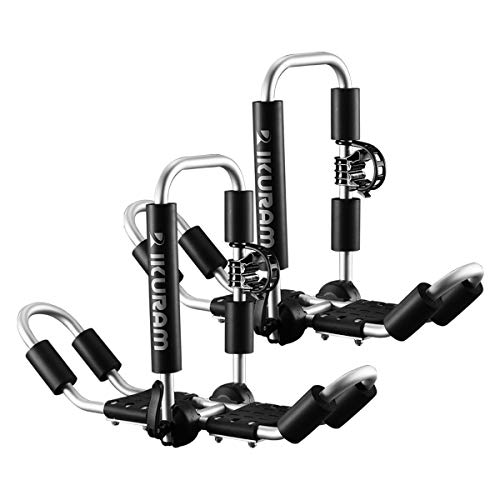 IKURAM R Folding J-Style Kayak Roof Rack
|
8.6/10 | Buy |
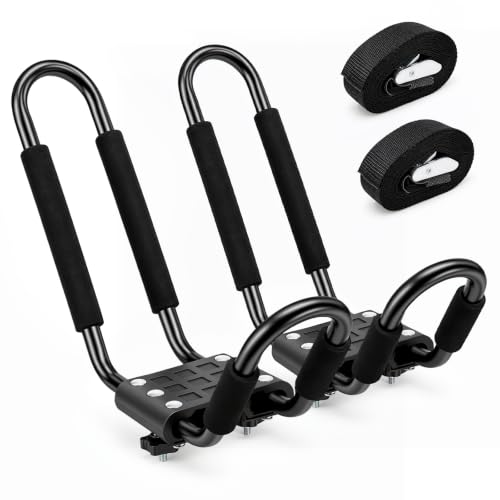 Forluck J-Bar Kayak Roof Rack (150 lbs)
|
8.3/10 | Buy | |
| Best Value |
 PIRIPARA J-Bar Kayak Roof Rack 2-Pair Set
|
8.1/10 | Buy |
 Ho Stevie! Surfboard Tie Down Straps Pair
|
8.0/10 | Buy | |
 Mrhardware Heavy-Duty J-Bar Kayak Roof Rack
|
8.0/10 | Buy | |
 Onefeng Sports 135-lb Kayak Saddle
|
7.8/10 | Buy |
Abahub 32-Inch Soft Roof Rack Pads and Tie-Down
The Abahub 32-Inch Soft Roof Rack system provides a dependable, portable transport solution for carrying surfboards, longboards, and foamies on cars without factory crossbars. Featuring dense EVA foam padding and durable 1680D fabric with neoprene buckle sleeves, it protects both your car roof and board rails on coastal surf trips.
Pros
- Universal compatibility fits almost any 2-door or 4-door vehicle without requiring permanent roof rails or crossbars
- Comprehensive tie-down package with multiple 13-foot and 16-foot straps plus neoprene buckle guards
- Thick EVA foam core and rugged 1680D outer fabric shield vehicle paint and surfboard hulls from pressure dings
- Quick setup and breakdown make it easy to stow in the trunk between coastal surf sessions
Cons
- Pass-through cabin straps can wick rainwater into the car interior during wet coastal storms
- High-speed highway driving may generate strap vibration hum without twisting the webbing during installation
- Soft foam pad design requires manual tensioning and routine strap checks before high-speed freeway travel
Taelakeni J-Bar Kayak Roof Rack (2 Pairs)
Designed for flat and square crossbars, this dual-pair J-bar carrier provides a space-saving solution to haul watercraft on your vehicle roof. Its steel construction with protective sponge padding holds gear upright without occupying the entire load bar.
Pros
- Space-saving side-loading J-bar profile
- Corrosion-resistant steel with baked finish
- Protective sponge pads prevent gear scratches
- Quick installation via bottom flange threads
- Accommodates up to two watercraft
Cons
- Incompatible with round crossbars
- Restricted to flat or square crossbars
- 150-pound maximum load capacity
IKURAM R Folding J-Style Kayak Roof Rack
Built with rust-resistant anodized aluminum, this folding carrier transports kayaks and paddleboards while collapsing flat to minimize overhead drag. Thick rubber padding prevents equipment scuffs, and built-in paddle holders keep gear organized on standard crossbars.
Pros
- Durable, rust-resistant anodized aluminum frame
- Folds flat to lower wind drag
- Thick rubber padding guards against hull damage
- Includes two dedicated paddle holders
- Simple mounting on standard vehicle crossbars
Cons
- Relatively heavy at over 21 pounds
- Requires an existing crossbar system for installation
Forluck J-Bar Kayak Roof Rack (150 lbs)
Built from powder-coated alloy steel, this J-bar carrier securely transports a single kayak up to 150 pounds across square or oval crossbars. Quick-release hardware and protective EVA foam padding make it a practical, tool-free solution for solo paddlers.
Pros
- Sturdy 150-pound capacity supports heavier watercraft
- Tool-free setup with quick-release mounting nuts
- Protective EVA padding prevents scratches and dents
- Corrosion-resistant powder-coated steel tubing
- Wide-mouth opening simplifies loading and unloading
Cons
- Fixed frame does not fold flat when unloaded
- Single-pair setup carries only one kayak
- Not compatible with round roof crossbars
PIRIPARA J-Bar Kayak Roof Rack 2-Pair Set
The PIRIPARA J-Bar Kayak Roof Rack set provides two pairs of alloy steel carriers designed to haul two kayaks with a combined capacity of up to 150 pounds. It offers a practical vehicle transport solution for paddlers looking to maximize rooftop space on square, oval, or flat crossbars.
Pros
- Transports two full-sized kayaks with four total J-bar uprights included in a single package
- Wide-mouth cradle opening makes side-loading kayaks onto high vehicle roofs significantly easier
- Adjustable padding helps safeguard plastic, composite, and thermoformed hulls from frame abrasion
- Versatile bracket design mounts securely onto flat, square, and oval crossbar shapes
- Includes four 8-foot tie-down straps and mounting bolts for immediate out-of-the-box installation
Cons
- Mounting brackets are strictly incompatible with round crossbar systems
- Total 150-pound limit requires careful weight budgeting if hauling two heavy rotomolded fishing kayaks
- Included 8-foot tie-down straps may prove short for extra-wide beam hulls or tall SUVs, and bow/stern safety lines are not included
Ho Stevie! Surfboard Tie Down Straps Pair
These 15-foot heavy-duty tie-down straps from Ho Stevie! secure surfboards or paddleboards to vehicle roof rack crossbars while silicone buckle covers shield boards and car paint from metal scratches. They are a practical transport solution for surfers hauling single boards or stacked quivers to the beach.
Pros
- Thick silicone guards protect surfboard rails, slick bottoms, and vehicle paint from metal buckle impacts
- Long 15-foot webbing easily accommodates multi-board stacks, bulky soft-tops, or wide paddleboards
- Heavy-duty 1.25-inch wide strap construction provides dependable hold on roof crossbars
- Includes a dedicated storage case to prevent straps from tangling in your vehicle cargo area
Cons
- Requires an existing roof rack system with crossbars installed on your vehicle
- Excess strap slack needs to be securely tied off to avoid loud wind flapping on the highway
- 15-foot length may feel excessively long if only hauling a single narrow shortboard
Mrhardware Heavy-Duty J-Bar Kayak Roof Rack
This dual-pair heavy-duty steel J-bar roof rack system by Mrhardware securely carries two kayaks up to 36 inches wide and 100 pounds each on factory or aftermarket crossbars. It is an ideal rooftop transport solution for recreational paddlers and families heading out to lakes and rivers with two boats in tow.
Pros
- Includes two full pairs of racks to carry two recreational or fishing kayaks on a single vehicle roof
- Comes equipped with four high-strength 10-foot ratchet tie-down straps rated to a 600-pound break strength
- Wide-mouth J-cradle profile simplifies the physical angle needed to lift and seat kayaks on vehicle crossbars
- Constructed with rust-resistant coated steel tubing and adjustable padding to safeguard boat hulls
Cons
- Not compatible with round crossbars that have a diameter of less than 1.2 inches
- Requires at least 3 inches of clear clearance space between the vehicle roof and crossbar for bolt installation
- Elevated vertical boat orientation increases aerodynamic drag and crosswind sensitivity during highway driving
Onefeng Sports 135-lb Kayak Saddle
Built with an aluminum frame and stainless hardware, this rooftop cradle secures watercraft weighing up to 135 pounds. Its 0 to 180 degree adjustable brackets and rubber padding make it an adaptable transport option for crossbars up to 4.3 inches wide.
Pros
- Corrosion-resistant aluminum frame with stainless hardware
- 180-degree angle adjustment accommodates various hull shapes
- Padded brackets and strap cam covers prevent scratches
- Fits wide crossbars up to 4.3 inches
Cons
- Carries only one watercraft at a time
- Maximum crossbar thickness limited to 1.8 inches
Direct Roof Rack Kayak Transport: Mechanics, Safety, and Hull Protection
Direct Crossbar Lashing Versus Naked Roof Transport
Directly securing a kayak to an automobile is entirely feasible, but you must first distinguish between bare vehicle crossbars and a completely naked vehicle roof. If your vehicle has factory or aftermarket crossbars installed, you can securely strap a hard-shell boat directly across those load bars. Conversely, you should never place a rigid kayak directly onto bare automotive sheet metal without some form of protective buffer. Unsupported contact against a painted car roof will scuff clear coats, dent thin roof panels, and offer zero friction to stop the craft from sliding sideways during a turn.
When a vehicle lacks crossbars, bare roof transport requires temporary foam cradles or universal soft roof rack pads. Soft pads, such as those made with high-density EVA foam and heavy-duty nylon, spread the watercraft weight evenly across structural door arches rather than unsupported sheet metal. These temporary setups loop straps directly through open vehicle doors and across the cabin ceiling. While a dedicated crossbar system provides superior rigidity, utilizing padded barrier blocks remains the only safe way to car-top without permanent racks.
Hull Orientation: Deck-Down Versus Hull-Down Positioning
Choosing the proper hull orientation when resting a kayak directly across flat crossbars directly influences hull longevity. For most traditional sit-on-top and recreational kayaks, positioning the boat upside down with the deck facing downward is the safest orientation. The gunwales, or the side upper edges of the boat, represent the stiffest structural zones on any rotomolded polyethylene or thermoformed hull. By placing the flat deck against the crossbars, you spread dynamic road shock across these reinforced gunwale perimeters rather than focusing stress along a vulnerable keel.
Transporting a kayak hull-down directly on flat bars introduces significant risks of bottom deformation. Crossbars exert narrow pressure lines against the bottom hull, and highway wind force combined with strap pressure can cause the bottom plastic to cave inward. This condition, commonly known as oil-canning, ruins hydrodynamic tracking efficiency by creating permanent indentations. If you must carry the kayak right-side up without cradles, wrap crossbars in dense foam tubing or purpose-built bar pads to soften concentrated pressure points.
The Mechanical Perils of Ratchet Straps
One of the most frequent mistakes paddlers make when tying boats directly to crossbars is reaching for heavy-duty industrial ratchet straps. Ratchet mechanisms use high mechanical gear advantage that easily generates hundreds of pounds of crushing tension with minimal hand effort. A standard rotomolded polyethylene hull will soften under warm summer ambient temperatures, making it exceptionally susceptible to structural crushing. Overtightened ratchet straps can permanently warp cockpits, crack scupper tubes, and split bulkheads without the user realizing how much pressure is applied.
Marine grade cam buckle straps are the industry standard because they rely entirely on direct human pulling strength. When you pull a cam strap tight, you naturally stop applying tension once the strap becomes snug against the plastic. This built-in physical feedback prevents you from over-compressing the hull material while providing sufficient retention for highway speeds. Quality cam straps feature spring-loaded metal teeth that grip woven polyester webbing securely without slipping, even under sustained road vibration.
Cam Strap Mechanics and Webbing Routing
Proper strap routing around the crossbars ensures the kayak remains immobilized against longitudinal and lateral forces. To begin, place the buckle end of the strap over the boat hull, positioning the metal buckle near the upper gunwale where you can easily reach it. Thread the loose tail of the strap under the crossbar on the near side of the vehicle, looping it around the bar inside the bar mounting foot. Toss the tail over the boat to the opposite side, pass it under the corresponding crossbar section, and bring it back over the top to meet the buckle.
Pressing down on the cam lever opens the toothed cam, allowing you to feed the webbing through the underside of the buckle before cinching it firm. Look for straps equipped with protective silicone or neoprene buckle covers, such as those featured on premium tie-down straps. These rubberized sleeves insulate the metal buckle from direct contact with vehicle paint and fiberglass or plastic boat surfaces. Once tightened, always tie off any excess strap tail around the crossbar to prevent loud, distracting wind flutter while driving.
Bow and Stern Lines for Aerodynamic Stability
Tying a kayak solely across two middle crossbars secures it against vertical bounce and mild lateral drift, but it leaves the bow and stern vulnerable to aerodynamic torque. At highway speeds of sixty miles per hour or greater, air flowing over the hood creates massive upward aerodynamic lift beneath the front bow. Without forward tethering, this upward lift exerts enormous rotational leverage against your vehicle crossbars and factory mounting bolts. Securing bow and stern safety lines transfers these aerodynamic forces directly to the vehicle chassis.
When transporting longer touring crafts or single sit-in kayaks, front and rear tie-downs prevent wind-driven yaw and sudden catastrophic rack detachment. Attach non-stretch rope or light cam lines from the kayak bow toggle directly to the front recovery tow hooks beneath your vehicle bumper. If your automobile lacks exposed metal tow hooks, install under-hood anchor straps that bolt to chassis fender bolts and protrude through hood gaps. Pull bow lines snug enough to eliminate slack, but avoid aggressive downward tension that could bend the boat bow out of alignment.
Crossbar Spread and Dynamic Roof Weight Ratings
Vehicle crossbars must provide sufficient physical separation to stabilize the overall length of your watercraft. The distance between the front and rear crossbars, referred to as the crossbar spread, should measure at least twenty-four inches, with thirty to thirty-six inches representing an ideal configuration. If crossbars are spaced too closely together, the kayak acts like an unstable see-saw in gusting winds, concentrating immense torque on small contact areas. Always consult your vehicle owner manual to determine the exact dynamic roof rack weight rating before loading.
Dynamic roof load ratings specify the maximum allowable cargo weight while the vehicle is actively driving, braking, and cornering. Many factory-installed vehicle crossbars feature dynamic limits between one hundred and one hundred and sixty-five pounds. A heavy rotomolded fishing kayak complete with stadium seating and rigging can easily approach seventy or eighty pounds, consuming half of that capacity. Exceeding dynamic weight limits can cause crossbar flex, bend mounting feet, or loosen roof track rivets over extended rough road travel.
Evaluating J-Cradles, Saddles, and Direct Mounting
While lashing a hull directly to bare crossbars works well for quick local trips, purpose-built carriers offer undeniable logistical benefits. Steel and aluminum J-bar carriers mount directly to crossbars and hold the boat securely on its side. Carrying a kayak on its side consumes minimal crossbar width, allowing paddlers to transport two boats or combine a kayak with a cargo box on a single vehicle roof. Furthermore, side-loading places the strongest hull lines directly into the cradle contour, naturally resisting flex.
Saddle mounts represent another excellent alternative for wide-beam fishing kayaks and recreational watercraft that struggle to balance in narrow J-bars. Padded saddles pivot to match the exact deadrise angle of the kayak bottom, spreading the cargo weight across several square feet of rubberized surface. This broad weight distribution effectively eliminates bottom oil-canning and simplifies solo loading from the rear bumper. For paddlers who find hoisting heavy plastic hulls onto tall SUV roofs too strenuous, transitioning to heavy-duty inflatable kayaks offers an appealing alternative that avoids roof transport entirely.
Deciding whether to buy dedicated kayak carriers or stick with direct crossbar transport depends on your travel frequency, kayak shape, and storage needs. Direct crossbar transport requires zero additional carrier hardware investment, keeps vehicle clearance low for parking garages, and sets up quickly with simple foam bar wraps. However, if you transport multiple watercraft, own an expensive composite hull, or take regular highway journeys across windy bridges, investing in padded saddles or J-cradles provides superior hull protection and long-term security.
Step-by-Step Direct Crossbar Lashing Procedure
Executing a safe direct crossbar tie-down requires methodical preparation before you pull out of your driveway. Begin by wrapping high-density foam pads or split pool noodles around the contact sections of both crossbars to provide friction and cushioning. Lift the kayak onto the vehicle roof with the cockpit facing downward, positioning the balance point directly centered between the two crossbars. Inspect the hull from both ends of the automobile to ensure the craft sits parallel to the vehicle centerline and does not tilt toward the shoulder.
Next, drape your primary cam straps across the hull at both crossbar locations. Route each strap around the bottom of the crossbar on one side, cross it over the top of the kayak hull, loop it around the opposite bar end, and feed it into the cam buckle. Pull the loose webbing end firmly with one hand while holding the buckle steady with the other until the strap sits taut against the gunwales. Tie off all dangling webbing tails around the crossbars using multiple half-hitch knots so loose ends cannot whip against car windows or tangle in vehicle wheels.
Finally, attach your bow and stern lines to complete the three-point transport harness. Hook your front line to the kayak bow handle and secure the bottom end to a sturdy front tow loop or under-hood webbing strap. Repeat this procedure at the rear, connecting the stern handle to a trailer hitch loop or rear tow eyelet. Verify that both safety lines are firm to the touch without pulling down so aggressively that they bend the boat nose downward.
Pre-Trip Shakedown Tests and Highway Transit Habits
Before shifting your vehicle into drive, always perform a physical shakedown check known across the paddling community as the handshake test. Grip the kayak firmly by the cockpit coaming or molded side handle and push vigorously side to side and forward to backward. The kayak and the vehicle should move together as one cohesive unit without any independent sliding or rocking on the crossbars. If you observe any slip between the hull and the bars, loosen the cam buckles, adjust bar padding, and re-tighten the harness.
After traveling your first ten to fifteen miles at highway speeds, pull over in a safe parking area to re-inspect all straps. Highway vibrations, crosswinds, and road bumps often settle the kayak into the foam padding, which can introduce slight slack into previously tight webbing. In wet weather, nylon and polyester straps can absorb ambient moisture and loosen slightly, requiring a quick secondary cinch. Developing this routine mid-trip inspection habit prevents highway shifts and ensures your paddlecraft arrives at the launch site in pristine condition.
Transport Summary and Safe Best Practices
Tying your kayak directly to vehicle crossbars is a safe, economical, and proven transport method when carried out with proper equipment and correct orientation. Always avoid placing bare hulls directly against naked car sheet metal, and completely eliminate dangerous ratchet straps from your paddling gear bin. Utilizing padded crossbars, reliable cam buckle straps, deck-down hull orientation, and redundant bow and stern safety lines will protect your vehicle, preserve your hull geometry, and keep fellow motorists safe on the road.
About the author
Marius Fox brings extensive hands-on experience from both above and below the water. A PADI Master Scuba Diver Trainer and AIDA freediver, she has worked as a scuba instructor, managed diving operations, participated in shark research, and contributed to marine conservation projects. His expertise provides a practical perspective on diving, snorkeling, water safety, and adventure gear.