
Best Heavy Duty Kayak Cart of 2026 for Easy Transport
Transport bulky fishing rigs effortlessly with the best heavy duty kayak cart updated for November 2026. Compare rugged dollies with heavy load capacities.
 By Maggie Nichols
Updated October 2, 2026

Hauling a fully loaded fishing rig or a wide tandem craft across soft sand and jagged gravel often turns a great day on the water into an exhausting chore. Dragging a rotomolded hull wears down the plastic keel, strains your lower back, and risks hull damage before you even launch. Selecting the best heavy duty kayak cart solves this launch hassle by bearing the boat weight over durable wheels and balanced frames. Based on our analysis of hull shapes, maximum load ratings, and frame engineering, having the proper carrier spares your energy for paddling rather than struggling at the boat ramp. Pair your setup with a matching kayak paddle and you are ready for a smooth day on calm lakes or coastal bays.
Modern pedal-drive craft and angling vessels easily exceed one hundred pounds once rigged with livewells, batteries, and crate accessories. Investing in a solid heavy duty kayak cart ensures that massive payload capacities, often upwards of three hundred to four hundred pounds, move effortlessly over uneven turf and parking lot curbs. Manufacturers now incorporate sturdy aluminum tubes, flat-free airless tires, and customizable bunker bars to cradle delicate hulls without causing structural deformation or scupper stress. Evaluating these cart configurations allows solo paddlers and tandem teams to transport heavy gear securely while preserving hull integrity for seasons to come.
| Award | Product | WSG Score About WSG ScoreThe WSG Score is our own rating from 0 to 10, based on performance, design and build, ease of use, and value. It reflects independent research and is never influenced by manufacturers, retailers, or affiliate commissions. Learn more › | |
|---|---|---|---|
| Best Overall |
JOIERW Heavy Duty Kayak Cart with 12-Inch
|
9.2/10 | Buy |
| Best Budget |
 VEVOR Heavy-Duty Kayak Cart with 450 lb Capacity |
9.1/10 | Buy |
| Best Premium |
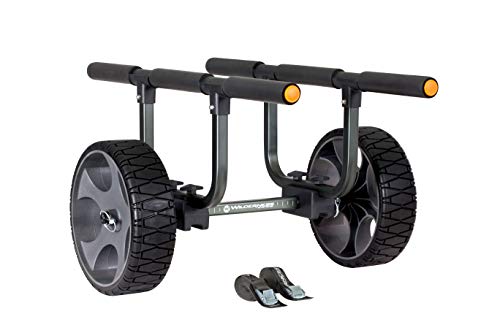 Wilderness Systems Heavy Duty Kayak Cart |
9.1/10 | Buy |
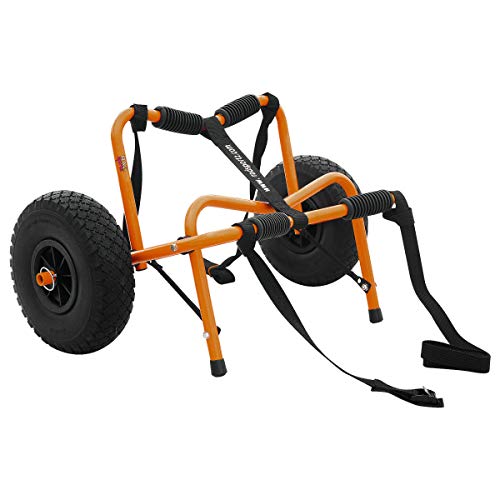 RAD Sportz Kayak Cart Dolly |
7.8/10 | Buy |
JOIERW Heavy Duty Kayak Cart with 12-Inch
Built for hauling heavy fishing rigs, tandems, and canoes, the JOIERW Kayak Cart combines a 300-pound load capacity with puncture-proof 12-inch airless wheels. Its width-adjustable padded bars make solo portage over boat ramps and rough trails simple for recreational paddlers.
Pros
- Substantial 300-pound payload capacity easily supports rigged fishing kayaks and tandem hulls
- Solid 12-inch flat-free tires eliminate flat tire hassles along rocky trails and launch ramps
- Adjustable support bar spacing (2.4 to 14.3 inches) delivers broad hull compatibility
- Corrosion-resistant anodized aircraft aluminum frame withstands repeated wet launch use
Cons
- At 13.68 pounds, it requires dedicated deck tankwell or vehicle trunk space when not in use
- Solid tires roll well on firm ground and ramps but require more pulling effort in deep, dry sand than balloon wheels
- Requires careful strap tensioning to prevent narrow or rounded hulls from shifting during steep descents
VEVOR Heavy-Duty Kayak Cart with 450 lb Capacity
The VEVOR Heavy-Duty Kayak Cart offers a rugged 450-pound load capacity and 12-inch flat-free solid tires, making solo hull portage effortless across gravel, grass, and boat ramps. It is an ideal transport accessory for kayak anglers and recreational paddlers hauling fully loaded fishing craft or heavy canoes.
Pros
- Robust 450 lb load rating easily handles heavy rotomolded plastic fishing hulls and gear-laden canoes.
- 12-inch puncture-proof solid tires eliminate flat tire worries over sharp gravel, thorns, and oyster beds.
- Adjustable 170 mm to 440 mm crossbar spacing allows a secure fit across varied hull widths and keel shapes.
- Single-foot kickstand holds the carrier steady while positioning heavy craft alone.
Cons
- Solid rubber tires pull heavier through extremely soft, loose sugar sand compared to wide low-pressure balloon wheels.
- At roughly 12.1 pounds, carrying the disassembled cart on open water adds noticeable weight to deck rigging.
- The single included tie-down strap requires careful routing and tensioning to prevent hull rotation on steep inclines.
Wilderness Systems Heavy Duty Kayak Cart
Engineered for heavy fishing kayaks and loaded canoes, the Wilderness Systems Heavy Duty Kayak Cart delivers a 450-pound capacity with an adjustable bunker-bar frame. Its flat-free wheels and scupper-free loading make it an ideal transport solution for solo paddlers navigating boat ramps and rough access trails.
Pros
- Impressive 450-pound capacity effortlessly handles heavy rotomolded angler hulls and expedition gear
- Bunker bar design protects delicate scupper holes from transport stress and point-load cracking
- Dual-height adjustment prevents wide or pontoon-style hulls from rubbing against the rolling wheels
- Flat-free tires eliminate punctures, pressure checks, and tire pump maintenance before trips
Cons
- At 13 pounds, the frame adds noticeable weight when lifting it into a vehicle or carrying it to the water
- Solid wheels can dig into deep, powdery coastal beach sand compared to specialized balloon-style tires
- Requires careful initial strap tensioning to secure narrow V-shaped canoe hulls tightly across uneven ground
RAD Sportz Kayak Cart Dolly
The RAD Sportz Kayak Cart is a folding, powder-coated aluminum dolly rated for 150 pounds, featuring puncture-proof 10-inch airless polyurethane tires and a double kickstand for straightforward solo loading. It is an ideal portage solution for solo paddlers, tandem kayak owners, and canoeists wanting to eliminate heavy lifting from vehicle to water.
Pros
- 10-inch airless polyurethane tires never go flat or lose pressure over rough launch terrain
- Dual kickstand provides steady two-point grounding for easier solo boat positioning
- Lightweight aluminum frame at under 10 pounds folds flat for compact transport
- Tool-free quick-release pins enable rapid assembly and breakdown at the water edge
- Includes hull-protecting rubber cradles, tie-down strap, and dedicated mesh tote bag
Cons
- Hard polyurethane wheels roll smoothly on firm paths but can dig into deep, loose beach sand
- 150-pound limit requires careful consideration when transporting fully rigged fishing kayaks loaded with heavy tackle and batteries
- Round or irregular hull shapes require careful strap tensioning to prevent shifting on steep launch ramps
Frequently Asked Questions
How much weight can the best heavy duty kayak cart support safely?
Direct Answer: Most reinforced models support between 300 and 450 pounds. This payload capacity accommodates heavy rotomolded sit-on-top hulls, pedal drives, integrated livewells, and fishing tackle with safety margin to spare. Exceeding manufacturer limits risks bending aluminum crossbars and flattening tires under heavy pressure.
Are bunker bar carts safer for kayak hulls than scupper post carts?
Direct Answer: Yes, bunker bar carts are significantly safer because they cradle the hull from underneath rather than stressing internal scupper drainage tubes. Heavy fishing kayaks can develop hull cracks around scupper holes when dynamic shock loads hit during transport over rough terrain. Padded bunker bars distribute hull weight evenly across the beam.
Do flat-free solid wheels work well on soft beach sand?
Direct Answer: Solid tires perform reliably on firm sand, gravel trails, and boat ramps, though wide balloon tires roll easier over deep, powdery sand. Ten-inch and twelve-inch airless tires eliminate puncture anxiety from sharp oyster shells or thorns. They provide steady ground clearance without ever deflating during long hauls.
Can a heavy duty trolley carry tandem kayaks and canoes?
Direct Answer: Yes, adjustable-width dollies readily handle wide beam canoes and tandem kayaks. Adjustable crossbars ranging from a few inches up to over fourteen inches allow precise hull alignment for different hull profiles. Securing your boat with durable cam straps keeps the watercraft centered during transport alongside other essential paddling gear.
Where should a kayak cart be positioned under the boat for easiest pulling?
Direct Answer: Positioning the cart directly beneath the center of gravity provides the lightest pulling weight at the bow handle. Placing wheels too far back forces the paddler to lift excessive tongue weight, while placing them too far forward causes hull dragging. Centering the cart balances the load so you only guide the craft forward.
How do you store a heavy duty cart while out on the water?
Direct Answer: Most carts feature quick-release lynch pins that allow rapid wheel removal and frame folding. The collapsed aluminum frame fits neatly into rear tankwells, large dry hatches, or strapped beneath deck bungee rigging. This compact storage keeps your gear safe and ready for the return haul.
About the author
Maggie Nichols is an experienced paddler, adventure guide, and gear reviewer with more than 25 years around paddle sports. Her background includes canoe touring, whitewater rafting and kayaking, ocean kayak guiding, and extensive outdoor education. She approaches water gear with a strong focus on real-world usability, durability, comfort, and practical performance.