
Carbon vs Fiberglass Kayak Paddles of 2026 Paddler Guide
Save your shoulders from fatigue on open water. Compare carbon vs fiberglass kayak paddles in this practical October 2026 paddler guide.
 By Brooke Hess
Updated October 5, 2026
By Brooke Hess
Updated October 5, 2026
Heavy paddle strokes can quickly turn a calm morning on the lake into a grind of aching shoulders and tender wrists. Pulling thousands of repetitive sweeps through the water means every ounce of swing weight matters, especially if you want crisp forward tracking without wasting stamina. Dissecting the core differences between carbon vs fiberglass kayak paddles helps you balance featherweight efficiency against rugged shoreline durability. Full carbon designs shave critical ounces for long-distance touring, while fiberglass composites provide a welcoming flex that cushions your joints during aggressive forward sweeps.
Based on product specifications and user feedback across modern watercraft, matching your paddle build to your boat beam remains essential. A wider fishing hull or paddling solo in a tandem kayak demands extra shaft length, where carbon-blend shafts prevent unwanted flex and stroke flutter. Sturdy fiberglass-reinforced blades easily brush off hidden gravel bars and submerged branches without chipping. Investing in the right composite setup keeps your cadence smooth, conserves energy across windy reservoirs, and delivers dependable stability every time blade meets water.
| Award | Product | WSG Score About WSG ScoreThe WSG Score is our own rating from 0 to 10, based on performance, design and build, ease of use, and value. It reflects independent research and is never influenced by manufacturers, retailers, or affiliate commissions. Learn more › | |
|---|---|---|---|
| Best Overall |
Pelican The Catch Kayak Fishing Paddle
|
9.2/10 | Buy |
| Best Budget |
 WONITAGO Carbon Fiber 220-240cm Kayak Paddle
|
9.1/10 | Buy |
 OCEANBROAD Adjustable Carbon Fiber Kayak Paddle
|
8.6/10 | Buy | |
| Best Premium |
 Hornet Watersports Fiberglass Kayak Paddle
|
8.6/10 | Buy |
 OCEANBROAD Adjustable Carbon Fiber Kayak Paddle
|
8.4/10 | Buy | |
 OCEANBROAD 2-Piece Carbon Fiber Kayak Paddle
|
8.1/10 | Buy | |
| Best Value |
 Best Marine Carbon Fiber Kayak Paddle 234cm
|
8.0/10 | Buy |
 Wilderness Systems Pungo Glass Paddle, 220-240cm
|
8.0/10 | Buy |
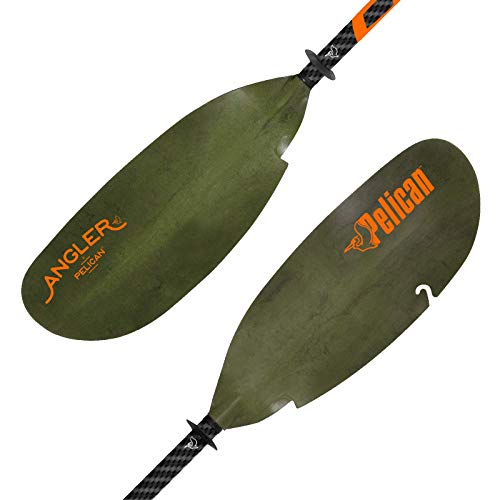
Pelican The Catch Kayak Fishing Paddle
The Pelican The Catch Kayak Paddle features an extended 260 cm fiberglass shaft and durable nylon blades engineered specifically for wide-beam fishing kayaks and taller paddlers. Weighing just 2.14 pounds, it incorporates an integrated hook retriever, shaft tape measure, and adjustable 0 to 65-degree feathering for efficient all-day angling.
Pros
- Generous 260 cm reach easily clears high stadium seats and wide-beam fishing hulls over 34 inches
- Lightweight 2.14-pound fiberglass build offers noticeably lower swing weight than basic aluminum paddles
- Practical angling features like the blade hook retrieval notch and shaft ruler add functional utility on the water
- Fiberglass-reinforced nylon blades provide excellent impact resistance against rocks, stumps, and concrete ramps
- Quick 0 to 65-degree blade angle adjustment helps paddlers adapt to stiff headwinds
Cons
- Fixed 260 cm length is overly long and awkward for narrow recreational sit-inside kayaks or paddlers under 6 feet
- Nylon blades display moderate flex under aggressive sprint strokes compared to rigid full-carbon blades
- Blade hook retrieval cutout can occasionally snag stringy weeds or hydrilla in thick vegetation mats
WONITAGO Carbon Fiber 220-240cm Kayak Paddle
Built with a carbon fiber shaft and composite blades, this lightweight paddle breaks down into three pieces for straightforward transport. Its 20-centimeter length adjustment and quick-pin ferrule suit recreational kayakers seeking reduced swing weight.
Pros
- Weighs only two pounds for low swing weight
- Three-piece design packs down easily for travel
- Floating composite blades resist saltwater corrosion
- Simple button lock allows smooth feathering adjustments
Cons
- Composite blade is heavier than full carbon alternatives
- Multi-piece design can introduce slight joint play
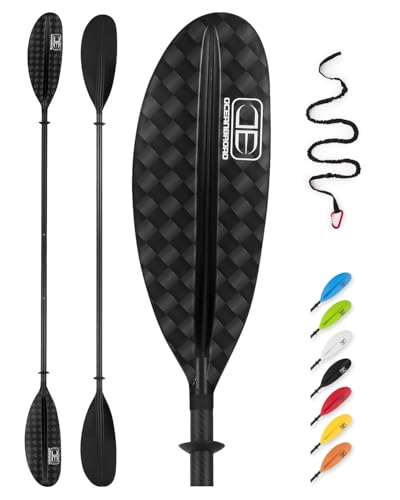
OCEANBROAD Adjustable Carbon Fiber Kayak Paddle
The OCEANBROAD Adjustable Kayak Paddle pairs a lightweight carbon fiber shaft with durable fiberglass-reinforced blades, weighing in at just 35 ounces with a versatile 220 to 240 cm length range. It serves recreational paddlers, kayak anglers, and day tourers looking to minimize arm fatigue and pack down their gear efficiently without paying high-end composite prices.
Pros
- Low 35-ounce total weight significantly cuts down swing fatigue compared to heavy entry-level aluminum paddles
- Broad 220 cm to 240 cm adjustable range accommodates both narrow sit-in hulls and wide-beam fishing kayaks
- Three-piece breakdown design packs down smaller than standard two-piece paddles for hassle-free transport
- Complete outfitting bundle includes a safety leash, built-in drip rings, and a 3-position angle lock out of the box
Cons
- Fiberglass-reinforced polypropylene blades exhibit more flex during aggressive sprint strokes than full carbon fiber blades
- Three-piece joint system introduces an extra connection point that requires routine rinsing to prevent sand or salt grit accumulation
- All-black carbon shaft and blade finish can become hot to the touch during peak midday sun on open water
Hornet Watersports Fiberglass Kayak Paddle
Built for touring and recreational paddling, this two-piece paddle pairs a lightweight carbon fiber composite shaft with a dihedral fiberglass blade. It offers on-the-fly length adjustments from 230 to 240 cm along with customizable blade feathering for varied paddling conditions.
Pros
- Weighs only 26 ounces for effortless handling
- Adjustable length accommodates different kayak widths
- Blade angle adjusts up to 60 degrees
- Two-piece design makes transport and storage easy
Cons
- Straight shaft lacks ergonomic bent grip contouring
- Base length of 230 cm is long for small paddlers
OCEANBROAD Adjustable Carbon Fiber Kayak Paddle
The OCEANBROAD Adjustable Kayak Paddle pairs a lightweight carbon fiber shaft with durable fiberglass-reinforced blades, delivering a low 35-ounce swing weight and flexible 220-240cm sizing. It is an excellent upgrade for recreational paddlers, kayak anglers, and day tourers wanting reduced arm fatigue and easy transport.
Pros
- Lightweight 35 oz build with carbon shaft helps eliminate fatigue during long outings
- Five-position length adjustment (220-240 cm) fits wide hulls and elevated stadium seats
- Three-piece breakdown system allows compact storage in vehicle trunks and gear duffels
- Integrated 0-degree and 60-degree feathering reduces wind resistance in strong breezes
- Comes ready to launch with an included safety leash and pre-fitted drip rings
Cons
- Polypropylene blades provide slightly more flex during hard power strokes than solid carbon blades
- Multi-piece locking mechanisms require periodic freshwater rinsing to prevent sand or grit buildup
- Three-piece design requires careful pin alignment during quick waterside setup
OCEANBROAD 2-Piece Carbon Fiber Kayak Paddle
Built entirely from carbon fiber, this lightweight paddle weighs approximately 32 ounces to help reduce paddler fatigue during long trips. Its integrated flip-lock mechanism permits quick length adjustments between 220 and 230 centimeters alongside fully customizable blade feathering angles.
Pros
- Full carbon fiber build weighs around 32 ounces
- Infinite blade offset angle adjustment
- Asymmetrical blades minimize wind resistance and flutter
- Comes bundled with carry bag, leash, and drip rings
Cons
- Length adjustment span is limited to 10 centimeters
- Total boxed weight reaches 3 pounds with accessories
Best Marine Carbon Fiber Kayak Paddle 234cm
Combining a lightweight carbon fiber shaft with impact-resistant polypropylene blades, the Best Marine 234cm paddle weighs around two pounds to help minimize joint and shoulder fatigue. It serves as an accessible, high-value upgrade for recreational paddlers and kayak anglers stepping up from heavy aluminum stock oars.
Pros
- Weighs only around two pounds, making it noticeably lighter than standard entry-level aluminum paddles
- Two-piece design separates quickly for easy transport in compact vehicles
- Three-position ferrule provides quick adjustments for both right- and left-handed feathering at 60 degrees
- Resilient fiberglass-reinforced blades resist gouging and abrasion on rocky launches
Cons
- Polypropylene blades show slightly more flex during hard power strokes than rigid all-carbon blades
- Push-button ferrule limits blade feathering to fixed 60-degree intervals rather than offering continuous micro-adjustments
- Fixed 234cm length does not offer telescopic length changes for paddlers alternating between narrow sit-inside boats and ultra-wide fishing craft
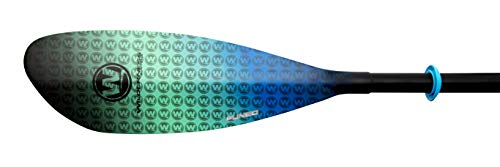
Wilderness Systems Pungo Glass Paddle, 220-240cm
Built for touring and day paddling, this paddle pairs a hybrid carbon-fiberglass shaft with fiberglass composite blades to deliver smooth strokes without flutter. Its expandable length provides flexible sizing tailored to Wilderness Systems Pungo hulls and similar recreational kayaks.
Pros
- Adjustable shaft extends from 220cm to 240cm
- Carbon-fiberglass blend balances strength and flex
- Durable composite blade resists recreational wear
- Blade profile helps prevent stroke flutter
Cons
- Starting 220cm length suits wider hulls over narrow kayaks
- Designed primarily for recreational rather than whitewater paddling
Paddle Materials and Performance Questions
Which blade material handles impact and rocky shorelines better?
Fiberglass provides superior impact resistance against rocky banks, gravel shallows, and submerged logs. While full carbon fiber is exceptionally rigid, it can crack or chip when struck against hard surfaces under heavy load. Many recreational kayakers favor fiberglass-reinforced nylon or composite blades because the subtle flex absorbs direct collisions without splintering. If your launch sites involve rough gravel or shallow riverbeds, fiberglass construction delivers peace of mind and long-term durability.
Does carbon fiber noticeably reduce arm and shoulder fatigue?
Yes, carbon fiber significantly reduces physical strain by cutting overall swing weight during each stroke cycle. Over thousands of paddle rotations, lifting a paddle that weighs around 30 to 32 ounces demands substantially less energy than heavier entry-level gear. A stiff carbon shaft also eliminates wasted flex, transferring more of your effort directly into forward hull propulsion. This makes carbon an exceptional choice for touring paddlers and long-distance day trippers aiming to prevent tendon fatigue.
How do carbon vs fiberglass kayak paddles differ in shaft flexibility?
Fiberglass shafts offer noticeable flex, whereas carbon shafts remain distinctly rigid under heavy paddling pressure. The natural give of a fiberglass shaft acts like a shock absorber, softening the catch phase of your stroke to protect wrists and elbows. Carbon shafts prioritize instantaneous power transfer and speed, which helps maintain straight-line tracking through wind and choppy swells. Many hybrid paddles combine both materials to strike a practical balance between joint comfort and mechanical efficiency.
What paddle length is needed for wide fishing kayaks?
Wide hulls measuring over 32 inches across require paddles measuring between 230 and 250 centimeters to ensure clean water entry. Using a paddle that is too short forces you to hit the gunwales and strain your lower back with every stroke. Anglers running wide craft or testing Old Town Sportsman PDL 106 setups often choose adjustable shafts with extended length ranges. Generous shaft dimensions let you maintain an upright posture in elevated stadium seats without sacrificing forward momentum.
Are full carbon paddles worth the higher investment for casual paddlers?
Casual lake paddlers rarely need full carbon paddles and often gain better overall value from fiberglass composite hybrids. Hybrid models paired with carbon shafts and fiberglass-reinforced blades keep total weight down near two pounds while keeping equipment costs accessible. Full carbon models shine during high-mileage coastal tours and fitness training where every saved ounce translates to better stamina. For short weekend outings on calm water, fiberglass hybrids offer the sweet spot of affordability, durability, and paddling comfort.
About the author
Brooke Hess is an accomplished whitewater kayaker and outdoor writer with years of experience paddling rivers around the world. He has competed internationally in freestyle kayaking and extreme races and has represented the United States in competitive kayaking. His deep understanding of river conditions and paddling performance gives her valuable insight into technical kayaking gear.