
How to Put a Kayak on Roof Racks: Practical Guide for 2026
Learn how to put a kayak on roof racks safely in October 2026 with simple solo loading techniques, secure cam strap rigging, and bow-stern line tie-downs.
 By Marius Fox
Updated October 5, 2026
By Marius Fox
Updated October 5, 2026

Lifting an awkward sixty-pound rotomolded hull onto a vehicle roof after a grueling afternoon on the water tests your physical endurance and patience. Learning how to put a kayak on roof racks efficiently prevents strained back muscles, crushed car panels, and costly gelcoat damage. Pairing proven physical leverage techniques with heavy-duty kayak roof racks ensures your boat stays balanced throughout the loading process. A steady, methodical approach protects your vehicle finish while keeping your watercraft secure for long highway drives.
Successful loading relies on using proper fulcrum points, choosing compatible carriers, and maintaining safe vehicle roof limits. Whether you mount side-loading J-bars, contouring saddle cradles, or temporary high-density foam pads, the underlying loading physics remains identical. Understanding how to distribute hull mass and secure non-stretch cam straps eliminates highway anxiety before you even start the engine. With the right sequence, solo paddlers can smoothly position heavy boats without risking injury or dropping their gear.
| Award | Product | WSG Score About WSG ScoreThe WSG Score is our own rating from 0 to 10, based on performance, design and build, ease of use, and value. It reflects independent research and is never influenced by manufacturers, retailers, or affiliate commissions. Learn more › | |
|---|---|---|---|
| Best Overall |
Abahub 32-Inch Soft Roof Rack Pads and Tie-Down
|
8.9/10 | Buy |
| Best Value |
 Forluck J-Bar Kayak Roof Carrier (2 Pairs)
|
8.9/10 | Buy |
| Best Budget |
 Taelakeni J-Bar Kayak Roof Rack (2 Pairs)
|
8.6/10 | Buy |
| Best Premium |
 SELERETE 48-Inch Universal Soft Roof Rack Pads
|
8.6/10 | Buy |
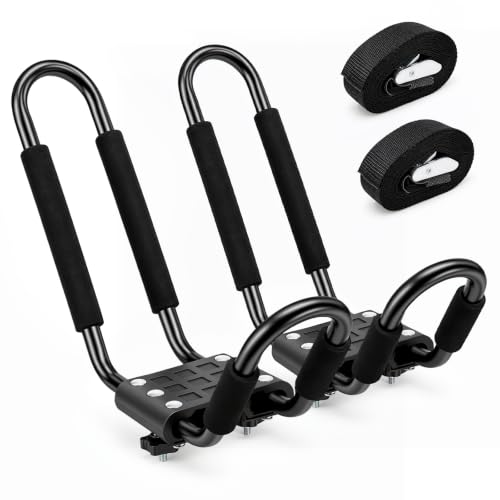 Forluck J-Bar Kayak Roof Rack (150 lbs)
|
8.3/10 | Buy | |
 PIRIPARA J-Bar Kayak Roof Rack 2-Pair Set
|
8.1/10 | Buy | |
 Yima Accessories J-Bar Kayak Roof Rack (2 Pairs)
|
8.0/10 | Buy | |
 Mrhardware Heavy-Duty J-Bar Kayak Roof Rack
|
8.0/10 | Buy | |
 Leader Accessories Folding Kayak J-Bar Rack
|
8.0/10 | Buy | |
 Onefeng Sports 135-lb Kayak Saddle
|
7.8/10 | Buy |
Abahub 32-Inch Soft Roof Rack Pads and Tie-Down
The Abahub 32-Inch Soft Roof Rack system provides a dependable, portable transport solution for carrying surfboards, longboards, and foamies on cars without factory crossbars. Featuring dense EVA foam padding and durable 1680D fabric with neoprene buckle sleeves, it protects both your car roof and board rails on coastal surf trips.
Pros
- Universal compatibility fits almost any 2-door or 4-door vehicle without requiring permanent roof rails or crossbars
- Comprehensive tie-down package with multiple 13-foot and 16-foot straps plus neoprene buckle guards
- Thick EVA foam core and rugged 1680D outer fabric shield vehicle paint and surfboard hulls from pressure dings
- Quick setup and breakdown make it easy to stow in the trunk between coastal surf sessions
Cons
- Pass-through cabin straps can wick rainwater into the car interior during wet coastal storms
- High-speed highway driving may generate strap vibration hum without twisting the webbing during installation
- Soft foam pad design requires manual tensioning and routine strap checks before high-speed freeway travel
Forluck J-Bar Kayak Roof Carrier (2 Pairs)
Built for transporting up to two kayaks, this alloy steel J-bar carrier mounts to standard crossbars with a 150-pound capacity per pair. Protective EVA foam and rubber bases safeguard boat hulls, while quick-release nuts allow tool-free installation.
Pros
- High 150-pound load capacity per pair
- Tool-free installation requires no extra equipment
- EVA padding protects watercraft from scratches
- Powder-coated steel resists rust and weather
Cons
- Compatible only with square and oval crossbars
- Conflicting listing details regarding included bar quantity
Taelakeni J-Bar Kayak Roof Rack (2 Pairs)
Designed for flat and square crossbars, this dual-pair J-bar carrier provides a space-saving solution to haul watercraft on your vehicle roof. Its steel construction with protective sponge padding holds gear upright without occupying the entire load bar.
Pros
- Space-saving side-loading J-bar profile
- Corrosion-resistant steel with baked finish
- Protective sponge pads prevent gear scratches
- Quick installation via bottom flange threads
- Accommodates up to two watercraft
Cons
- Incompatible with round crossbars
- Restricted to flat or square crossbars
- 150-pound maximum load capacity
SELERETE 48-Inch Universal Soft Roof Rack Pads
Built for paddlers needing roof transport without fixed crossbars, these 48-inch soft pads support up to 200 pounds of watercraft gear. The package includes an extensive set of tie-downs, though the pass-through strap design makes it unsuitable for wet-weather driving.
Pros
- Compatible with almost any car roof configuration
- Heavy-duty 900-denier fabric resists UV exposure and wear
- Generous 200-pound weight capacity for heavy kayaks
- Comprehensive hardware bundle eliminates need for extra straps
- Nonslip backing protects vehicle paint from sliding pads
Cons
- Unsafe for wet weather because straps wick water inside
- Straps can produce noticeable wind noise at highway speeds
- Must be thoroughly dried before long-term storage
Forluck J-Bar Kayak Roof Rack (150 lbs)
Built from powder-coated alloy steel, this J-bar carrier securely transports a single kayak up to 150 pounds across square or oval crossbars. Quick-release hardware and protective EVA foam padding make it a practical, tool-free solution for solo paddlers.
Pros
- Sturdy 150-pound capacity supports heavier watercraft
- Tool-free setup with quick-release mounting nuts
- Protective EVA padding prevents scratches and dents
- Corrosion-resistant powder-coated steel tubing
- Wide-mouth opening simplifies loading and unloading
Cons
- Fixed frame does not fold flat when unloaded
- Single-pair setup carries only one kayak
- Not compatible with round roof crossbars
PIRIPARA J-Bar Kayak Roof Rack 2-Pair Set
The PIRIPARA J-Bar Kayak Roof Rack set provides two pairs of alloy steel carriers designed to haul two kayaks with a combined capacity of up to 150 pounds. It offers a practical vehicle transport solution for paddlers looking to maximize rooftop space on square, oval, or flat crossbars.
Pros
- Transports two full-sized kayaks with four total J-bar uprights included in a single package
- Wide-mouth cradle opening makes side-loading kayaks onto high vehicle roofs significantly easier
- Adjustable padding helps safeguard plastic, composite, and thermoformed hulls from frame abrasion
- Versatile bracket design mounts securely onto flat, square, and oval crossbar shapes
- Includes four 8-foot tie-down straps and mounting bolts for immediate out-of-the-box installation
Cons
- Mounting brackets are strictly incompatible with round crossbar systems
- Total 150-pound limit requires careful weight budgeting if hauling two heavy rotomolded fishing kayaks
- Included 8-foot tie-down straps may prove short for extra-wide beam hulls or tall SUVs, and bow/stern safety lines are not included
Yima Accessories J-Bar Kayak Roof Rack (2 Pairs)
Built with padded steel J-bars, this dual-pair rooftop carrier holds watercraft up to 36 inches wide and 75 pounds. It offers a practical transport setup for paddlers, coming complete with mounting hardware and 600-pound break strength tie-down straps.
Pros
- Accommodates kayaks up to 36 inches and 75 pounds
- Rust-resistant coating on steel frame and hardware
- Comes with heavy-duty 600-pound break strength straps
- Adjustable padding prevents boat scratches
- Wide-mouth J-bar facilitates straightforward loading
Cons
- Incompatible with round crossbars under 1.2 inches
- Limited to kayaks weighing 75 pounds or less
- Restricted to maximum boat widths of 36 inches
Mrhardware Heavy-Duty J-Bar Kayak Roof Rack
This dual-pair heavy-duty steel J-bar roof rack system by Mrhardware securely carries two kayaks up to 36 inches wide and 100 pounds each on factory or aftermarket crossbars. It is an ideal rooftop transport solution for recreational paddlers and families heading out to lakes and rivers with two boats in tow.
Pros
- Includes two full pairs of racks to carry two recreational or fishing kayaks on a single vehicle roof
- Comes equipped with four high-strength 10-foot ratchet tie-down straps rated to a 600-pound break strength
- Wide-mouth J-cradle profile simplifies the physical angle needed to lift and seat kayaks on vehicle crossbars
- Constructed with rust-resistant coated steel tubing and adjustable padding to safeguard boat hulls
Cons
- Not compatible with round crossbars that have a diameter of less than 1.2 inches
- Requires at least 3 inches of clear clearance space between the vehicle roof and crossbar for bolt installation
- Elevated vertical boat orientation increases aerodynamic drag and crosswind sensitivity during highway driving
Leader Accessories Folding Kayak J-Bar Rack
Designed to carry two watercraft simultaneously, this powder-coated steel carrier folds flat to clear low garage openings when not in use. It mounts without tools onto factory square or aerodynamic crossbars, making it practical for recreational paddlers needing multi-boat transport.
Pros
- Folds down flat for standard garage clearance
- Tool-free mounting simplifies attachment
- Thick foam padding protects hulls from scratches
- Durable powder-coated steel construction
- Includes four heavy-duty tie-down straps
Cons
- Not compatible with round crossbars
- Heavy total weight at nearly 24 pounds
- 150-pound limit may exclude heavier tandem kayaks
Onefeng Sports 135-lb Kayak Saddle
Built with an aluminum frame and stainless hardware, this rooftop cradle secures watercraft weighing up to 135 pounds. Its 0 to 180 degree adjustable brackets and rubber padding make it an adaptable transport option for crossbars up to 4.3 inches wide.
Pros
- Corrosion-resistant aluminum frame with stainless hardware
- 180-degree angle adjustment accommodates various hull shapes
- Padded brackets and strap cam covers prevent scratches
- Fits wide crossbars up to 4.3 inches
Cons
- Carries only one watercraft at a time
- Maximum crossbar thickness limited to 1.8 inches
Mastering Kayak Roof Rack Loading and Transport Security
Transporting a kayak safely starts long before you merge onto the highway. Moving a bulky watercraft from ground level onto an elevated vehicle roof requires a clear understanding of balance, grip points, and mounting hardware. When paddlers struggle with vehicle loading, the issue rarely stems from a lack of muscle; rather, it usually points to poor mechanical leverage and rushed strap management. Following a structured procedure protects your vehicle, preserves your hull integrity, and keeps your watercraft firmly planted in all transit conditions.
Crossbar Profiles and Carrier Mount Compatibility
Vehicle crossbars provide the structural foundation for any roof-mounted watercraft carrier. Factory installed crossbars and aftermarket systems generally fall into square, round, or aerodynamic oval profiles. Many popular steel carriers, such as the PIRIPARA J-Bar Carrier and Taelakeni Kayak Carrier Racks, fit standard square, flat, or oval load bars but explicitly exclude thin round bars. Verifying that your crossbar dimensions match the carrier mounting hardware prevents loose brackets and hazardous shifting at speed.
Soft roof rack systems present a practical alternative for vehicles lacking permanent raised rails or crossbars. Products like the Abahub Soft Roof Rack Pads and SELERETE Soft Kayak Roof Rack utilize dense EVA foam blocks encased in tough nylon fabric to cushion bare vehicle roofs. These temporary setups loop wide tie-down straps directly through the vehicle cabin to distribute load across the structural roof pillars. While convenient for occasional day trips, soft pads demand careful placement to ensure they sit directly over supported sheet metal rather than flexible center panels.
Pre-Loading Preparation and Weight Reduction
Staging your equipment properly before attempting any lift makes the entire loading sequence far safer. Start by removing all loose gear from the kayak, including framed stadium seats, fishing tackle crates, pedal-drive units, and detachable rudders. Stripping heavy fishing accessories can reduce total boat weight by fifteen to twenty-five pounds, drastically cutting the physical effort required to lift the hull. Stowing these components inside your vehicle trunk also lowers aerodynamic drag while driving.
Inspect your vehicle roof and crossbar hardware before touching the kayak. Road grit, sand, and dust act like coarse sandpaper under foam pads or rubber carrier bases, quickly dulling automotive clear coats. Wiping down the vehicle roof panels with a quick-detailer spray or damp microfiber cloth prevents abrasive friction damage during transit. Simultaneously, hand-check all crossbar mounting knobs, flange threads, and carrier clamps to verify nothing loosened during previous excursions.
The Solo Rear-Pivot Method for Heavy Hulls
Solo paddlers do not need to lift an entire sixty-to-eighty-pound kayak above their heads to reach an SUV roof. The rear-pivot method divides the boat weight in half by allowing the ground to support the stern while you lift the bow. Position the kayak directly behind your vehicle, parallel to the car and pointing forward. Place a thick rubber bath mat, padded moving blanket, or commercial suction roller across the rear vehicle spoiler or tailgate edge to protect the paint.
Lift the bow of the kayak by the front carry toggle or handle, keeping your back straight and driving power through your legs. Walk forward toward the back of your car until the bow rests securely on the padded rear crossbar or protected tailgate edge. At this midpoint, the kayak sits at an angle with the stern grounded and the bow supported by the vehicle. The vehicle now bears half the total weight, allowing you to reposition your body without fatigue.
Move to the stern of the boat, grasp the rear handle or hull chine with both hands, and lift upward. Push the kayak forward in one smooth, continuous glide until the hull centers across both roof crossbars or settles into your carrier cradles. The padded contact points prevent metal-to-plastic gouging as the boat slides into position. Once the hull reaches balance, remove the protective rear mat and store it inside your cargo area for unloading at the boat ramp.
Executing a Balanced Two-Person Lift
Loading a boat with a paddling partner eliminates mechanical strain and reduces vehicle contact risks. Both individuals should stand at opposite ends of the kayak, facing each other with knees bent and feet shoulder-width apart. Avoid lifting solely by flexible plastic carry toggles if the kayak is fully rigged, as molded hull handles or structural gunwales offer significantly better control. Establish a clear verbal countdown so both lifters raise the boat simultaneously in a controlled movement.
Raise the kayak to chest level first, pause to verify footing, and then press upward until the hull clears the vehicle roof height. Walk forward together toward the side of the vehicle, maintaining a level orientation so neither paddler bears an unexpected weight transfer. Gently lower the hull directly into the waiting carrier saddles or J-cradles without dropping or slamming the plastic. Clear communication between both paddlers prevents sudden slips and keeps the boat clear of vehicle mirrors and side glass.
Mounting Styles: J-Cradles Versus Saddle Systems
Choosing between angled J-bars and horizontal saddles depends heavily on your roof space and boat profile. J-style carriers, such as the Forluck Kayak Roof Rack J-Bar Carrier and Leader Accessories Folding Kayak Roof Rack, support the kayak on its side at an angle. This vertical orientation consumes minimal crossbar width, leaving ample room to carry a second boat, a cargo box, or a bicycle on the same vehicle roof. The wide-mouth J-frame also provides a natural catching lip that prevents the boat from sliding off during solo loading.
Horizontal saddle carriers, such as the Onefeng Sports Kayak Saddle, cradle the kayak flat with the hull facing upward or downward. Saddles feature pivoting rubber-padded wings that articulate to match the specific deadrise and beam curvature of your watercraft. This flat orientation presents a lower aerodynamic profile, generating less wind drag and crosswind buffeting on long highway journeys. However, horizontal saddle mounts occupy substantially more crossbar width, typically limiting narrow vehicle roofs to carrying a single craft.
Rigging Cam Straps Without Damaging Plastic Hulls
Proper strap selection and routing represent the most critical factors in securing your boat for high-speed transit. Always use heavy-duty polyester cam buckle tie-down straps rather than mechanical ratchet straps. Ratchet straps generate tremendous mechanical advantage that can easily crush hollow polyethylene hulls, crack gelcoat layups, or cause permanent oil-canning indentations. Cam straps rely on manual arm tension alone, which provides ample holding strength without over-compressing structural plastic.
Route the strap around the top bar of the carrier or underneath the vehicle crossbar on the inside of the mount. Toss the free, unbuckled strap end over the kayak hull to avoid striking car windows or chipping exterior paint. Wrap the webbing under the crossbar on the opposing side, bring it back across the hull, and thread it through the spring-loaded cam mechanism from underneath. Pull the strap snug while rocking the kayak gently with your free hand to seat the webbing evenly across the hull contour.
Neoprene buckle sleeves, like those found on Abahub and Onefeng Sports strap kits, shield both vehicle paint and boat hulls from metal impact. After pulling both primary straps taut, test the installation by firmly pushing the kayak sideways and fore-to-aft. The kayak should move the entire vehicle on its suspension rather than slipping within the rack pads. Tie off all excess webbing tails around the crossbars using multiple half-hitch knots to prevent loose straps from whipping against automotive paint or humming loudly in the wind.
Bow and Stern Lines: Vital Redundant Highway Safety
Primary crossbar straps hold the kayak down against the rack, but bow and stern tie-downs counteract aerodynamic lift and lateral crosswind forces. At highway speeds, rushing air underneath the kayak creates substantial upward pressure that attempts to peel crossbars off factory roof rails. If a crossbar clamp fails or a primary strap snaps under highway vibration, bow and stern lines prevent the watercraft from launching backward into following traffic. Safe paddlecraft transport always treats front and rear safety lines as mandatory equipment.
Attach non-stretch rope or cam straps from the bow carry handle or structural tow ring down to your vehicle front chassis points. If your modern car lacks exposed steel recovery loops under the front bumper, install temporary hood loop straps under the engine hood bolts or fender edges. These synthetic loops emerge harmlessly from the hood seam, providing elevated, scratch-free anchor points that avoid rubbing delicate plastic grilles. Adjust front and rear lines so they remain firm and snug without applying excessive downward force that could warp the kayak bow.
Dynamic Roof Capacity and Crossbar Spread Limits
Vehicle manufacturers establish strict dynamic roof load limits that govern how much total weight a vehicle roof can safely handle while moving. Dynamic weight ratings typically range between one hundred and one hundred sixty-five pounds for standard sedans and small crossovers. Always calculate the combined weight of your crossbars, mounting carriers, and all loaded kayaks against this manufacturer limit. Exceeding dynamic limits raises your vehicle center of gravity, severely degrading braking distance and cornering stability.
Crossbar spread distance, the front-to-back spacing between your two load bars, dictates how stably a long kayak rides at highway speeds. A minimum crossbar spread of twenty-four to thirty inches is generally recommended to prevent longitudinal rocking and pitch rotation. Spreading crossbars as wide as your vehicle roof permits provides a broader support base for long touring hulls. If you transport single sit-in touring kayaks measuring twelve to fourteen feet, wider bar spacing drastically reduces hull flex over highway undulations.
Hull Profiles and Construction Nuances
Different hull materials and deck architectures behave differently when clamped tightly to vehicle roof systems. Rotomolded linear polyethylene hulls are rugged and impact-resistant, but they soften considerably under hot summer sun. Parking a car in high ambient heat with overtightened straps can cause the bottom plastic to deform permanently around crossbars, a condition known as oil-canning. Thermoformed ABS and composite fiberglass hulls resist heat warping better but possess rigid gelcoats that crack under localized pinch stress if padding is inadequate.
Cockpit configuration also influences how you position the craft on horizontal roof bars. Wide sit-on-top fishing platforms often feature flatter hull geometries that sit securely upside-down directly on padded crossbars or contoured saddles. Enclosed sit-inside hulls can be transported right-side-up with a snug cockpit cover to keep rain from pooling inside during travel. In rainy weather, water weight accumulating inside an uncovered cockpit can add dozens of pounds of sudden ballast, destabilizing your vehicle roof rack.
Common Transport Pitfalls and Weather Complications
Paddlers frequently encounter avoidable headaches by overlooking vertical clearance restrictions with loaded boats. High-profile SUVs fitted with vertical J-cradles can easily reach overall vehicle heights of nine to eleven feet. Attempting to enter low-clearance parking garages, drive-through restaurants, or home garage bays with a kayak mounted overhead results in catastrophic roof and boat damage. Always measure your total vehicle clearance with boats mounted and post a reminder note on your dashboard.
Inclement weather introduces specific transport hazards that demand extra vigilance. Bare soft rack pads that wrap through car door jambs can wick heavy rainwater directly into vehicle headliners and interior upholstery. When driving through sudden downpours, water tracks along the synthetic strap fibers into the cabin interior. Furthermore, highway wind buffeting can loosen hardware vibration over time, making it prudent to pull off the road after the first ten to fifteen miles to re-check all strap tensions.
Pre-Flight Shake Test and Highway Safety Routine
Conducting a physical shake test before placing the vehicle in drive confirms that your rigging is highway-ready. Walk up to the side of the car, grasp the kayak firmly near the middle cockpit or gunwale, and shake the boat vigorously. The kayak should move in complete harmony with the vehicle chassis, compressing the vehicle suspension without any independent wiggle or shifting in the cradles. If the hull wiggles within the pads or slides along the crossbar, unbuckle and re-tension the primary straps immediately.
Inspect all strap buckles, latch teeth, and knot terminations during your walk-around check. Ensure every excess strap tail is coiled securely and locked down with multiple half-hitches so loose webbing cannot slap against windows or wheels. Re-verify that bow and stern lines remain taut with straight vertical tension that does not pull the hull off-center. Developing this disciplined pre-trip inspection routine guarantees that you arrive at your favorite launch ramp safely, confidently, and ready to paddle.
Taking the time to master roof rack mechanics transforms kayak transport from an exhausting chore into a smooth, routine pre-paddle ritual. Matching your carrier hardware to your crossbars, utilizing body leverage over brute strength, and securing redundant safety lines protects your equipment on every trip. With deliberate execution and regular hardware checks, you can travel confidently across winding backcountry routes and high-speed interstates alike.
About the author
Marius Fox brings extensive hands-on experience from both above and below the water. A PADI Master Scuba Diver Trainer and AIDA freediver, she has worked as a scuba instructor, managed diving operations, participated in shark research, and contributed to marine conservation projects. His expertise provides a practical perspective on diving, snorkeling, water safety, and adventure gear.