
Do It Yourself Kayak Storage Rack Picks of 2026
Organize your garage with a do it yourself kayak storage rack built for heavy hulls. Compare top freestanding and wall mounts in October 2026.
 By Marius Fox
Updated October 5, 2026
By Marius Fox
Updated October 5, 2026

Leaving a rotomolded polyethylene or thermoformed hull resting directly on a concrete garage floor can quickly cause uneven pressure points and permanent oil-canning deformation. Storing your watercraft off the ground protects delicate chines, keeps cockpit interiors free from moisture or pests, and clears valuable floor area for vehicles and gear. Setting up a dedicated do it yourself kayak storage rack gives paddlers a dependable, space-efficient way to organize multiple boats, stand-up paddleboards, and heavy fishing rigs without permanent wall modifications. If you are comparing freestanding assemblies or permanent wall fixtures, choosing between commercial units and custom heavy-duty kayak storage racks comes down to structural load limits, ease of assembly, and protective padding.
Modern storage hardware makes it simple to assemble a reliable setup using basic hand tools rather than building wooden frames from scratch. Whether you need an adjustable multi-level stand for tandem watercraft or a space-saving ceiling hoist for high garage rafters, selecting the proper weight rating ensures your craft remains secure through the off-season. Powder-coated steel tubing, thick EVA foam or felt sleeves, and adjustable support arms help distribute hull weight evenly across contact points. By matching your boat length, beam width, and fully rigged gear weight to a sturdy rack design, you can safeguard your investment and make loading up for your next water adventure effortless.
| Award | Product | WSG Score About WSG ScoreThe WSG Score is our own rating from 0 to 10, based on performance, design and build, ease of use, and value. It reflects independent research and is never influenced by manufacturers, retailers, or affiliate commissions. Learn more › | |
|---|---|---|---|
| Best Overall |
VEVOR Freestanding Kayak Storage Rack
|
8.6/10 | Buy |
| Best Premium |
 Morohope 4-Level Freestanding Kayak Storage Rack
|
8.6/10 | Buy |
| Best Budget |
 niffgaff 120 lb Garage Hooks (4-Pack)
|
8.4/10 | Buy |
 Morohope 6-Kayak Freestanding Storage Rack
|
8.3/10 | Buy | |
 RAD Sportz Kayak Hoist 2-Pack Garage Ceiling
|
8.1/10 | Buy | |
| Best Value |
 UOKRR 2-Level Freestanding Kayak Storage Rack
|
8.0/10 | Buy |
VEVOR Freestanding Kayak Storage Rack
This heavy-duty steel freestanding storage stand holds up to two kayaks, canoes, or paddleboards with a 175-pound total load capacity. Featuring tool-free width adjustment and padded support arms, it provides paddlers with an organized, drill-free hull storage solution for garages, sheds, or docks.
Pros
- Freestanding design eliminates the need to drill mounting brackets into drywall or dock pilings
- Quick-adjust hand screws allow tool-free width adjustments between 48.4 and 71.8 inches
- Padded 21.1-inch support arms help safeguard boat finishes against direct metal contact
- Broad triangular base footprint with non-slip rubber pads stays planted on level concrete or decking
Cons
- Total 175-pound weight ceiling means pairs of fully rigged heavy pedal fishing kayaks may exceed safe limits
- Must be assembled and placed on strictly flat, level ground to prevent wobbling or balance issues
- Assembly required out of the box before loading watercraft
Morohope 4-Level Freestanding Kayak Storage Rack
The Morohope 4-Level Freestanding Storage Rack organizes up to four watercraft with a stout 400-pound total capacity and protective felt padding. It is a dependable space-saving choice for multi-boat paddlers, kayak anglers, and families needing versatile indoor or outdoor garage and dock storage.
Pros
- Robust 400-pound total load capacity handles up to four heavy recreational or fishing kayaks at 100 pounds per level
- Protective felt-lined support arms safeguard plastic, fiberglass, and foam deck surfaces from scuffs and pressure scratches
- Fully freestanding design allows flexible positioning in garages, sheds, or outdoor docks without wall drilling
- Compact vertical footprint preserves floor area while organizing multiple paddlecraft cleanly
Cons
- Top-heavy when improperly loaded, requiring heavier watercraft to be placed strictly on the bottom tiers for balanced stability
- Deep 46-inch base footprint requires adequate floor clearance away from tight vehicle parking zones
- Outdoor dock use in wet or marine environments may require periodic inspection to preserve hardware and frame longevity over time
niffgaff 120 lb Garage Hooks (4-Pack)
Built from powder-coated stainless steel, these heavy-duty hooks hold up to 120 pounds per pair to lift kayaks, ladders, and sporting gear off the floor. Thick EVA foam padding cushions contact points to guard against scratches, while included hardware supports installation on studs or drywall.
Pros
- Sturdy stainless steel frame resists corrosion
- Extended foam padding prevents surface scratches and slips
- Strong 120-pound load capacity per pair
- Includes installation guide and extra mounting hardware
Cons
- Fixed rigid design cannot fold against the wall
- Extends nearly 16 inches out from the mounting surface
Morohope 6-Kayak Freestanding Storage Rack
Designed for multi-craft owners, this heavy-duty steel rack organizes up to six kayaks or paddleboards without requiring wall mounting. Protective felt padding shields watercraft hulls from scratches during indoor or outdoor storage.
Pros
- High 600-pound overall weight capacity
- Freestanding setup requires no wall drilling
- Protective felt padding prevents hull scratches
- Versatile storage for kayaks, SUPs, and surfboards
Cons
- At 44.7 pounds, fully assembled frame is cumbersome to move
- Wide base requires dedicated floor footprint
RAD Sportz Kayak Hoist 2-Pack Garage Ceiling
The RAD Sportz Kayak Hoist 2-Pack provides a reliable garage ceiling storage system with a 125-pound capacity per lift, designed to get kayaks, canoes, and ladders safely off the floor. Featuring an automatic locking rope brake, wide nylon straps, and rubber-coated hooks, it is an ideal storage upgrade for solo paddlers and multi-boat households.
Pros
- Convenient two-pack setup provides ceiling storage for two personal watercraft at an accessible price point
- Self-locking rope brake mechanism stops slippage instantly, making solo loading and unloading manageable
- Protective nylon straps distribute hull weight broadly to reduce the risk of bottom oil-canning during hot summer storage
- Rubber-coated attachment hooks prevent cosmetic scratching on composite, thermoformed, or polyethylene hulls
- Flexible ceiling bracket mounting works with both parallel and perpendicular joist layouts up to 12-foot heights
Cons
- Requires careful measurement and secure anchoring into structural ceiling joists with basic workshop tools
- The 125-pound maximum rating will not support oversized, fully rigged pedal fishing kayaks or heavy motorized rigs
- Ceiling joist spacing in some garages may require mounting a secondary wooden backing board for proper strap alignment
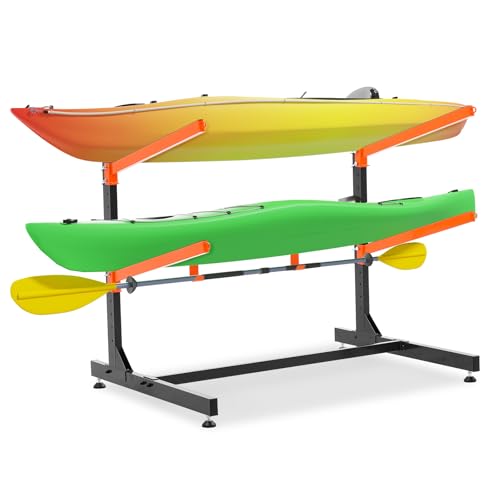
UOKRR 2-Level Freestanding Kayak Storage Rack
The UOKRR 2-Level Freestanding Kayak Stand provides a sturdy powder-coated steel storage solution engineered to support two watercraft up to 200 pounds total. With adjustable-height padded arms and leveling feet, it is an ideal garage or dock organizer for paddlers wanting to protect their hulls from oil-canning without drilling into walls.
Pros
- Heavy-duty industrial steel frame rated for up to 100 pounds per tier and 200 pounds total
- Completely freestanding footprint eliminates the hassle and wall damage of hanging heavy kayak brackets
- Support arms adjust vertically up to 22 inches to fit varying kayak hull depths and paddleboard rails
- Durable felt protective padding prevents hull gouging, gelcoat scratches, and plastic scuffing
- Adjustable leveling feet keep watercraft steady on irregular surfaces like cracked concrete or wooden docks
Cons
- Maximum vertical tier clearance caps at 22 inches, which may require removing tall stadium seats or gear consoles before stowing
- Weighs 26 pounds unladen, so high-wind outdoor dock placements may require using supplemental bungee cords or base tie-downs
- Assembly is required out of the box and calls for careful alignment of the arm adjustment pins
Building and Selecting the Ideal Storage Setup for Your Kayaks
Selecting or assembling the right storage system requires balancing available garage space, structural load capacities, and long-term hull preservation. A proper storage setup keeps watercraft elevated away from floor moisture, prevents accidental impacts from vehicles, and organizes paddling gear in one accessible location. Whether you choose a modular freestanding stand, wall-mounted cradle arms, or an overhead ceiling pulley hoist, matching your boat profile to the storage hardware ensures your equipment stays in peak condition.
Understanding Hull Dynamics and the Physics of Safe Kayak Storage
Storing a paddlecraft correctly requires understanding how hull materials behave under steady gravitational load. Rotomolded high-density polyethylene is exceptionally resilient against rocky riverbeds, but it remains susceptible to plastic creep when subjected to concentrated, localized pressure over extended periods. When a heavy hull rests across narrow, unpadded metal crossbars, the bottom plastic gradually sags and forms permanent indentations known as oil-canning. These depressions disrupt the hydrodynamic efficiency of the keel line, creating noticeable tracking drag on open water.
Thermoformed ABS and composite fiberglass watercraft demand equal care, even though their rigid outer shells resist subtle plastic sagging better than rotomolded polyethylene. Concentrated point loading on composite hulls can cause fine hairline fractures within the exterior gelcoat layer. Distributing physical weight across wide, contoured contact surfaces prevents structural stress concentrations from forming along delicate gunwales, chines, or cockpit coamings. Positioning support arms directly beneath reinforced internal bulkheads provides the strongest structural foundation for carrying hull weight without distortion.
Hull orientation on the rack plays a major role in preserving the original design geometry of your boat. Storing sit-on-top or sit-inside watercraft on their reinforced side gunwales or resting deck-down on broad padded bars provides greater stiffness than resting them flat on their hulls. Polyethylene designs maintain their factory rocker curvature and beam width when cradle arms support the boat along its strongest lateral sections. Elevating the hull also keeps grit and road grime from grinding into the finish.
Comparing Storage Configurations: Freestanding Stands, Wall Mounts, and Ceiling Hoists
Choosing between freestanding frames, wall brackets, and ceiling hoists depends largely on available floor space, wall construction, and rental restrictions. Freestanding multi-tier racks provide the ultimate versatility for paddlers who need portable organization without drilling into drywall or ceiling joists. Modular systems like the VEVOR freestanding kayak storage rack and Morohope outdoor kayak storage rack freestanding stand upright on wide bases, allowing you to reposition the entire unit between a garage bay, backyard shed, or boat dock. This mobility suits paddlers who frequently reconfigure their storage space.
Wall-mounted cradle arms excel in narrow garage layouts where floor space must remain clear for parked vehicles and lawn equipment. Heavy-duty brackets, such as the niffgaff heavy duty garage storage hooks, transfer the boat weight directly into structural wall studs, suspending hulls securely above ground level. This elevated position keeps gear away from floor-level dampness while holding the watercraft at an ergonomic height for easy solo lifting onto vehicle roof carriers. However, wall brackets require solid framing timber and permanent lag bolt installation.
Ceiling hoist pulley assemblies offer the most efficient use of vertical volume by lifting watercraft into unused overhead space above garage doors. Systems like the RAD Sportz kayak hoist 2-pack quality garage utilize mechanical advantage pulleys and heavy nylon straps to hoist bulky hulls smoothly up to twelve-foot ceilings. Elevating watercraft overhead eliminates floor clutter while protecting delicate composite and plastic shells from accidental impacts. The primary consideration is ensuring structural ceiling joists can carry the suspended weight without obstructing overhead garage door paths.
Calculating Safe Payload: Bare Hull vs Rigged Operating Weight
Storage rack failures almost always stem from underestimating the cumulative weight of modern, fully outfitted paddlecraft. Manufacturers publish bare hull weights in product brochures, but watercraft rarely enter home storage stripped down to bare plastic. Outfitted angling craft, pedal platforms, and tandem setups accumulate significant mass from adjustable aluminum stadium seats, gear tracks, rod holders, and battery boxes. Storing fully rigged pedal kayaks with trolling motors requires a storage system rated well beyond the base displacement of the bare hull to prevent cantilevered arms from sagging.
Understanding the distinction between per-level load ratings and total cumulative capacity is vital when loading multi-tier racks. For instance, the Morohope freestanding kayak storage rack provides six storage levels with individual limits of one hundred pounds per tier, achieving a six-hundred-pound total capacity. Similarly, the UOKRR 2-level kayak stand supports up to one hundred pounds per tier for a two-hundred-pound total rating. Exceeding an individual arm limit can bend support brackets or create an unstable, top-heavy center of gravity, even if the total load stays within limits.
Applying a conservative twenty-five to thirty percent safety buffer protects your storage equipment from structural fatigue over years of service. Keeping operating payloads comfortably below the published ceiling ensures welded steel joints, mounting brackets, and fastening hardware never operate near their mechanical yield points. Heavy accessories such as deep-cycle lithium batteries, electric motor pods, and rotary pedal drives should be removed from the hull and stored on low shelves. Removing dense gear reduces localized hull pressure and makes lifting the craft significantly safer.
Frame Engineering: Base Stability, Width Adjustability, and Leveling
Maintaining solid base stability on uneven flooring is a crucial engineering requirement for any freestanding storage assembly. Concrete garage slabs typically incorporate deliberate drainage slopes, while outdoor patio pavers and wooden dock planks frequently exhibit minor elevation differences. Freestanding units like the UOKRR 2-level kayak stand solve this problem by integrating adjustable leveling feet that screw inward or outward to compensate for uneven ground. Establishing a balanced contact eliminates frame wobble and keeps stored watercraft centered safely on their support bars.
Adjustable frame width gives paddlers the versatility needed to store watercraft of varying lengths and hull contours on a single stand. The VEVOR freestanding kayak storage rack incorporates tool-free width adjustment ranging from 48.4 inches to 71.8 inches, utilizing two-inch increment settings secured with hand screws. Expanding the lateral frame stance provides balanced support under long touring kayaks and tandem canoes, preventing ends from sagging excessively past the support arms. Narrowing the frame footprint accommodates shorter whitewater playboats, surfboards, or stand-up paddleboards without wasting space.
Triangular base structures provide superior resistance against tipping when sliding heavy hulls onto cantilevered storage arms. Broad floor runners reinforced with welded corner gussets distribute downward gravitational force evenly across the ground, preventing top-heavy loads from rocking. Non-slip rubber base pads grip smooth epoxy or polished concrete floors, keeping the rack stationary during boat handling while preventing metal legs from scratching surfaces. Selecting frames manufactured with powder-coated industrial steel ensures the structure resists moisture intrusion, saltwater spray, and rust formation over years of use.
Protective Padding: Comparing EVA Foam, Rubber Sleeves, and Weatherproof Felt
The protective material lining each support arm serves as the primary barrier against abrasive hull wear and cosmetic damage. Resting a glossy composite or rotomolded plastic hull directly onto bare steel can rub away protective clear coats, scratch molded patterns, and create localized pressure ridges. Storage manufacturers utilize different cushioning materials, including high-density EVA foam, thick rubber sleeves, and outdoor-rated felt wraps. Selecting the appropriate padding material depends on whether your rack is located inside a garage or outdoors.
High-density EVA foam padding delivers outstanding shock absorption and contour conformity for wall-mounted brackets and cradle arms. Hardware such as the niffgaff heavy duty garage storage hooks features extended EVA foam padding that completely wraps the front cradle profile to protect against accidental contact. Closed-cell EVA foam does not absorb water, ensuring moisture cannot pool against the hull bottom and cause mildew growth during damp seasons. The textured surface also prevents slick rotomolded hulls from sliding forward when nudged.
Weatherproof felt and industrial rubber sleeves provide durable cushioning solutions tailored for multi-tier freestanding stands and outdoor marina docks. Systems manufactured by Morohope and UOKRR utilize dense felt padding along their horizontal support arms to cradle hulls securely without scratching delicate finishes. Felt allows paddlers to slide heavy watercraft onto upper tiers with minimal surface friction, significantly reducing the physical strain required to position large boats. Meanwhile, anti-slip rubber sleeves like those found on the VEVOR stand resist ultraviolet degradation and weathering on exposed docks.
Installation Protocols for Wall Hooks and Ceiling Hoist Systems
Installing wall-mounted storage brackets requires methodical preparation to guarantee the hardware anchors securely into structural wall framing. Never attempt to hang heavy paddlecraft from bare drywall using hollow-wall plastic anchors, toggle bolts, or masonry nails. Begin by locating the center of your garage wall studs using an electronic stud finder, marking the stud positions with a pencil at your desired mounting heights. Spacing the brackets roughly one-third of the overall boat length inward from the bow and stern aligns with internal bulkheads on single sit-in kayaks.
Drill straight pilot holes into the center of the marked wall studs using a drill bit sized slightly smaller than the root diameter of the mounting screws. Pre-drilling relieves internal stress in the wooden framing lumber, preventing dense studs from splitting while allowing the fastener threads to bite firmly. Hold each bracket against the wall, check for vertical plumb using a spirit level, and drive heavy-duty stainless steel lag screws tightly into the wood using a socket wrench. Using premium stainless steel screws, such as those supplied with niffgaff brackets, prevents fastener shearing.
Ceiling hoist systems require similar precision when fastening pulley brackets into overhead ceiling joists up to twelve feet high. Kits like the RAD Sportz kayak hoist 2-pack quality garage utilize mechanical advantage pulleys and nylon cradle slings to elevate boats smoothly. Mounting the brackets directly into the center of solid ceiling joists with heavy lag bolts ensures the system can support its rated working load safely. Always route the pull rope through the automatic locking brake cam correctly, and secure excess line around a wall tie-off cleat as an essential secondary backup.
Off-Season Protection, Climate Care, and Structural Maintenance
Proper off-season watercraft care extends far beyond simply lifting your boat off the garage floor. Environmental conditions inside sheds, unheated outbuildings, and open carports can degrade plastic hulls and storage hardware over prolonged periods of disuse. Sunlight streaming through garage windows or outdoor exposure subjects polyethylene hulls to ultraviolet radiation, which breaks chemical polymer bonds and causes brittle plastic discoloration. Storing watercraft away from direct window glare and treating hulls with a marine-grade UV protectant preserves plastic flexibility and shields rich hull colors from fading.
Moisture management is equally critical for preventing interior hull degradation, mildew growth, and storage rack corrosion. Always wash your kayak thoroughly with clean fresh water after paddling in coastal saltwater or muddy rivers to remove corrosive minerals and grit. Drain all residual water from the cockpit bilge, open waterproof hatch covers to allow internal hull chambers to dry completely, and remove rubber scupper plugs before racking. Storing a damp boat with closed hatches traps condensation, which can degrade bulkhead adhesives and produce persistent musty odors.
Establishing a regular maintenance routine keeps both your storage hardware and watercraft in peak operational condition throughout the year. Periodically inspect structural bolts, thumb screws, and wall fasteners to ensure building vibration or seasonal timber contraction has not loosened mounting hardware. Check hoist ropes for fraying near pulley sheaves and examine arm padding for compression thinning down to bare metal. Promptly touching up chipped powder coating with rust-inhibiting exterior paint protects welded joints from corrosion, ensuring your storage setup remains dependable, safe, and ready for your next launch.
About the author
Marius Fox brings extensive hands-on experience from both above and below the water. A PADI Master Scuba Diver Trainer and AIDA freediver, she has worked as a scuba instructor, managed diving operations, participated in shark research, and contributed to marine conservation projects. His expertise provides a practical perspective on diving, snorkeling, water safety, and adventure gear.