
How to Secure a Kayak Without a Roof Rack: Practical Transport Guide for 2026
Master how to secure a kayak without a roof rack in October 2026 using soft pads, door-frame cam straps, and secure bow lines for safe vehicle transport.
 By Sara James
Updated October 5, 2026
By Sara James
Updated October 5, 2026

Heading out to the water often stalls before you even leave your driveway when your car lacks factory crossbars or side rails. Transporting a rotomolded hull directly on bare car sheet metal risks denting the vehicle roof, scratching the clear coat, and creating dangerous aerodynamic lift at highway speeds. Understanding how to secure a kayak without a roof rack allows solo paddlers and weekend adventurers to reach the boat ramp safely without investing hundreds in permanent aftermarket hardware. Simple setups such as dense EVA foam blocks, temporary soft roof pads, and durable cam straps provide a stable base while protecting your car from scuffs.
While paddlers eyeing frequent long-distance trips might eventually install heavy-duty kayak rack systems, temporary roof-top rigging works reliably for casual lake outings and river floats. The key lies in distributing the hull weight across the structural roof pillars, looping non-stretch cam straps through the open door frames rather than through open windows, and anchoring independent bow and stern lines to solid vehicle tow points. Taking these extra structural precautions prevents severe hull oil-canning, stops strap flutter, and keeps your watercraft firmly planted even during sudden stops or crosswind gusts.
| Award | Product | WSG Score About WSG ScoreThe WSG Score is our own rating from 0 to 10, based on performance, design and build, ease of use, and value. It reflects independent research and is never influenced by manufacturers, retailers, or affiliate commissions. Learn more › | |
|---|---|---|---|
| Best Overall |
Abahub 32-Inch Soft Roof Rack Pads and Tie-Down
|
8.9/10 | Buy |
| Best Budget |
 Taelakeni J-Bar Kayak Roof Rack (2 Pairs)
|
8.6/10 | Buy |
| Best Premium |
 SELERETE 48-Inch Universal Soft Roof Rack Pads
|
8.6/10 | Buy |
 MeeFar 32.5-Inch Soft Roof Rack Pads
|
8.6/10 | Buy | |
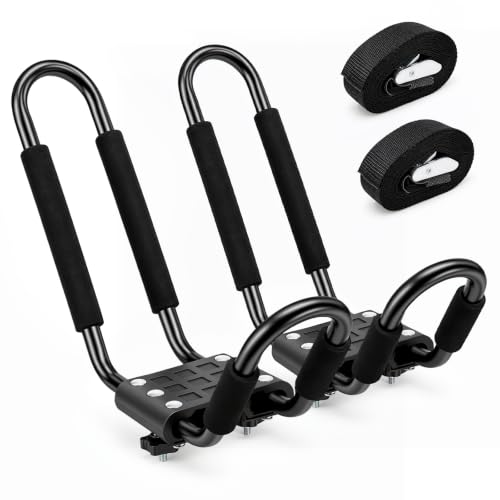 Forluck J-Bar Kayak Roof Rack (150 lbs)
|
8.3/10 | Buy | |
| Best Value |
 PIRIPARA J-Bar Kayak Roof Rack 2-Pair Set
|
8.1/10 | Buy |
Abahub 32-Inch Soft Roof Rack Pads and Tie-Down
The Abahub 32-Inch Soft Roof Rack system provides a dependable, portable transport solution for carrying surfboards, longboards, and foamies on cars without factory crossbars. Featuring dense EVA foam padding and durable 1680D fabric with neoprene buckle sleeves, it protects both your car roof and board rails on coastal surf trips.
Pros
- Universal compatibility fits almost any 2-door or 4-door vehicle without requiring permanent roof rails or crossbars
- Comprehensive tie-down package with multiple 13-foot and 16-foot straps plus neoprene buckle guards
- Thick EVA foam core and rugged 1680D outer fabric shield vehicle paint and surfboard hulls from pressure dings
- Quick setup and breakdown make it easy to stow in the trunk between coastal surf sessions
Cons
- Pass-through cabin straps can wick rainwater into the car interior during wet coastal storms
- High-speed highway driving may generate strap vibration hum without twisting the webbing during installation
- Soft foam pad design requires manual tensioning and routine strap checks before high-speed freeway travel
Taelakeni J-Bar Kayak Roof Rack (2 Pairs)
Designed for flat and square crossbars, this dual-pair J-bar carrier provides a space-saving solution to haul watercraft on your vehicle roof. Its steel construction with protective sponge padding holds gear upright without occupying the entire load bar.
Pros
- Space-saving side-loading J-bar profile
- Corrosion-resistant steel with baked finish
- Protective sponge pads prevent gear scratches
- Quick installation via bottom flange threads
- Accommodates up to two watercraft
Cons
- Incompatible with round crossbars
- Restricted to flat or square crossbars
- 150-pound maximum load capacity
SELERETE 48-Inch Universal Soft Roof Rack Pads
Built for paddlers needing roof transport without fixed crossbars, these 48-inch soft pads support up to 200 pounds of watercraft gear. The package includes an extensive set of tie-downs, though the pass-through strap design makes it unsuitable for wet-weather driving.
Pros
- Compatible with almost any car roof configuration
- Heavy-duty 900-denier fabric resists UV exposure and wear
- Generous 200-pound weight capacity for heavy kayaks
- Comprehensive hardware bundle eliminates need for extra straps
- Nonslip backing protects vehicle paint from sliding pads
Cons
- Unsafe for wet weather because straps wick water inside
- Straps can produce noticeable wind noise at highway speeds
- Must be thoroughly dried before long-term storage
MeeFar 32.5-Inch Soft Roof Rack Pads
Designed for vehicles with or without gutters, this portable foam pad system provides a tool-free transport option for surfboards, kayaks, and SUPs. The non-slip base and EVA cushioning safeguard car paint while keeping outdoor cargo secure on the road.
Pros
- Universal design fits most bare roof vehicles
- Padded cam locks prevent metal buckles from scratching paint
- Complete strap and rope kit included out of the box
- Folds down easily into a compact storage bag
Cons
- Capacity limited to one or two watercraft
- Requires routing straps through vehicle doors and cabin
- Not intended for permanent exterior vehicle mounting
Forluck J-Bar Kayak Roof Rack (150 lbs)
Built from powder-coated alloy steel, this J-bar carrier securely transports a single kayak up to 150 pounds across square or oval crossbars. Quick-release hardware and protective EVA foam padding make it a practical, tool-free solution for solo paddlers.
Pros
- Sturdy 150-pound capacity supports heavier watercraft
- Tool-free setup with quick-release mounting nuts
- Protective EVA padding prevents scratches and dents
- Corrosion-resistant powder-coated steel tubing
- Wide-mouth opening simplifies loading and unloading
Cons
- Fixed frame does not fold flat when unloaded
- Single-pair setup carries only one kayak
- Not compatible with round roof crossbars
PIRIPARA J-Bar Kayak Roof Rack 2-Pair Set
The PIRIPARA J-Bar Kayak Roof Rack set provides two pairs of alloy steel carriers designed to haul two kayaks with a combined capacity of up to 150 pounds. It offers a practical vehicle transport solution for paddlers looking to maximize rooftop space on square, oval, or flat crossbars.
Pros
- Transports two full-sized kayaks with four total J-bar uprights included in a single package
- Wide-mouth cradle opening makes side-loading kayaks onto high vehicle roofs significantly easier
- Adjustable padding helps safeguard plastic, composite, and thermoformed hulls from frame abrasion
- Versatile bracket design mounts securely onto flat, square, and oval crossbar shapes
- Includes four 8-foot tie-down straps and mounting bolts for immediate out-of-the-box installation
Cons
- Mounting brackets are strictly incompatible with round crossbar systems
- Total 150-pound limit requires careful weight budgeting if hauling two heavy rotomolded fishing kayaks
- Included 8-foot tie-down straps may prove short for extra-wide beam hulls or tall SUVs, and bow/stern safety lines are not included
How to Secure a Kayak to a Bare Vehicle Roof Safely
Transporting a kayak on a vehicle without factory crossbars or side rails requires careful attention to load distribution, friction, and multi-point anchoring. Without structural metal crossbars, your vehicle roof sheet metal must support the downward weight of the kayak while the vehicle frame absorbs aerodynamic lift. Relying solely on friction between the boat and the roof is dangerous because highway air resistance exerts immense upward and lateral force on the hull. Using proper temporary padding, routing heavy-duty cam straps through the vehicle cabin, and anchoring independent bow and stern lines will keep your paddlecraft rock-solid without causing vehicle or hull damage.
Selecting the Right Padding System for Bare Roofs
Direct contact between a plastic or fiberglass kayak hull and bare car paint will quickly scuff your clear coat and cause the watercraft to slide during sudden braking. Temporary soft roof racks and dense EVA foam blocks provide the necessary friction, cushioning, and height clearance to protect both surfaces. High-density EVA foam pads wrapped in heavy-duty exterior fabrics, such as 900D or 1680D nylon with non-slip rubberized bottom linings, grip the vehicle roof firmly without shifting under highway wind pressure. In contrast, makeshift alternatives like low-density pool noodles often compress completely under strap tension, leaving the hard plastic hull resting directly on your car sheet metal.
Positioning these pads correctly on your car roof makes a significant structural difference during transit. Car roofs are strongest along the outer perimeter edges near the structural door pillars (the A-pillars, B-pillars, and C-pillars), while the center panel remains relatively thin and flexible. Place your front pad directly over the B-pillar seam and your rear pad near the back edge of the roofline to prevent the center sheet metal from oil-canning or denting under strap load. Spacing the pads roughly 24 to 36 inches apart creates a wide, balanced platform that minimizes front-to-back hull teetering during acceleration and deceleration.
Understanding Soft Racks Versus Crossbar-Mounted J-Cradles
Paddlers shopping for vehicle transport gear often encounter two distinct product categories: universal soft roof rack pads and rigid steel J-bar carriers. Universal soft rack systems, such as padded kits from MeeFar, SELERETE, and Abahub, include integrated straps engineered specifically to loop through the interior cabin of bare-roof vehicles. These soft setups require no preexisting rails, gutters, or crossbars, making them ideal for standard sedans, hatchbacks, and bare-roof compact SUVs. They fold up into compact storage bags when not in use, offering a convenient, portable solution for paddlers who rent vehicles or prefer not to leave hardware on their cars.
In contrast, rigid steel J-bar carriers, such as models from Forluck, Taelakeni, and PIRIPARA, are strictly designed to clamp onto factory or aftermarket crossbars with square, oval, or flat profiles. These J-style carriers hold the kayak securely on its side to maximize crossbar space for second boats or gear boxes, but they cannot attach directly to bare vehicle sheet metal or bare flush rails. Attempting to bolt or strap a steel J-bar onto a bare roof without crossbars creates severe stress points that will puncture sheet metal and cause catastrophic cargo failure. Always verify whether a carrier is a soft strap-through pad system or a rigid crossbar clamp before planning your bare-roof transport rigging.
Step-by-Step Rigging: Routing Cam Straps Through the Cabin
Before placing any gear on the car, thoroughly clean and wipe down both the vehicle roof and the bottom of your soft pads. Road grit, sand, and dust trapped beneath foam pads act like sandpaper once the vehicle is in motion, grinding into the vehicle clear coat under strap pressure. Once the roof is clean, set the soft pads in position and center your kayak evenly across both pads. Placing traditional sit-on-top kayaks upside down with the deck resting on the pads often provides the flattest, most stable surface, while sit-inside hulls usually travel hull-down with the cockpit rim facing upward.
The most critical safety rule when securing a kayak without a roof rack is to open all vehicle doors before threading the primary straps. Never route tie-down straps through open window frames, because closing the doors afterward traps the straps against the window glass and prevents the doors from opening in an emergency. With the doors wide open, toss the strap end without the metal buckle over the kayak hull to avoid denting your car paint. Bring the webbing inside the car cabin directly beneath the interior roof headliner, connect the working end to the cam buckle, and pull the strap snug.
Cam buckle straps with padded neoprene or rubber sleeves, such as those included with the Abahub and MeeFar kits, protect both the vehicle finish and the kayak hull from metal-on-plastic impact. Always use non-stretch polyester or nylon cam buckle straps rather than mechanical ratchet straps when securing paddlecraft. Ratchet straps generate massive mechanical leverage that easily cracks fiberglass seams, warps composite gelcoats, or permanently crushes polyethylene plastic hulls. Cam straps provide more than enough holding power using manual pulling force without risking structural hull deformation.
Once the front and rear belly straps are routed through the door frames and tightened, close all four doors firmly over the webbing. The vehicle weatherstripping will compress around the flat webbing, holding the strap in place while keeping the door latch mechanisms fully operational. Inside the cabin, the straps will run across the ceiling well above the driver and passenger headrests. Tie off the excess strap length inside the vehicle cabin so loose tails do not dangle in your field of view or interfere with mirror visibility while driving.
Rigging Independent Bow and Stern Lines
Primary belly straps passing through the cabin secure the kayak against lateral movement, but they cannot counteract the intense rotational and lifting forces generated at highway speeds. As air flows over your vehicle hood, it creates a powerful low-pressure zone that lifts the kayak bow upward, while crosswinds generate severe yawing torque. Independent bow and stern tie-down lines are mandatory safety equipment that keep the boat pinned down and aligned with your vehicle centerline. Relying solely on belly straps without front and rear tie-downs is the leading cause of kayaks peeling off bare car roofs on the highway.
To anchor the front of your kayak, locate solid structural metal points beneath your vehicle bumper or inside the engine compartment. Modern vehicles often feature plastic lower bumper fascias that will bend or crack if tied to directly; never attach tie-down hooks to plastic grilles, decorative trim, or steering linkages. Instead, utilize factory chassis recovery loops, or install temporary under-hood webbing loops that bolt to existing fender bolts or drop inside the hood seam. Run your tie-down rope or strap from the kayak front grab handle down to these anchor points, forming an inverted V-shape or single tight anchor line.
At the rear of the vehicle, anchor the stern line to a structural trailer hitch receiver, a factory rear tow hook, or a trunk-lid anchor strap loop. Tighten both the bow and stern lines until they are snug and firm to the touch, but do not overtighten them so much that they bend the kayak keel upward like a recurve bow. Excessive downward tension on the bow and stern can cause plastic hull deformation and bend the middle of your car roof downward. When paddling popular touring crafts like recreational single sit-in kayaks, balanced fore-and-aft line tension ensures the boat remains hydrodynamically neutral throughout your commute.
Aerodynamic Management and Strap Noise Control
Driving at highway speeds with flat webbing straps exposed to the wind frequently generates a loud, deafening humming or buzzing noise inside the vehicle cabin. This noise is caused by vortex shedding, where air rushing across flat strap surfaces creates rapid aerodynamic flutter and vibration. You can eliminate this vibration easily by introducing a simple half-twist or full twist into every exposed section of strap webbing between the kayak and the car roof. The twist disrupts the laminar airflow over the strap edge, breaking up the vortex pattern and silencing the annoying acoustic drone completely.
Managing loose strap ends is equally important for aerodynamic stability and vehicle safety. Loose strap tails whipping in the wind at sixty miles per hour can strip the clear coat off your vehicle paint, damage door seals, and create erratic drag. Always wrap excess webbing tails around the secured load lines and tie them off with two or three half-hitch knots. Alternatively, tuck the strap tails into the vehicle cabin before shutting the doors to ensure zero flapping along exterior body panels during transport.
Managing Weather Hazards and Interior Water Infiltration
Transporting a kayak with soft roof pads during rainy weather introduces a unique challenge known as capillary action or strap wicking. Soft rack manufacturers, including SELERETE, specifically advise caution when transporting gear in wet conditions because rainwater can saturate exposed woven strap fibers. As rain pours onto the car roof, water absorbs into the strap webbing and follows the fabric weave past the compressed rubber door gaskets directly into the vehicle interior. Over a long drive in heavy rain, this wicking action can leave front seats and headliners soaked with water.
If you must travel in rainy conditions without crossbars, several practical adjustments can help minimize interior water seepage. Applying small silicone drip loops or twisting the strap just outside the door frame encourages water droplets to fall off before reaching the interior gasket. Some paddlers wrap electrical tape tightly around the strap section that contacts the weatherstrip to create a non-porous moisture barrier. After arriving at your destination or returning home, immediately remove the wet pads from your car roof and let them air-dry completely to prevent mildew growth and roof clear-coat clouding.
Preventing Hull Deformation and Managing Weight Limits
Most recreational paddlecraft are constructed from high-density rotomolded polyethylene, a durable plastic material that possesses inherent flexibility and thermal memory. When a polyethylene boat is cinched tightly against narrow foam pads under direct summer sunlight, localized pressure points can cause the bottom plastic to sag or dent inwards. This permanent hull deformation, known as oil-canning, significantly increases water resistance and ruins the boat straight-line tracking efficiency. To prevent oil-canning, loosen tie-down tension whenever your car remains parked in hot sun for extended stops, and never store your kayak on car-top pads between trips.
Every vehicle has a certified dynamic roof load capacity specified in the owner manual, typically ranging between 100 and 165 pounds for bare roofs. While a single recreational kayak weighing 45 to 60 pounds remains well within safe limits, attempting to transport two heavy rotomolded fishing kayaks or bulky tandem setups on a bare roof can exceed vehicle structural tolerances. Paddlers who lack factory crossbars and frequently transport heavy gear might consider switching to compact heavy-duty inflatable kayaks that pack neatly into your trunk. Inflatables completely eliminate car-top aerodynamic drag, roof weight concerns, and the need for complex strap routing through your cabin.
Pre-Trip Safety Checks and Highway Driving Protocol
Before putting the vehicle in gear, always conduct a physical shake test at both ends of the watercraft. Grab the kayak bow firmly and pull vigorously from side to side and up and down; the entire car should rock on its suspension rather than the kayak sliding on its pads. If the kayak slips, rotates, or shifts even an inch across the foam pads, the belly straps or bow lines lack adequate tension. Re-tighten all cam buckles and adjust pad placement immediately before pulling onto public roadways.
Driving with a car-topped boat requires adjusted driving habits and regular hardware checks. Stop five to ten miles into your journey at a safe roadside turnout to inspect strap tension, because highway vibrations and initial settling naturally cause strap fibers to relax. Reduce your cruising speed below 65 miles per hour, maintain greater following distances behind other vehicles, and account for crosswinds when passing commercial trucks or crossing open bridges. With careful padding placement, proper strap routing through the door frames, and secure bow and stern lines, your bare-roof transport setup will deliver your kayak safely to the water every time.
About the author
Sara James is an experienced paddler and outdoor gear reviewer with more than two decades of involvement in paddle sports. Her background spans touring kayaking, Class V whitewater, stand-up paddleboarding, and international kayaking events. She brings a practical, experience-driven perspective to evaluating kayaks, paddles, life jackets, dry bags, and other essential water gear.