
How to Transport a 14 Foot Kayak: Safe Transport Guide for 2026
Learn how to transport a 14 foot kayak safely using roof racks, trailers, and dollies in this October 2026 practical guide.
 By Edward Ting
Updated October 5, 2026
By Edward Ting
Updated October 5, 2026

Transporting a 14-foot kayak introduces unique logistical challenges that smaller recreational boats rarely present. Hull length creates substantial cantilever overhang on vehicle roofs, making wind shear and highway vibration critical factors during transit. Learning how to transport a 14 foot kayak safely requires understanding proper rack configurations, weight distribution, and highway tie-down physics. Pairing your vehicle with reliable heavy duty kayak roof rack options ensures the craft remains stable even during sudden braking or highway crosswinds.
Beyond vehicle crossbars, long boats often demand specialized equipment such as low-profile kayak trailers or heavy-duty shoreline dollies. A rotomolded 14-foot touring or fishing craft can weigh anywhere from 60 to over 100 pounds when rigged with accessories. Using proper cam straps prevents structural plastic deformation while bow and stern safety lines guard against aerodynamic lift. Selecting the right combination of vehicle mounts, cradles, and launch carts makes moving your kayak manageable and stress-free.
| Award | Product | WSG Score About WSG ScoreThe WSG Score is our own rating from 0 to 10, based on performance, design and build, ease of use, and value. It reflects independent research and is never influenced by manufacturers, retailers, or affiliate commissions. Learn more › | |
|---|---|---|---|
| Best Overall |
Bonnlo 450 lb Heavy Duty Kayak Cart
|
9.1/10 | Buy |
| Best Budget |
 GanFindX Heavy-Duty Stainless Steel Kayak Cart
|
8.9/10 | Buy |
| Best Value |
 RealTruck J-Cradle Kayak Carrier
|
8.6/10 | Buy |
| Best Premium |
 GigaCraft 32-Inch Kayak Cart Dolly with 10-Inch
|
8.4/10 | Buy |
 GanFindX 16-Inch Kayak Cart (350 lbs)
|
8.1/10 | Buy | |
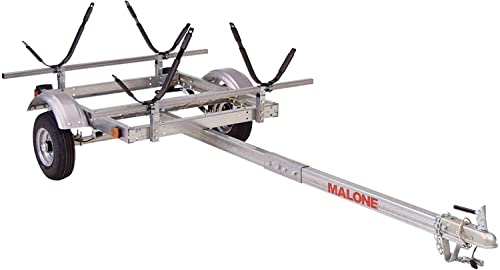 Malone EcoLight 2-Kayak Trailer with J-Racks
|
8.1/10 | Buy | |
 GanFindX 16-Inch Wheel Kayak Cart
|
7.8/10 | Buy |
Bonnlo 450 lb Heavy Duty Kayak Cart
Built with marine-grade heat-treated aluminum, this rugged cart supports up to 450 pounds and adjusts to fit hull widths between 6.3 and 18.7 inches. Its 12-inch solid flat-free wheels and integrated kickstand make solo loading and hauling across sand or rough terrain much simpler.
Pros
- High 450-pound capacity handles loaded tandem kayaks
- Flat-free 12-inch wheels eliminate puncture risks
- Built-in kickstand keeps cart upright for solo loading
- Axle measurement markings make width adjustments easy
- Marine-grade aluminum construction resists water exposure
Cons
- Maximum bar width is limited to 18.7 inches
- At 11.2 pounds, it adds noticeable stowed cargo weight
GanFindX Heavy-Duty Stainless Steel Kayak Cart
The GanFindX Kayak Cart is a heavy-duty stainless steel scupper trolley built to transport sit-on-top kayaks up to 240 pounds without cumbersome tie-down straps. Its 0.8-inch rubber-sleeved posts and puncture-proof 8-inch foam wheels make it a practical portage tool for solo paddlers hauling gear across gravel, grass, and boat ramps.
Pros
- Strap-free scupper insertion enables fast, single-person loading without wrestling loose cam straps
- Stainless steel frame construction delivers a generous 240-pound maximum weight capacity
- Solid 8-inch foam wheels are completely puncture-proof and maintenance-free on rough ground
- Protective rubber sleeves prevent bare metal hardware from rubbing against plastic scupper holes
Cons
- Strictly limited to sit-on-top kayaks with vertical scupper holes wider than 0.8 inches
- Cannot be used with sit-inside recreational kayaks, inflatables, or folding watercraft lacking scupper drains
- Narrow 8-inch foam wheels require extra pulling effort through deep, loose beach sand compared to balloon tires
RealTruck J-Cradle Kayak Carrier
The RealTruck Kayak Carrier provides a dedicated J-shaped cradle supporting up to 90 pounds, engineered for stable highway-speed boat transport. It offers an adaptable rooftop transport solution for solo paddlers and weekend boaters using universal clamp or T-slot crossbars.
Pros
- Supports up to 90 lbs, accommodating most recreational, sit-inside, and day touring kayaks
- Dual mounting flexibility with universal clamps and T-slot track compatibility
- Engineered and rated for highway driving stability
- Complete kit with all required installation hardware and tools included
- Protective, rust-resistant coating guards against road spray and rain
Cons
- 90-pound maximum weight rating is not suitable for ultra-heavy fully rigged pedal fishing kayaks or tandems
- Not compatible with wide overland crossbars exceeding 4 inches in width
- Fixed J-cradle geometry increases overall vehicle clearance height when driving into low garages
GigaCraft 32-Inch Kayak Cart Dolly with 10-Inch
The GigaCraft Kayak Cart Dolly is a track-mounted transport system featuring a 32-inch crossbar and 10-inch flat-free TPE wheels rated up to 150 pounds. It provides solo kayak anglers with stable ramp portage and convenient on-water stowing without slipping straps.
Pros
- Direct track attachment prevents the carrier from slipping out from under the hull like traditional friction-strap dollies
- Puncture-resistant 10-inch TPE wheels roll reliably across asphalt, boat ramps, and compacted soil without tire pressure maintenance
- Stowable design keeps the wheels out of the water line while paddling without consuming precious rear tankwell crate storage
- Stainless steel and aluminum components provide dependable corrosion resistance for brackish and marine launches
Cons
- 150-pound maximum weight threshold may not accommodate extra-heavy motorized tournament rigs loaded with large batteries
- 32-inch crossbar requires compatible gear track spacing on your kayak hull for proper mounting alignment
- Adds 16 pounds of transport rigging that stays with the watercraft unless completely disassembled prior to launch
GanFindX 16-Inch Kayak Cart (350 lbs)
Built with a reinforced steel frame and oversized 16-inch wheels, this folding dolly hauls watercraft up to 350 pounds across soft sand and rough terrain. An integrated kickstand and adjustable width make solo loading straightforward at any launch point.
Pros
- Robust 350-pound load rating
- Large 16-inch wheels handle rough terrain smoothly
- Adjustable frame adapts to diverse hull contours
- Pre-assembled design is ready to use immediately
- Integrated kickstand allows hassle-free solo loading
Cons
- Steel frame is heavier than aluminum alternatives
- Oversized 16-inch wheels require more storage space
Malone EcoLight 2-Kayak Trailer with J-Racks
The Malone EcoLight 2-Kayak Trailer delivers a road-ready transport solution designed to haul two kayaks up to 14 feet with a 400-pound maximum load capacity. Built with pre-galvanized marine-grade steel, submersible LED lighting, and included J-style carriers, it is ideal for paddlers looking to avoid vehicle roof loading.
Pros
- Submersible pontoon wheels and sealed marine bearings allow confident backing directly down boat ramps
- Low loading height eliminates the heavy physical strain of lifting kayaks onto tall vehicle roof racks
- Sturdy 11-gauge pre-galvanized steel frame provides solid resistance against road grime and moisture
- Package comes complete with two sets of J-rack carriers, hardware, and pre-wired submersible LED lights
Cons
- Requires three to four hours of mechanical assembly and standard tools prior to first-time road use
- Maximum watercraft length rating is limited to 14 feet, excluding longer ocean touring and expedition kayaks
- Galvanized industrial finish offers a purely utilitarian aesthetic compared to painted trailer frames
GanFindX 16-Inch Wheel Kayak Cart
Engineered with a 300-pound capacity steel frame, this GanFindX cart moves heavy fishing kayaks and canoes across rough ground using oversized 16-inch puncture-proof wheels. The adjustable-width support bars and protective foam padding accommodate wide or irregular hulls during shoreline treks.
Pros
- High 300-pound load capacity for loaded gear
- Oversized flat-free wheels easily navigate uneven ground
- Adjustable frame accommodates diverse hull shapes
- Foam padding protects hull surfaces from damage
Cons
- Heavier frame at over 19 pounds
- Large 16-inch wheels take up substantial cargo space
Mastering 14-Foot Kayak Transport: Gear, Loading Techniques, and Highway Safety
A 14-foot kayak occupies a distinct category in the paddling world, bridging the gap between standard recreational day boats and extended sea touring craft. At 168 inches in length, these watercraft generate significant aerodynamic leverage when mounted on standard passenger vehicles. Improper mounting can lead to severe hull flexing, roof rack failure, or hazardous shifting at highway speeds. Understanding the mechanics of load distribution, hull support, and roadway forces is essential for protecting both your kayak and surrounding motorists.
Vehicle Roof Rack Loading: Crossbar Spread and Cantilever Physics
Most factory roof racks feature crossbar spreads between 24 and 36 inches, which leaves substantial portions of a 14-foot kayak unsupported at both ends. When a long kayak travels at highway speeds, incoming air exerts upward lift on the bow while turbulence buffs the stern. This cantilever effect amplifies vibration and places immense torque on crossbar towers and vehicle mounting channels. Maximizing the physical distance between your crossbars helps distribute these aerodynamic forces across a broader section of the hull.
Choosing between J-cradles and horizontal saddle mounts depends largely on vehicle height and hull beam width. J-style carriers, such as the RealTruck Kayak Carrier designed for crossbars under 4 inches wide with a 90-pound capacity, hold the boat at an angle to conserve roof space. Storing a 14-foot boat on its side exposes more surface area to lateral crosswinds, which can affect vehicle handling in gusty corridors. Horizontal saddle cradles conform to the bottom contours, lowering the overall profile and reducing wind resistance.
Solo loading a 14-foot boat onto a tall SUV or truck cap requires smart lifting technique rather than brute strength. Lifting an entire 70-pound kayak horizontally above your shoulders increases the risk of lower back strain and vehicle paint damage. Positioning a bath mat, foam roller, or suction-mounted loading roller at the vehicle rear allows you to rest the kayak bow securely on the back edge. You can then walk to the stern, lift the rear of the craft, and slide the boat smoothly forward into the cradles.
Dedicated Kayak Trailers: Why 14-Foot Boats Benefit from Low-Deck Towing
Dedicated trailers represent the most practical transport method for paddlers who frequently launch heavy 14-foot fishing craft or multiple watercraft. Hoisting an outfitted boat onto an elevated roof rack becomes physically exhausting after hours on the water. Kayak trailers lower the loading height to waist level, allowing a single person to guide the boat onto bunk boards with minimal effort. This configuration also preserves your vehicle roof weight capacity and maintains normal vehicle aerodynamics on long road trips.
Purpose-built trailers provide structural engineering specifically calibrated for long paddlecraft hulls. The Malone MPG586XJ EcoLight trailer supports up to two 14-foot kayaks with a 400-pound load capacity on an 11-gauge pre-galvanized steel frame. Submersible LED light kits and marine-grade sealed pontoon bearings allow paddlers to back the trailer directly down boat ramps without electrical shorts or bearing contamination. Having dedicated bunk support prevents the concentrated pressure points that often cause plastic hull deformation during rooftop transit.
Towing a long trailer requires attention to vehicle tongue weight, hitch coupler security, and state roadway laws. Heavy pedal kayaks with trolling motors significantly alter trailer weight distribution when rigged with batteries and drives. Maintaining approximately 10 to 15 percent of the total trailer weight on the hitch ball prevents dangerous trailer sway at highway speeds. Always cross safety chains beneath the trailer coupler and verify that tire pressure matches manufacturer specifications before highway travel.
Securing the Hull: Cam Straps, Ratchet Strap Hazards, and Bow-Stern Lines
Securing a kayak requires non-stretch polyester cam buckle straps rather than mechanical ratchet straps. Rotomolded polyethylene softens quickly in warm weather and direct sunlight, making it vulnerable to crushing forces. Ratchet straps provide massive mechanical leverage that can easily crack deck seams, crush scupper channels, or cause permanent hull oil-canning. Cam straps allow you to pull the webbing snug using your own physical strength, holding the boat firmly without distorting the plastic.
Proper routing around crossbars ensures the kayak cannot shift forward, backward, or laterally during transit. The strap should loop under the crossbar inside the mounting tower, pass over the kayak hull, loop under the opposite crossbar, and return through the cam buckle. Pulling the strap taut compresses the cradle padding slightly, creating friction against the hull surface. Always tie off loose strap ends behind the buckle mechanism to eliminate wind fluttering and prevent accidental slippage.
Bow and stern safety tie-downs serve as critical secondary backups that prevent disastrous roof rack failure. Even if roof crossbars loosen or a primary strap fails, bow and stern lines keep the 14-foot craft anchored to the vehicle frame. Anchor the bow line to structural recovery points or dedicated under-hood webbing loops rather than plastic vehicle grilles. The lines should remain snug without downward overtightening, which could bend the bow tip and cause unnecessary hydrodynamic rocker distortion.
Shoreline and Ramp Transport: Matching Kayak Carts to Hull Architecture
Transitioning a 14-foot kayak from your parking spot to the water edge requires an appropriate cart to prevent hull abrasion. Dragging a rotomolded hull across coarse gravel, boat ramp concrete, or oyster shells quickly strips away protective plastic. Because long kayaks are front-heavy or rear-heavy depending on outfitting, placing a wheeled dolly near the center of balance reduces physical carrying strain. Quality carts feature sturdy frames, padded supports, and wide wheels designed for specific launch terrain.
Universal bunker-bar carts provide broad hull support for a wide variety of bottom contours. The Bonnlo Kayak Cart features adjustable bunker bars ranging from 6.3 to 18.7 inches with a 450-pound weight rating and 12-inch flat-free solid wheels. This design supports flat, multi-chine, or pontoon hulls without pressing against fragile internal cockpit drains. An integrated kickstand holds the cart upright while you position the kayak, making solo shoreline loading straightforward.
Scupper-style carts insert vertical posts directly into the kayak molded drainage holes for strap-free loading. The GanFindX Kayak Cart uses a stainless steel frame supporting up to 240 pounds with upright posts measuring 0.8 inches in diameter. Paddlers must verify that their kayak drain holes measure larger than 0.8 inches before attempting to use this style. While plug-in loading is remarkably quick, scupper carts should only be used on hulls with reinforced scupper tubes to avoid cracking under heavy dynamic loads.
Rolling over soft sand, muddy riverbanks, or steep gravel ramps demands oversized wheel diameter. Dollies equipped with 16-inch flat-free wheels, such as the GanFindX Heavy-Duty Kayak Cart with its 300 to 350-pound capacity, roll smoothly across soft shorelines where small wheels dig into the ground. These larger wheels roll over rocks and beach ruts with substantially less rolling resistance. Paddlers moving long single sit-in kayaks across marshy access trails benefit greatly from this increased ground clearance.
Integrated track-mount landing gear systems offer an alternative for anglers who prefer not to store loose carts. The GigaCraft Kayak Cart Trailer Package mounts directly to hull gear tracks via a 32-inch crossing bar, providing 10-inch flat-free wheels rated for 150 pounds. This setup allows wheels to deploy for shoreline transit and pivot or detach quickly once on the water. Using marine-grade stainless steel and aluminum components prevents saltwater corrosion while eliminating cart storage issues in the rear tankwell.
Highway Safety, Legal Overhang Rules, and Pre-Trip Checklists
State transportation departments enforce strict rules regarding load overhang beyond vehicle bumpers. In most jurisdictions, any cargo extending more than 3 to 4 feet past the vehicle rear bumper requires a bright red or fluorescent orange safety flag. When transporting a 14-foot kayak in a short 5.5-foot pickup truck bed, the stern extends several feet into open air. Utilizing a hitch-mounted bed extender supports the unsupported rear hull while keeping the load compliant with state marking requirements.
Executing a thorough pre-trip inspection ensures mechanical safety before merging onto fast-moving expressways. Check all rack mounting bolts, crossbar clamps, and cradle hardware to verify that nothing has loosened from road vibration. Perform the universal grab-and-shake test by firmly taking hold of the kayak bow and rocking the entire boat side to side. The vehicle suspension should move in unison with the craft; any independent slipping or pivoting indicates loose straps that require immediate tensioning.
Highway travel requires defensive driving habits and routine mid-trip stops. Strong crosswinds, large commercial truck wakes, and elevated highway bridges exert substantial lateral pressure on long watercraft. Plan to stop at a rest area within the first 15 to 20 miles of driving to inspect strap tension and buckle security. Strap webbing naturally settles and stretches slightly under highway vibration, making a quick mid-trip retightening essential for safety.
On-Water Transition and Safe Launch Protocols
Arriving at a busy public boat ramp or launch dock requires organized staging to avoid blocking access for other boaters. Pull into a designated parking space or prep area to unfasten tie-downs before approaching the active ramp. Detach your bow and stern safety lines first, loosen your main crossbar straps, and position your shoreline cart underneath the kayak. Completing your prep work away from the water edge ensures a smooth, respectful, and swift launch.
Balancing gear weight before pushing off into the water protects both paddling trim and shoreline maneuverability. A 14-foot kayak typically balances slightly behind its midpoint, but heavy stern coolers, tackle crates, or battery boxes shift the center of gravity aft. Place your transport cart slightly behind this balance point so the bow handle stays light in your grip as you roll down the ramp. Once at the water line, float the boat off the dolly rather than dragging it over hard ground.
Personal safety outfitting must accompany every launch routine before you begin paddling. United States Coast Guard regulations under Title 33 CFR Part 175 require carrying a properly fitted, USCG-approved Type III or Type V wearable personal flotation device for every boater aboard. Keep an accessible pea-less safety whistle attached to your vest and verify that all hull drain plugs are tightly secured before stepping off the bank. Stashing your transport cart securely in your vehicle or strapped to your rear deck allows you to enjoy confident, worry-free paddling.
Transporting a 14-foot kayak safely requires the right hardware, deliberate rigging habits, and respect for roadway physics. Whether you choose a rugged low-deck trailer, a rooftop saddle system, or an all-terrain cart, taking time to balance the load preserves your hull and vehicle integrity. Inspecting your cam straps, securing bow and stern lines, and observing highway overhang regulations guarantees peace of mind on every journey. With reliable transport routines in place, you can focus on exploring distant waterways and enjoying your time on the water.
About the author
Reuben Parsons is an experienced water-sports writer and gear reviewer specializing in surfing and stand-up paddleboarding. With a background in marine biology and more than a decade of outdoor writing, He has tested hundreds of products and spent thousands of hours evaluating outdoor gear. He approach combines technical research with genuine experience on the water.